Saturday, February 28, 2026

Saturday, April 05, 2025
petty fights may harm Africa
I am not sure what this is about, and I ran across it on Gateway Pundit, a right wing site that has a lot of gossip on it.
French President Macron wants European companies to end all American investments.
— Daniel Turner (@DanielTurnerPTF) April 4, 2025
Two can play this game, Emmanuel.
President @realDonaldTrump should immediately cancel the $5 billion U.S. loan for France's TotalEnergies African LNG project. pic.twitter.com/HYoTPFALe0
it seems to rfer to this loan approved last week to Mozambique:
US approves $5 billion loan to TotalEnergies for Mozambique gas project By Reuters March 15, 202
So I asked Grok to summarize all the recent articles on what is going on:
The U.S. approval of a nearly $5 billion loan to TotalEnergies for its Mozambique gas project refers to a decision by the U.S. Export-Import Bank (EXIM) in March 2025 to reapprove funding for the long-delayed Mozambique LNG project.
This project, valued at $20 billion, is led by the French energy giant TotalEnergies, which holds a 26.5% operating stake.
The loan, initially approved in 2019 during Donald Trump’s first administration as a $4.7 billion commitment, required reapproval after construction halted in 2021 due to violent unrest in Mozambique’s northern Cabo Delgado region, triggered by an insurgency linked to Islamic State militants.
so the project was not halted by the DOGE vs the French, but because terrorists were attacking it.
The halt led TotalEnergies to declare force majeure, freezing the project before any funds were disbursed.
The project aims to tap into vast natural gas reserves—estimated at 65 trillion cubic feet—in the Rovuma Offshore Area 1, positioning Mozambique as a major LNG producer.
Security improvements since 2021, bolstered by regional forces including Rwandan security guarantees, and renegotiations with contractors, paved the way for the EXIM board’s decision on March 13, 2025, to reinstate the loan.
TotalEnergies CEO Patrick Pouyanne had anticipated this move, noting in February 2025 that U.S. financing was expected soon, with other export credit agencies (UK and Dutch) likely to follow. The project’s revival is seen as critical for Mozambique’s economic development, with its sovereign dollar bond rising over 2 cents after the announcement.
However, recent discussions about canceling this loan stem from geopolitical tensions in April 2025.
Posts on X and media reports suggest that Richard Grenell, a key Trump advisor, proposed scrapping the $5 billion loan in retaliation to French President Emmanuel Macron’s call to suspend future European investments in the U.S. Macron’s statement came after Trump imposed tariffs on April 2, 2025, prompting a tit-for-tat escalation. Grenell’s suggestion aligns with a broader push for U.S. energy dominance, arguing that funds should prioritize American LNG leadership rather than foreign projects like TotalEnergies’ in Mozambique.
Some X posts reflect sentiment that canceling the loan would signal U.S. resolve, though no official cancellation has been confirmed as of April 5, 2025.
so still only gossip and innuendo.
But what about attacks on the site? And is a lot of the money going to middle men and local corruption instead of actually drilling for gas? Nothing mentioned here, but much of the DOGE cancelations of foreign aide had more to do with middle men/NGOs siphoning off money and corruption that led to donations being diverted or stolen. But no information on this project.
The idea of cancellation remains speculative, driven by political posturing rather than finalized policy.
The loan’s status is still active per the latest reports from March 2025, and TotalEnergies continues preparations to resume construction, with commercial operations eyed for 2028 or later.
WTF: It is about global warming. I guess it's okay for folk in Mozambique to starve so the Euroweenies and their climate change gods can be obeyed.
Critics of the project, including environmental and human rights groups, have long opposed it, citing climate impacts—potentially 121 million tonnes of CO2 equivalent annually—and alleged abuses tied to the conflict zone, complicating the narrative around its funding.
that last part? well, remember that the human rights folks thought arresting Duterte for fighting the drug gangs who were causing chaos here in the Philippines was what should be done, Abuses in conflict zones are a real problem, but it is also easy for the bad guys and the partly bad guys to sort of lie about what is going on.
Whether the Trump administration will act on Grenell’s advice hinges on ongoing U.S.-EU economic frictions, but no concrete steps to cancel have been documented yet.
Wednesday, July 17, 2024
Blood cobalt and the chaos in central Africa
but the part I want to quote is this, and I wonder how China managed to control their mineral wealth.
Just defeating Kabila in an election was a remarkable feat because the former president had enriched himself with corrupt dealings. The worst corruption was in eastern Congo (Ituri, North and South Kivu provinces) and southern Congo (Katanga province). These provinces are where foreign firms mine and export valuable minerals.
what it comes down to is that China is investing in the cobalt mining, and it's easy to bribe and let authorities steal the profit (and probably the Chinese firms will also divert some of that money).
In southeastern Congo (Lualaba province) the state-owned cobalt monopoly, Entreprise Generale du Cobalt (EGC), had been paying artisanal, or informal, cobalt miners a minimum price of $30,000 a ton for cobalt that was selling for $50,000 a ton. The government contended that unregulated minral brokers paid artisanal miners much less than $30,000 a ton. For a long time these independent miners have produced about ten percent of Congo’s Cobalt. Most of those mineral brokers work with or for Chinese companies which control an estimated 70 percent of Congo’s mineral deposits and mining industry. The Chinese state-owned CNMC (China Nonferrous Metal Mining Company Ltd.) owns huge cobalt and copper reserves in Congo.,,,
Congo is the world’s biggest cobalt producer, each year producing a growing majority of the world’s total cobalt. In 2020 Congo produced about 100,000 tons of cobalt, which was 71 percent of the world total. By 2021 industry sources estimated that Chinese companies controlled around 40 percent of Congo’s cobalt mining capacity.
Why cobalt? China is planning to take over the world with their electric cars.
it is not just exploiting the workers and stealing the profits: It is also destroying the environment and displacing people from their traditional land.
Human rights abuses are well documented
AlJazeerah reportAlJazeerah report
In the report Powering Change or Business as Usual? published on Tuesday, Amnesty International and the DRC-based organisation IBGDH, or Initiative pour la Bonne Gouvernance et les Droits Humains (Initiative for Good Governance and Human Rights), detail how the expansion of multinational mining operations has led to communities being forced from their homes and farmland.,,“Climate justice demands a just transition. Decarbonising the global economy must not lead to further human rights violations. The people of the DRC experienced significant exploitation and abuse during the colonial and post-colonial era, and their rights are still being sacrificed as the wealth around them is stripped away.”
Amnesty International report:“The forced evictions taking place as companies seek to expand industrial-scale copper and cobalt mining projects are wrecking lives and must stop now,” said Agnès Callamard, Amnesty International’s Secretary General.
NPR reports:How 'modern-day slavery' in the Congo powers the rechargeable battery economy
much of the DRC's cobalt is being extracted by so-called "artisanal" miners — freelance workers who do extremelyKara says the mining industry has ravaged the landscape of the DRC. Millions of trees have been cut down, the air around mines is hazy with dust and grit, and the water has been contaminated with toxic effluents from the mining processing. dangerous labor for the equivalent of just a few dollars a day.
even Joe Rogan is publicizing this atrocity:
Wednesday, July 04, 2007
Zim runs out of cattle vaccine
BULAWAYO – Zimbabwe has run out of vaccines for the treatment of anthrax and foot-and-mouth diseases as a senior government veterinary official warned that an outbreak of the two deadly diseases that affect cattle could see the entire national herd wiped out.
The shortage of vaccines could also scuttle lucrative deals clinched last year to export beef export to Hong Kong, Democratic Republic of the Congo and Angola as most governments ban beef imports from countries affected by the especially contagious foot-and-mouth in order to protect domestic herds.
Zimbabwe lost a key beef export contract to the European Union in 2001 following an outbreak of foot and mouth disease in the country.
“There is not even a single dose of vaccines and this is tragic for the country. If there are any outbreaks of diseases, then it will be a disaster,” said Josphat Nyika, a health expert at the government’s Department of Veterinary Services.
Nyika, who was speaking at a Monday meeting called by the state’s Cold Storage Commission meat processing company to discuss rebuilding the national herd, said Zimbabwe did not also have drugs to treat tick borne diseases.
Zimbabwe’s national herd has dramatically fallen from an estimated six million cattle in 2001 to four million chiefly because of the government’s chaotic and often violent programme to seize white-owned farms to give to blacks.
The farm seizures that President Robert Mugabe says were necessary to ensure blacks also had a share of arable land saw militant government supporters slaughter for meat whole herds, including special breeding cattle, left behind by fleeing white farmers.
Nyika called on Reserve Bank of Zimbabwe governor Gideon Gono to avail hard cash to pay foreign manufacturers of livestock vaccines, adding that the critical shortage of vaccines wgas because there was no foreign currency to import them.
Zimbabwe was a major exporter of beef to the EU, delivering 9 100 tonnes of top quality meat to the European market every year and generating much needed foreign currency. - ZimOnlineZim wildlife pay cost of economic crisis
Zimbabwe, once one of Africa's premier safari destinations, has suffered severe wildlife losses on private game ranches and conservancies due to forced farm seizures and the country's economic crisis.
Animal welfare group the Zimbabwe Conservation Taskforce (ZCT) said the farm seizures ordered by President Robert Mugabe's government in 2000 triggered an estimated 83 percent slump in wildlife on private farms and conservancies.
The drop also closely followed a dramatic decline in the number of Zimbabwe's private wildlife ranches and conservancies, which the group blamed largely on government land policy.
"We based the estimations on the fact that we believe there were 620 private game farms prior to the land invasions and according to our records, there are only 14 left today," the task force said in a statement.
"According to our records, there were 14 conservancies prior to the land reform and now, the only one left of any consequence is Save Valley Conservancy," it added.
Zimbabwe is home to some of Africa's largest game reserves but experts say several animal species such as impala, warthog, kudu and wildebeest are at risk from rampant poaching by people struggling with hunger and rising poverty and from cross-border trophy hunters.
The welfare group said it studied 62 farms, 59 of which reported wildlife losses totalling 42,236 animals including the lion, elephant, python and blue duiker that were already on the list of endangered animals.
Zimbabwe's state National Parks and Wildlife Authority says animals in its larger game reserves have not been affected by massive poaching and remain safe.
The ZCT says the story on private land is different. It chose 17 of the 62 farms that kept proper records and supplied the task force with up-to-date statistics in order to estimate the total percentage of wildlife lost on the private ranches.
It estimates that at least 15,704 animals were killed on the 17 farms between 2000 and 2007, an average of 923 animals per farm, largely to be sold as meat.
Sunday, June 10, 2007
Green Racism
Fenn is coordinator of the World Wildlife Fund's campaign against a proposed mining project near Fort Dauphin, Madagascar. The locals strongly support the project and want the jobs, development, improved living standards and environmental quality the state-of-the-art operation will bring.
People there live in abject poverty, along dirt roads, in dirt-floor shacks, and are hardly able to afford food on their $1,000-a-year average incomes. There is little power, no indoor plumbing. The local rain forest has been destroyed for firewood and slash-and-burn farming. People barely eke out a living.
But Fenn claims the mine will change the "quaint" village and harm the environment. He says he feels "like a resident," his children "were born and raised" there, and the locals "don't consider education to be important" and would just spend their money on parties, jeans and stereos.
Actually, Fenn lives 300 miles away and sends his children to school in South Africa. And the locals hardly conform to his insulting stereotypes. "If I had money, I would open a grocery store," said one. "Send my children to school," start a business, become a midwife, build a new house, said others....
These enemies of the poor say they are "stakeholders" wishing to "preserve" indigenous people and villages. They never consider what's wanted by the real stakeholders — those who live in these communities and must endure the consequences of harmful campaigns waged all over the world.
The WWF, Greenpeace, Oxfam, Sierra Club, Rainforest Action Network and other multinational activist groups battle mines in Romania, Peru, Chile, Ghana and Indonesia; electricity projects in Uganda, India and Nepal; biotechnology that could improve farm incomes and reduce malnutrition in Kenya, India, Brazil and the Philippines; and DDT that could slash malaria rates in Africa, where the disease kills 3,000 children a day.
They harp on technology's speculative hazards and ignore real, life-or-death dangers that modern mining, development and technology would reduce or prevent. They never mention the jobs, clinics, schools, roads, improved housing and small business opportunities — or the electricity, refrigeration, safe water, better nutrition, reduced disease and fewer dead children.
They pervert "sustainable development" to mean no development, and ignore how mines will lay the foundation that will sustain prosperity and better living standards for generations.
Agitators use global warming and "corporate social responsibility" to force companies to acquiesce to their agendas — and ignore human rights to energy and technology, and people's desperate cries for a chance to take their rightful places among the Earth's healthy and prosperous people.
They extol the virtues of microcredit, to support minimal family enterprises, and demand debt forgiveness and more foreign aid for corrupt dictators — but oppose economic development that would eliminate the need for international welfare. They blame Newmont Mining for accidents that killed five people over a two-year period in Ghana, but refuse to admit that their pressure campaigns cause millions of deaths every year. ...
Saturday, April 14, 2007
Will Africa pay for European "green" Policies?
the result could be devestating to Africa's newly growing tourist industry.
And then it gets worse.
...other African success stories are threatened by this new "stay local" trend. During the last decade, African agricultural products are increasingly admitted into the protectionist European market, even when also produced in Europe. This includes beef from Namibia and Botswana, fresh flowers, fruit and vegetables from Kenya and even processed food products from South Africa and Ghana.
None of the few African countries that have managed to enter European markets with agricultural products that compete with local producers have had an easy path reaching their position. Food quality and hygiene standards in Europe are extremely rigid and to a large degree designed to exclude foreign competition. To be able to reach sceptical European consumers, African producers mostly also have been obliged to follow strict environmental and social guidelines.
Also, African food products for years had to fight against false prototypes promoted by seemingly well-meaning anti-globalisation activists that to a great degree were funded by local farmer organisations. Development specialists - who do not get much air-time in European media - had to explain on and on again that European consumers were not "stealing food from starving Africans" when buying their products, but that these imports indeed would promote wealth and empowerment in rural Africa.
But in country after country, also these hard-bought gains are now under attack. Britain is the country where consumers so far have had the strongest focus on how far the food basket has travelled before reaching supermarkets. "Fresh vegetables from Africa" have for several years been one of the main focuses of environmental and anti-globalisation activists. They have even produced research claiming that the further foods have travelled, "the more their vitamin and mineral content deteriorates."
Already in 2003, airlifted baby carrots and garden peas from South Africa were highlighted in energy budgets of imported foods. For carrots, "it will have taken 68 calories of energy in the form of fuel to air freight each calorie of carrot energy," while "fresh peas require approximately two and half times the energy to produce, package and distribute as those sourced locally," the British daily 'Guardian' reported. South African wine, which is mostly shipped, however was praised for its "tiny" CO2 emissions. Of all the African products scrutinised, only wine is not produced Britain.
Years of campaigning against African agricultural products in the UK - whose funding has yet to be revealed - has already left its mark on British consumers. The easy-selling "fact" that locally produced vegetables, meat, flowers and fruits are more environmentally fit than African imports has made many consumers look for "low emission products".
That this trend is significant was demonstrated by a surprise marketing campaign by Britain's largest supermarket chain, Tesco, in February 2007. The retailer was to introduce "carbon counting" labelling to let
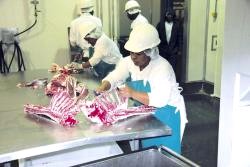 |
High quality lamb processed for the Norwegian market in Mariental, Namibia: |
| © Ulvar Arnkværn/Norwatch/afrol News |
Tesco is one of the main channels for Kenyan products to European consumers - indeed half of Kenya's agricultural exports go to Britain. Naturally, the surprise marketing stunt caused frustrations at the Fresh Produce Exporters Association of Kenya (FPEAK), which had not been consulted on the move. While Tesco promised to keep on importing Kenyan products, "carbon counting" labels on these goods from 2008 will tell a one-sided story to British consumers. ...