Friday, June 24, 2022

Nigeria: attacks on Christians

 Get Religion blog reports on the thousands of deaths of Nigerian Christians by Muslim terrorists: some are religious and some are tribal massacres by the Muslim herder tribes.

link2

....
hey, just like the millions killed in Rwanda or DRC or Uganda, it's not a big news story. Most of these wars were exacerbated by colonial powers who favored one tribe over another, and of course when the atrocities started, these colonial powers looked the other way.

Sigh. And one doubts the neocolonialist China will do any better: China is well known for it's kleptocracy and bribing of politicians.

 nothing new here, of course: I am old enough to remember the Biafiran war, which left several million dead, mainly of starvation. LINK2.

The Igbo became the most effective at integrating and benefitting from British rule. Compared to the other Nigerian ethnic groups, the Igbo more aggressively pursued western religion, education and spread throughout Nigeria with these advantages to seek employment and establish livelihoods after Nigeria declared independence in 1960. Although the Igbo hailed from the eastern part of the country, the Igbo had established lives throughout the country by the time of independence.

In other words, they ran the place (and I knew several who fled and were working in Liberia when I worked there).

The massacres of course were blamed on the rebels for letting people starve and trying to get sympathy from the west so that the wests would help them. (/sarcasm). Wrong move.

The west only cared about keeping the country intact so they could more easily exploit the oil found there.

. LINK

The attempt by Biafra to secede from the federation provoked the Nigerian Civil War that raged for almost three years. Oil was one of its major causes. Shell-BP was a British multinational company that had dominated the exploration process of the Nigerian oil industry since the 1950s. This study focuses on Shell BP’s dilemma in Nigeria during the civil war era (1967-1970). By using relevant primary and secondary sources, the paper explores the complexities that surround Shell-BP’s position either on the side of Federal government in Lagos through which it got its operating license or the Biafra government in the East that was desperate to secede from the federation. The paper further highlights the economic value of Shell-BP’s investment in oil exploration, its position during the civil war barely eleven years of oil production in eastern and mid-western Nigeria, problem of royalties’ payment in the face of dreadful threat to installations by Biafran troops, and the involvement of British government. The major findings of the paper show that despite Shell-BP’s claim of non-partisanship, its exploration activities went on almost smoothly for the larger part of the war period. This feat could have been achieved by Shell-BP only with payment of adequate royalties to the federal government, and at the same time payment of certain undisclosed token to the Biafran leaders to avoid severe damage to its installations. This study contributes to the existing knowledge on oil and war, particularly the conflict of interests associated with oil companies, the government and other stakeholders. It also contends that it is difficult for any oil company to be completely non-partisan in the conduct of its business activities in a country like Nigeria. The paper concludes that the circumstances of war era compelled Shell-BP to adopt the strategy of constructive negotiation with the Biafran leaders without undermining the Federal Government.


corruption is easy to exploit, something the Brits, and now the Chinese are happy to do. 

LINK:


the report in The Economist magazine of October 10, 2019 which revealed that about $582bn has been stolen from Nigeria since independence in 1960. ... At least N11tn is said to have been diverted in the power sector alone since 1999, while N1.3tn public funds were reportedly laundered between 2011 and 2015.,,,It quoted Britain’s International Corruption unit as saying it has confiscated £76m ($117m) loot from Nigeria since 2006. “Another £791m has been frozen worldwide, thanks to its work,” it said, adding that “it barely makes a dent in the £100bn of illicit funds

and one wonders who got the recovered money? I suspect a lot of that recovered money got stolen too, just like the funds stolen by Marcos and recovered ended up being stolen by other politicians after it was returned to the Philippines.

Sorry, but every time I read some bleeding heart say that there is no hell, it makes me hope they are wrong. And I suspect that sardonic Jewish carpenter would agree with me: Matthew 18:21-35 

Thursday, June 23, 2022

Hunger is coming to Africa

Sigh. ....SP also has a report on peacekeepers and corruption LINK...

Thursday, April 28, 2022

digital rights oppression in Zimbabwe

 Check report on Global Voices.

the law is enabling the blocking of opposition voices.

more at Netblocks.


hmm... I wonder if Starlink service would enable the news to get out. But I lack expertise in this area.

Sunday, March 13, 2022

The sorrows of Mozambique

 StrategyPage has a link to the present troubles of Mozambique, which now has an ISIS related terrorists, many who were Somalis, that sprang up where foreign investors were drilling for oil/natural gas. it could have made the locals rich but corruption happened so some decided that terror was the way to go.

It includes the history of that poor country. Sometimes with most of the terrorism and civil wars being blamed on Islam, one forgets two things: One, many of Africa's massacres and wars are tribal. And two: many, especially in the past, were inspired and funded by communist countries and/or the left, who saw the goal of independence and a socialist state should replace the (very badly run) colonial state.

Mozambique leaders feared that the growing Islamic terrorist violence could lead to another long civil war. Mozambique has been suffering wars or threats of war since the 1960s. Mozambique is a largely coastal country north of South Africa and south of Tanzania. Most of the coastline runs parallel to the large island of Madagascar. The current population of 30 million is a lot larger, and less prosperous, than the six million living there in 1950. For over a thousand years Mozambique has, like many other parts of East Africa, consisted of coastal cities that prospered by serving as a marketplace where people from the interior could obtain all manner of foreign goods. Mozambique was part of a vast trading network that used dependable seasonal winds to allow ships to move goods from East Africa to the Persian Gulf, India and Indonesia. In the 1500s Portugal, using new technologies (cannon and superior sailing ships) created the borders for Mozambique, which explains why the country consists largely of coast and interior areas reachable via rivers. What ended Portuguese rule was an anti-colonial rebellion that lasted from the early 1960s, when other European colonizers were voluntarily departing, until 1975 when Portugal finally officially got rid of its colonies. This meant nearly 300,000 Portuguese settlers and officials left Mozambique, taking with them a major portion of the new nation’s technical personnel and skilled administrators. Newly independent Mozambique elected a government that lasted two years before a fifteen-year long civil war began. This civil war was far more damaging than the shorter, and less successful anti-colonial war. The civil war killed over a million people and drove more than 20 percent of the population from their homes for months or years. Nearly two million of those refugees fled the country.

sigh.

one of my friends, an African nun, went there to teach seminarians theology and English, because the missionaries also were thrown out.  The schools and convents, including the libraries, had been looted so only the building was left: She had to sleep on a mat (hint: Bugs and mice could attack and did). And she had to live at a primitive level with the other African sisters because of lack of funds and lack of access to clean water and food. 

She left after a year because of a stroke from high blood pressure, exacerbated by poor diet and the hot climate (she was from the high veldt and not used to the heat).

Sigh.

Thursday, February 24, 2022

Refugees in Angola (from DRC Civil wars and Ruanda)

at Crux.

how the Catholic church is helping refugees, who lack proper papers, in a country that was poor to start with.

in the past Angola had it's own civil war, and Cuban military helped the winning (minority) tribe win LINK


and in the last two decades, China has essentially taken over their economy (and oil wealth).

LINK


Friday, December 31, 2021

China's fake development deals

 StrategyPage has a long discussion of China's investment in the Congo, which was supposed to include money for roads and development.

but a lot of the money went to the usual suspects:


The investigators found evidence that the engineering contract was used to distribute $55 million to senior members of former President Joseph Kabila’s government. The bribery plot used several shell companies in Congo and elsewhere that made the operation look legitimate. The shell companies provided fake invoices and other paperwork. One even provided fake telephone justifications for payment. 

since Kabila is out of power, they are working on new deals.

and just ignore the cooperation of western banks to this type of embezzlement of development money/stealing resources of poor countries:

Some of the money flowed through major European and American banks. .... 

then you have the scam of China giving aid lending money and then stealing stuff when you can't repay them. This is something we see in Asia and the Philippines is worried that their aid here will let them steal our resources and ports too.

December 3, 2021: A recent report looked at Zambia’s debts to China. Here’s the bottom line. From 2000 to 2010 Chinese financial groups loaned Zambia around $10.3 billion. So far Zambia has only repaid $1.2 billion. Zambia fears it will be another victim of Chinese Debt Trap tactics which involve offers to settle such debts by taking possession of key items, like ports, railroads or mining rights, that China wants to control....

and then there is this: 
 

 December 1, 2021: China is urging Chinese citizens now in eastern Congo (South Kivu, North Kivu and Ituri provinces) to immediately move to safer areas in Congo. In the last month at least a dozen Chinese citizens living in these provinces have been attacked or kidnapped. It is believed most Chinese nationals in these areas are involved in businesses dealing in minerals and other manufacturing resources.


so are they planning to keep them until ransom is paid, like the terrorists in the Philippines, or will China send in Wolf Warrior II to rescue them a la Rambo? 


Tuesday, December 28, 2021

the African resistance to covid

 I have cited this elsewhere, but am posting here so I don't lose the link.

Although people of African heritage are more prone to get and die of covid in the USA and UK, (maybe due to the lack of Vitamin D caused by darker skin blocking sunlight), there are fewer deaths in the African continent.

And this might be a genetic factor.

Austin Bay (10 2020) noted 


Chinese are a growing presence in Africa where they are making large investments in mining and other enterprises. As a result, there is a lot of travel between China and Africa and covid19 showed up in Africa but has not become an epidemic. The public health systems in Africa are far less capable as those in the rest of the world like China.


Chinese researchers discovered that Africans are less likely to catch covid19 because they have one fifth as many cellular receptors in their lungs than Chinese.

italics mine. 

That difference enables covid19 to cause breathing problems more, or less, readily. Other researchers found that this genetic difference was most helpful for Africans and most harmful for East Asians. People in other parts of the world have less resistance to covid19 than Africans.
Lung damage is the most frequent cause of death among covid19 victims. By April Africa, with 18 percent of the world population, has only suffered about 0.3 percent of the covid19 infections. Africans are not immune, just less likely to get infected or suffer the breathing problems that cause most covid10 related deaths.

 again, italics mine.

Such genetic differences are common and account for some ethnic groups having different health problems, or advantages.

the article then goes on to note a few other racial traits that are associated with less disease, such as malaria and sickle cell. Light skin colour and less rickets and fewer maternal deaths from rickets also was a strong evolutionary reason for pale Koreans and Scandanavians.


Wednesday, October 13, 2021

Mozambique's natural gas deposits are good news. But now the bad news

 StrategyPage has a long article on Mozambique.

That country suffered starvation after the Portuguese leftist government left the communists take it over and the communists threw out all the Europeans and mixed race and local educated folk.

How bad was it? Well, the Catholics sent local Mashona nuns there from Zimbabwe to help. Sister E, a friend, said the convents had been looted and she had to sleep on a mat and the food was poor. After two years, she had a stroke from the stress and was flown home. 

So although this blog was originally started to document the atrocities of Mugabe, at least there was not the chaos and civil war as there was in Mozambique.

The presence of South African mercenaries in Mozambique (who were protecting the mines) didn't help because the propaganda types (i.e. the leftist press in Europe) blamed all their problems on evil South Africa.

Presumably if they had left the Cubans (and now Chinese) run the place and loot their resources while killing the minority tribes as their sister colony in Angola did, it would have been a socialist paradise. (/s).

But that was many years ago.

Now the problem is that natural gas/oil reserves have been discovered, and are being developed by French and Italian companies.

The bad news? that means instead of the communist crazies, we have the Islamicist crazies making trouble, trying to stop the outsiders looting, I mean developing this resource, and of course, keeping the politicians rich with bribes etc.

StrategyPage:


The presence of large offshore deposits was confirmed fifteen years ago and, after 2010 natural gas related activity began to show up in northern Mozambique. This meant more business for local firms and jobs for people in the area. That attracted the attention of criminal gangs in Mozambique and throughout East Africa.
The current Mozambique government is something of a political gang itself, which is common in Africa and many other parts of the world.
Local expectations soon exceeded reality and the local politicians and gangsters took advantage of it. They were joined by Islamic terrorists from other parts of East Africa where there are larger Moslem populations. ...
Mozambique, with 30 million people, is 20 percent Moslem and 60 percent Christian. To the north, Tanzania, with 56 million people, is 35 percent Moslem. You don’t encounter a Moslem majority nation until you reach Somalia, which is currently the source of most of the Islamic terrorist activity in East Africa. For that reason, it was Somali Islamic terrorists who were attracted to northern Mozambique and played a role in creating some of the local Islamic terrorist groups. 

Sigh. 

the SP version of what happened there in the past can be found at their site.

short summary: 

The rebels were never a real threat to the colonial government. After Mozambique became independent in 1975, its first government was socialist and run by politicians who wanted to establish a communist police state “for the greater good.” This triggered a civil war in 1977 that killed over a million people, most of them civilians, before it ended in 1992.


and then there is the problem of tribalism and corruption.

Something to remember the next time you read the globalist want to give money to poor countries to atone for climate change: it won't go to the people but to the corrupt politicians and businessmen. 

As for China: Wikipedia has an entire article on Chinese/Mozambique relationship. Lots of this sounds familiar (they do this to us in the Philippines, and in other African countries):

China has also become a major buyer of Mozambican timber; despite local regulations forbidding the export of unprocessed logs, which aim to force foreign countries hoping to gain access to Mozambican resources to invest in setting up processing facilities in the country, many logs are exported illegally. 
Chinese businessmen are not typically involved in the actual practise of logging; instead, it is performed mainly by locals, who then bring the logs to buyers in port cities.[7]
China has also become an increasingly important player in Mozambique's construction industry; over one-third of Mozambique's new road construction is now carried out by Chinese contractors. Contractors from other countries, who have been losing out on business due to their higher costs, complain that the Chinese contractors make no effort to transfer skills or technology to locals, and do not make use of local or regional labour subcontractors, instead preferring to import and manage their own workers.

Sigh.

Sunday, October 10, 2021

invest in China

As an ex federal employee, I have a small inestment in the government Thrift Savings program

A couple years ago, Tsp planned to invest in high risk questionable  overseas funds including some in china
https://401kspecialistmag.com/tsp-still-investing-in-shady-chinese-companies

https://www.washingtonpost.com/politics/the-federal-retirement-fund-is-about-to-invest-in-china-some-former-us-military-leaders-object/2020/04/27/9cd30280-84dd-11ea-a3eb-e9fc93160703_story.html

senators tried to stop it over the objections of certain unions, but Trump heatd about it and stopped it.

Much of the objections were that the money would support the Chinese govt, but the lack of transparancy was also noted.

But the usual suspects lamented how this interfered with the ability of federal employees to make good investments...but we were not informed about it.

But other US pension funds did invest in Chinese companies.

So now that Evergreen and other chinese companies are going belly up, I will have to start googling if US pension funds are affected.


https://www.nytimes.com/2020/05/13/business/economy/china-tsp-federal-retirement-fund.html

This article is from last month
 
https://www.foxbusiness.com/media/kudlow-china-list-sanctioned-americans

Last month chinese propaganda said invest in china
http://t.m.china.org.cn/convert/c_yBSHWQBB.html

Saturday, September 25, 2021

China in Ethiopia

 Global voices has a long article about China in Ethiopia:

Many of what is reported is what we see here in the Philippines:

Promising jobs but importing their own laborers, pushing vaccine diplomacy, promising infrastructure, flooding shoddy imports.

read the whole thing. 

Neocolonialsm at it's best and something rarely reported in the western media, 

Tuesday, August 17, 2021

covid in Africa

 fast forward to 23 minutes:

............

also discusses the new Marburg virus outbreak.

Chinese neocolonialism in Africa

 StrategyPage has a long article about Chinese investments etc. in Asia and Africa.

they invest in projects but bring their own people to do the work (so no local jobs). And afterward, the Chinese stay to take over the economy. They mainly work with corrupt governments who will take their bribes to do so.

and then the locals protest.

Hmm... sounds familiar. they are doing a lot of this in the Philippines. heck, even the last buybust drug raid in our are resulted in the death of a "chinese national" who was running the drug gang.


Because of this, China is increasingly seen as a supporter of evil governments and that has generated widespread African hostility towards all things Chinese.


This has led to anti-Chinese riots in some countries and a general animosity towards the Chinese at the grass roots level. Thus when these countries go through their next rebellion, Chinese are likely to be a popular target and a major loser if the rebels win.


These problems exist, to a lesser extent, in the Middle East and Asia. China has been at this for since 2002. This really kicked into high gear when China declared 2006 was officially "The Year of Africa." China went all out to make a favorable impression on African governments and increase Chinese economic and diplomatic activity in Africa that year. To that end, about a billion dollars-worth of debts, of African nations to the Chinese government, were forgiven. The year before, Chinese commercial and government organizations invested over $13 billion in Africa. This was less than one percent of China's GDP but by African standards, it was a huge investment.


However, there was some blowback. The Chinese were mainly after raw materials, especially oil. A lot of that $13 billion was bribes for local officials.

well, duh. 

As usual, the average African was getting screwed by these deals. China is also flooding African markets with inexpensive goods. This and imported Chinese workers are hurting local businesses and causing unrest among African business owners and workers. As a result, it's become common for opposition parties in Africa to accuse China of "neo-colonial exploitation." The accusation fits, and the Chinese will pay for it down the road, as will peacekeepers brought in to help clean up the mess.


millet and teff and Sorghum oh my

PhysOrg article on alternative cereal crops in Africa.

Actually our farmers in Zimbabwe often planted these crops as an alternative if the rains were not enough to get a good harvest of maize. Also, we advised moms to make sadza for babies with them because maize was hard for malnourished kids to digest.

another article on the cereal grains of Africa.

Millet Before maize was introduced to Sub Saharan Africa, millet was the most widely eaten grain across the continent. In fact, up to 50 years ago, it was still the grain of choice. Millet, particularly pearl millet, is said to have originated in Africa prior to being exported to Asia. In fact, according to the National Research Council, it has been documented that pearl millet was domesticated over 4000 years ago in West Africa. Other types of millet include fonio and finger millet (rapoko). Millet is highly nutritious and provides far more to the African food economy than maize does, however, due to the amount of scientific research and investment in cultivating maize, the use of millet as the main staple has been surpassed by that of maize. This is unfortunate because the plant is highly resistant to droughts, requires less irrigation than maize does and is a viable option for the provision of food security.


Sorghum Sorghum is sometimes used interchangeably as millet, however, it is a different grain. It is popular in countries such as Botswana and is used to make pap or sadza, known in Botswana as bogobe. It can be fermented and made into a sour porridge known as ting.

In Zimbabwe we ate maize but rice was eaten in Liberia. The article does not mention rice even though there was an alternative rice domesticated in west Africa.

the article also mentions teff, but that is grown in the horn of Africa where I did not work.

More here: Foods of Zimbabwe.

Monday, August 09, 2021

Stopping the desert

 Atlas Obscura has an article on projects in Senegal that are hoping to stop the spread of the desert along the southern edge of the Sahara.

LINK

The garden is the latest iteration of the pro

ject known as The Great Green Wall, first envisioned as a viridescent belt squiggling thousands of miles across the Sahel region, from Senegal to Djibouti. Launched in 2007 by the African Union with backing from the European Union, World Bank, and the United Nations, the project was initially meant to help stave off desertification by stymying the Sahara as it wandered south. ... The drivers of desertification include climate variability and climate change, overgrazing, the construction of river dams, and conflicts that displace people and spur shifts in land use. Long droughts can leave fertile soil vulnerable, and winds and rains can whisk it away. “Deforestation can accelerate the process, because trees serve as windbreaks,” Okolie says. That’s where the Great Green Wall concept came in. The initial plan emphasized trees as an anchor for soil and a buffer against the encroaching sand. Some elements of the idea made sense, says Geert Sterk, a geoscientist at Utrecht University who studies land degradation. “Tree and shrub roots hold soil, [and] the canopies trap raindrops before reaching the soil surface and reduce strong winds,” curbing erosion by wind and the region’s relatively rare but fierce rain,

............

it is not just a problem in Africa: China worries about the Gobi.


Friday, June 04, 2021

covid information: Ivermectin use in Zimbabwe


.....
in the west, it is the sick, elderly, and those with chronic illness such as diabetes or renal failure who are dying.

But in Africa, those HIV positive are at risk.


The effect of HIV infection on COVID-19 outcomes is unclear. Studies in South Africa (1) and the United Kingdom (2) found an independent association between HIV infection and COVID-19 mortality; however, other studies have not found an association between poor COVID-19 outcomes and either HIV status among hospitalized patients (3–5) or HIV-associated factors such as CD4 count, viral load, or type of antiretroviral therapy (ART) (6). The effect of HIV infection on COVID-19 outcomes remains an urgent question in sub-Saharan Africa, where many countries are experiencing dual HIV and COVID-19 epidemics, and capacity to treat severe COVID-19 is limited. ... those with severe HIV disease were more likely to develop severe COVID-19 or to die of COVID-19 compared with those with controlled HIV disease.


translation: If you have severe HIV, you are at higher risk. 
If your HIV is under control (e.g. by taking treatment) your risk is normal.

the big problem is keeping HIV positive people taking their anti HIV medicine during the pandemic. 

Saturday, May 08, 2021

Mozambique update

 StrategyPage has a summary of terrorism in Mozambique, and the presence of US experts to train the local military.

few Yanks know about their history: all the skilled folks left and the civil war after independence killed a million people (starvation and disease). So the Frelimo communists took over, meaning that they set up an oligarchy to steal everything in sight.

the Muslim uprising here is about the Frelimo oligarchy controlling all the wealth from the new natural gas/oil fields and leaving the locals poor. It is in an area where there are a lot of Muslims, so voila, guess who is willing to help them?

Anyone who noted how this worked out in the rest of Africa realized this was going to make some Mozambique politicians very rich while everyone else remained poor.


That got the northern Moslems receptive to calls for rebellion and that led to Islamic terrorists taking the lead, as they often do in Moslem majority areas. It only took a few years for several small Islamic terror groups to get organized and then agree to merge to form the larger Ansar-al-Sunna group. Starting out with less than a hundred gunmen and even more unarmed supporters, it took about four years of fighting, growth and a few spectacular victories for Ansar-al-Sunna to reach nearly a thousand gunmen. At that point the Moslem rebels decided to become an ISIL (Islamic State in Iraq and the Levant) affiliate called ISCAP (Islamic State Central Africa Province).

Saturday, April 17, 2021

Terrorism in Mozambique

 StrategyPage discusses the ISIS like Islamic terrorism in Mozambique, that attacked an oil facility.

LINK

several notes: They came from the outside via Tanzania, so are not locals.

The oil facility is bringing in money, but the problem is that they brought in outside help, since such facilities require skilled workers, and locals can't do the job. So there is a resentment against them. 
There are some jobs for locals, but of course they went to the friends and relatives of the local big shots. So as in Nigeria, corruption means local resentment, which facilitates terrorism.


The local anger at the new natural resource bonanza is a common phenomenon in Africa, where most nations with oil or natural gas or any valuable exportable raw material see most of the export income stolen by corrupt politicians. This is the rule, not the exception in Africa. Big promises were made to nearby inhabitants, but governments crippled by corruption fail to deliver the promised benefits. Add the fact that Mozambique’s minority Moslem population is concentrated in the north, to provide the Islamic terrorists with recruits and some local support and you have potential problem. This can create a classic long-term problem sustained by fanatic Islamic terrorists.


this time it's the muslim terrorist vs the French and local corrupt officials etc. 

read the whole article, which relates the sad history of Mozambique and it's many wars... and the Russian/communist history for good or evil is mentioned.

One hopes Biden will not decide to get involved, since this should be Europe's sphere of influence.

And not just Europe:

the Chinese are aware that they could face similar attacks in countries where they have similar facilities... they even have their own Rambo type propaganda film that ends with the promise that China will defend their people no matter what. Heh. in the film he rescues all those Chinese working in a local factory... you mean no locals working/ Well never mind.  But you see the potential problem. Neocolonialism: only skilled workers can develop resources, but locals are not skilled, and the money goes to the corrupt local politicians, a good way to get a war started.


And the reason Angola had so many Cuban soldiers in the olden days was to let the government, run by a minority tribe, get all that lovely loot. And then there is Nigeria....sigh.


Saturday, March 20, 2021

Sttarting the covid shots

 Reuters article says that Zimbabwe is getting the vaccine from China India, and Russia

the chinese vaccine gives 50 percent protection but China is giving it to a lot of poor countries to push their image of the savior country.

Ironically, the Russian Sputnik vaccine works: It is based on the old fashioned adenovirus type vaccine and reviewed in the British medical literature as being 90 percent effective.

the Indian vaccine is less tested and relies on the old fashioned technology of using an inactivated virus. more info on it's Wikipedia page.


the article says that less than 2000 people have died from Covid, which is a low number given the many other diseases there killing people, for example a large HIV positive population.

Alas, I haven't heard from my friend there in two years: And she never picked up the last two wire money I sent her, so I can't get a first hand report on what is going on.

Thursday, February 18, 2021

and now they canceled Australis

The tech companies are blocking mainstream conservative stories, no problem.

But now facebook is saying they will block any news from Australia.
Something to do with their copyright law.  

And Australia investigating them under anti trust laws. 

https://mattstoller.substack.com/p/australia-strips-googlefacebook-to

And they are going after google too.

https://youtu.be/Fsu4dQbHKOc

Last month, China tried to bully Australia into submission and lost.


Thursday, February 11, 2021

Fertilizer? We don't need no stikin' fertilizer

 that is sarcasm and refers to this meme


in recent years, the Chinese have moved to Africa in search of mineral resources and farmland. 

In Zimbabwe, they took advantage of the self righteous "sanctions" against Mugabe, who "stole" the farm land of the white farmers (who of course had stolen their farm lands a couple of decades ago from the local Africans). But China ignored the sanctions, and was not above giving gifts to move in.

I am ambivalent about Chinese investment: They are neocolonialists when it comes to exploiting the mines (so Chinese exploitation instead of European exploitation) and their shops sell cheap Chinese goods that make local factories uncompetitive (something we see here in the Philippines).

 But China is helping the agricultural sector by introducing modern high yield methods (fertilizer, "green" hybrids and GM hybrids and working with farmers who own their own land, 

and yes, Bill Gates is helping supply the much needed fertilizer in some areas.

this goes against the meme of the powerful "organic" ecology movement. of course who see traditional practices as sustainable and pollution free (just ignore the kids dying of kwashiorkor).

The modern "green revolution" hybrids (that required fertilizer) and especially now the even more productive GM seeds have been discouraged by some governments in Africa, because of powerful NGO's and church groups that believe in the myth that change is bad, and primitive farming methods and tribal customs should not be changed.

NatGeo on China who now has pollution problems (but hey they are feeding their people). But when it comes to Africa, note that one lady scientists said they can't afford it.

“Africa cannot afford massive amounts of fertilizer,” says Sieglinde Snapp, a crop scientist at Michigan State University. A more sustainable approach, she says, is greater reliance on nitrogen-fixing plants.
Summary: Fertilizer? we don't need no stinkin fertilizer. (pun).


as for the Chinese takeover/looting of Africa's mineral resources: This is from StrategyPage:

February 3, 2021: China has continued to expand its dominant control of African raw materials. Currently Chinese firms control about 70 percent of Congo’s mineral deposits and mining industry. Chinese state-owned firms own most of this, which includes substantial portions of the global supplies of copper and cobalt. Since 2012 Chinese companies have invested at least $12 billion in Congolese mineral assets.
Some of those billions go to enrich Congolese officials who make possible Chinese ownership and protect it from local or foreign interference. The eagerness to gain control of so much cobalt is driven by Chinese plans to become the major producer of electric vehicles. Congo is the world’s biggest cobalt producer, each year producing between 55 percent or 65 percent of the world’s total cobalt. 
Chinese companies control around 40 percent of Congo’s cobalt deposits and means of extraction. Cobalt is critical as a stabilizer in rechargeable lithium-ion batteries. It takes about ten kg (22 pounds) of cobalt to manufacture an electric car battery. China is committed to producing electric vehicles (EVs) of all types.


Wednesday, December 23, 2020

Nigerian massacres

GetReligionblog discusses the many sources of the killing of mainly Christian peoples: by the Islamic militants and the tribal conflicts between the Muslim cattle herders and the Christian farmers.

Of course, both these terrorist groups kill fellow Muslims, but not so much.

The press coverage is spotty of course.

sad.

But of course they left out the terror by southern "terrorists" who mainly are Christian and object to the oil wealth being siphoned off.

And I'm old enough to remember when the mainly Christian Biafiran tribe sought to seceed and were literally destroyed by the government forces (estimated 2 million killed by famine) (rumor: with the help of the western companies that wanted their oil wealth). This is worse than it seemed since the tribe was also highly educated. Ironically, the best coverage of this was by the Irish, since many local missionaries were from that country.


Monday, August 10, 2020

Rwanda: Big brother?

Global voices, a site that publishes independent bloggers, has a report about how Rwanda is monitoring all their citizens.

a story complicated by their history of the massive slaughter during their civil war, and the impressive rebuilding of the country.

I have no expertise here so advise you just to read the story.


Sunday, July 26, 2020

covid in Zimbabwe

An article in Global voices (independent bloggers) on Covid in Zimbabwe, and the protests against corruption (stealing money meant to go to the folks suffering from the virus).

and AlJ has an article on the crack down on dissenters.

Chin'ono is accused of inciting public violence. He denies the allegations and says journalism is being criminalised.
He has written articles alleging corruption in multimillion-dollar deals to combat coronavirus that have been awarded to powerful individuals close to the government.

Monday, June 08, 2020

Coronavirus in Africa

AlJ link


There are 183,474 confirmed infections and 81,367 recoveries, according to the Africa Centres for Disease Control and Prevention. Experts warn fragile healthcare systems in many African countries could be overwhelmed in the face of a severe outbreak of COVID-19, the highly infectious respiratory disease caused by the coronavirus.
if you believe that the number of "confirmed" cases is the same as the actual number of cases, then you are a fool.

most of the cases are in Egypt and South Africa. Ah, but how many are dying in villages or in the neighborhoods and aren't getting a diagnosis? Especially if they are elderly (and in Africa, elderly means 50 years old) or have HIV.

One thing I haven't read much about: is the use of Chloroquin being done as prevention? Are people still taking Chloroquin for malaria prevention (even when I worked in Africa, Falciparum malaria was becoming resistant).

And what about those taking retroviral drugs for HIV? Are they dying at a higher rate (HIV affects T cells, which are the cells that fight Covid) or are the retroviral drugs protecting people?

Just wondering.

Saturday, June 06, 2020

Black Lives matter (but not if they live in Africa)

StrategyPage summarizes the latest news from Central Africa.

Ebola is back, alas.

 While Ebola is one of the most lethal epidemic diseases ever encountered, a much less lethal visitor from China has recently shown up in Congo. The covid19 has, in three months, inflicted around 3,400 confirmed cases of covid19 virus in Congo and 72 confirmed deaths. That’s 37 per million people and 0.8 deaths per million. For all of Africa (including North Africa) there have been 120 cases per million and 3.4 deaths per million people. That’s far lower than anywhere else...
the only problem: the numbers are not accurate you know.

 There may be more cases in Congo but the country has little or no access to modern medical care and people regularly die of undiagnosed afflictions. Since most of these involve a fever, caused by the immune system trying to fight off some kind of infection, people call many fatal conditions an unspecified fever, and such fatal fevers are common.
Sigh. This is probably true here in the Philippines too. One of our neighbors had a fever and shortness of breath but died in the hospital of a "heart attack". I am pretty sure that he had Covid, but they didn't test him. I have no proof, but maybe because if a known case was found in that (private) hospital then no one would go their for routine illnesses.

Saturday, April 11, 2020

shut down economies from virus could lead to massive starvation

on my main blog, I have written about the increase in poverty and need for food aid here in the Philippines: my latest report HERE.


but not much is being written about how it might affect Africa.

There are some reports that genetics makes Africans less likely to get the virus, but that hasn't been the case in the USA. And in Africa, one wonders if the climate//sunshine might lower the spread (i.e. when it is warm, you don't have people indoors as much, but in todays' world of buses, factories, schools, etc that might not be true).

Virtueonline, an Anglican website, has posted an article about the virus in Africa: not a lot of numbers next to the many thousands who die from malaria or other common diseases, but the pressure to use western style prevention methods might make things worse.

and yes, many of these countries will stop planting the next crop for prevention of virus spread: but I wonder if this is overdoing it: Here in the Philippines after some mix ups about food and rice delivery trucks being allowed to go though check points, things have improved. And our farmers are harvesting here, even though we have a strict lockdown of our town (although one suspects family members won't be able to come back from Manila to help with the harvest, our people here in town can drive out to the farm in cars to help with the harvest... I don't know if this is true in other areas.

but this report of strict urban style lockdowns in rural areas is disturbing: If true, more will die of starvation than any virus.

Pastor Campos Afonso's report from churches in Angola is repeated throughout the continent where most states are in lockdown. The President of Angola declared a quarantine and State of Emergency from 27 March-11 April. All church meetings are closed. Pastors, leaders and members are observing the measures in their homes to combat the virus from spreading.
If the lockdown situation of COVID-19 continues it will affect the 2020 harvest because people will not be able to work in the fields. The lockdown means a shortage of work, tools and transport to take products from the countryside to the cities.
Lack of transport also means people cannot get from the cities to work on their family land to gather the harvest. Products collected this year will rot in the fields. New seeds will be in short supply for cultivation in the next year.
People are consuming the products that were being reserved as seeds for planting in 20202021 after having sold the December and January production. Most have nothing to eat in this period of isolation. Many could die of hunger instead of being killed by COVID-19. Locals say that church intervention is needed to help the most vulnerable people and poor Christians.

Tuesday, March 24, 2020

DRC response to coronavirus

globalvoices has a report on the cases in DRC, which were imported from Europe.

 DR Congo has banned large gatherings, ordered school and university closures for four weeks and closed its border with Rwanda, all measures taken to stem the spread of the virus. The government also suspended all international flights from countries with a high number of cases of COVID-19.

Genetic puzzle on coronavirus

I had read a couple articles that mentioned Africans having fewer Corona virus cases and deaths, and I assumed that this was because of the sunlight/living outdoors instead of inside houses in the winter as in China and the USA/Europe, or maybe because a lot of Africans take anti malarial medicine to prevent getting that disease, or maybe just that they haven't done enough tests and people are sick without going to hospitals and getting counted.

But StrategyPage notes:

...Chinese researchers found that Africans are less likely to catch covid19 because they have one fifth as many cellular receptors in their lungs than Chinese. That difference enables covid19 to cause breathing problems more, or less, readily. ...
  Lung damage is the most frequent cause of death among covid19 victims. So far Africa, with 18 percent of the world population has only suffered about 0.3 percent of the covid19 infections. Africans are not immune, just less likely to get in infected or suffer the breathing problems that cause most covid10 related death

this doesn't mean they can't get sick or die, but merely that the disease might be less fatal in certain populations.

One wonders if this observation is seen in the African diaspora on other continents.


Wednesday, March 04, 2020

the chaos in the DRC

LINK

stategypage discusses ebola and other disease, locusts, and war.


You think you have it bad?

the Congo and other central African areas are fighting disease, war, and locusts.

Disease: unlike Liberia, the WHO has fought the Ebola epidemic with local health care workers, and is now using vaccines.

the churches are doing a lot of the developmental work, but  are not mentioned in most of the lay press reports, but when I was in Africa, most of the rural hospitals and clinics were either church sponsored or run by medical personnel trained in church hospitals. I suspect it is the same in Central Africa, but of course the secular "doctors without borders" get most of the publicity in the news reports, probably because they are European/American (i.e. white).

the bad news: Corona virus is expected to hit (maybe via China, since China has a lot of their people doing work on various projects in Africa). But since there is now a medical infrastructure in place (to fight ebola), it mwans maybe they will be able to handle this better than more African countries.

SP latest news is that cases are down:
The number of new Ebola “cases per day” has dropped. From February 18 to 23, there was only one new confirmed case in North Kivu Province. As of February 23, there have been 3,444 total cases,

but ebola is not the only killer here. From SP:
February 14, 2020: The UN issued a report examining malaria in Burundi during 2019. From January through December 2019 Burundi had 8,892,300 malaria cases. The disease killed 3,294 people or 37 per 100,000 infected.
and measles has killed at least 6000 in the area:

Under the leadership of the DRC Ministry of Health, WHO, Gavi, the Vaccine Alliance, and other partner aid agencies vaccinated more than 18 million children under five across the country in 2019. '
However, in some areas, routine vaccination coverage remains low and 25% of the reported measles cases are in children over the age of five. ....
Since the start of 2019, around 310 000 suspected measles cases have been reported. The epidemic has been aggravated by low vaccination coverage among vulnerable communities, malnutrition, weak public health systems, outbreaks of other epidemic-prone diseases, difficult access by vulnerable populations to health care and insecurity that has hampered response in some areas.
see that comment about "insecurity?

This is from gangs/ irregular tribal insurgencies and wars.

when I was in Africa, our main danger was not from government soldiers, or even the regular insurgents, but from deserters or rogue groups from both sides who had guns and who used them to rob/rape/kill.

Again the SP article includes reports of various groups who killed people.


But note that these are being fought. China got into the news saying they will export 100 thousand ducks to eat the locusts, but I wonder if that will work: I suspect most will die during transport, and those that survive the trip might not adjust to the climate. More likely the locals and the dogs will eat the ducks.

but the dirty little secret is that pesticides are being used (don't tell western greenies). Again from SP:

On February 11 the Ugandan government deployed around 2,000 Ugandan Army soldiers to fight the locusts. Here’s how an army counter-locust operation works. When locals detect a swarm they report it. Uganda is also employing drone aircraft to monitor locust swarms and their movements.
When a swarm is identified, several dozen soldiers armed with manual and motorized pesticide spray pumps move to the infested area. Ugandan military officers report that locust swarms don’t move at night, which means the pre-dawn hours are the optimal time to spray pesticide on an infested field to insure killing adult locusts. 
Speaking of "greenies":  one of the reasons I dislike "animal conservation" is that they take the side of animals against the locals.

Usually this means stopping locals from killing predators or elephants who eat them or their crops, but SP notes:

February 6, 2020: European media are citing a draft report that alleges “ecoguards” in the Republic of Congo (Brazzaville) are physically assaulting and intimidating Baka pygmy tribesmen who live near a national park the guards patrol. Ecoguard is shorthand for “ecological guard.” The ecoguard program is partially funded by international conservation groups. According to reports, the ecoguards carry firearms. For thousands of years, pygmies have been persecuted by the majority of Africans of normal height. As a result, the pygmies lived reclusive lives, often deep in forests away from majority populations.

Sigh.

Friday, January 31, 2020

voter biometrics in Zimbabwe (China link)

from Global voices:


In previous elections, citizens could visit any polling station and vote just by showing their conventional ID cards, which contained their name, ID number, date and place of birth and date of issue. After voting, one's finger would be smeared with indelible ink to avoid double voting. Now, citizens suddenly had to submit their photos, fingerprints, national identity numbers and home addresses into one integrated and digitized system. If they did not do this, they were told, they might be barred from voting. This increased public fears of monitoring and intimidation, already a common theme for elections in Zimbabwe. The system was touted both by ruling party and opposition voices as a strong guard against “ghost” voters and other types of election fraud.

But its underlying technology was not built with these issues in mind. Nor was it built in Zimbabwe. China’s ‘AI foray’ into southern Africa
The government of Zimbabwe signed a strategic partnership with CloudWalk Technology, a Chinese company that has become a leader in the field of facial recognition, in March 2018. The objective of the partnership was to commence a large-scale facial recognition program in Zimbabwe, which government officials said would be used to preserve “law and order,” and then expanded to other public sector programs.
oh, by the way, the UKGuardian calls the famine "man made". Duh.

Saturday, December 21, 2019

Blood cobalt

Slashdot reports: Apple and google were named in a lawsuit over the death of children mining cobalt in the DRC (DRCongo).

(Headsup Instapundit)

Original report is in the UKGuardian.

The extraction of cobalt from DRC has been linked to human rights abuses, corruption, environmental destruction and child labour. The lawsuit argues that Apple, Google, Dell, Microsoft and Tesla all aided and abetted the mining companies that profited from the labour of children who were forced to work in dangerous conditions – conditions that ultimately led to death and serious injury.
the children were not physically "forced to work there: They work there because of extreme poverty forces them to work if they want to eat.
The families argue in the claim that their children were working illegally at mines owned by UK mining company Glencore. The court papers allege that cobalt from the Glencore-owned mines is sold to Umicore, a Brussels-based metal and mining trader, which then sells battery-grade cobalt to Apple, Google, Tesla, Microsoft and Dell.
Other plaintiffs in the court documents say they worked at mines owned by Zhejiang Huayou Cobalt, a major Chinese cobalt firm, which the lawsuit claims supplies Apple, Dell, and Microsoft and is likely to supply the other defendants.

so the tech giants who are going around the US and the world funding "progressive" causes are getting rich on the blood of children. So what else is new?

But one of the substories in here is that China is trying to get a monopoly on Cobalt and other rare earth metals used in high tech.


Bloomberg report from Dec 2018: not only are 8 of the 14 largest cobalt mines in the DRC owned by China, but they essentially own the supply chain to companies that use the mineral in their batteries, metal alloys, etc.

essentially they own most of the cobalt refineries, and many of the factories that make batteries for Tesla and electric cars.

Here, LimacharlieWord discusses the importance of cobalt to the Chinese economy.

They also note European and Chinese corporations and governments are "lobbying" to stop the country from taxing the metal in order to keep the price down. They also note China is not only investing in the country, but sending in a lot of Chinese to do the work.

and they note half the money for infrastructure sent there by China is "unaccounted for" (duh), and the political instablity partly caused by a president who refuses to leave and wars going on in the area.


Thursday, December 19, 2019

Chinese investments in Africa

,,,,,,,,,,

one advantage: China doesn't worry about supporting corrupt and murderous politicians.

Another advantage: The US MSM hasn't noticed what is going on.

A third advantage: Unlike the US State Department, they aren't going to push African countries to accept homosexuality, which translates to letting pedophiles (both local and sex tourists) to abuse their youth.

Saturday, September 07, 2019

Thursday, June 13, 2019

Kill the elephants


Nderiki and her husband had been married 65 years before he was killed by an elephant in 2014. Like nearly everyone else in this cluster of villages, it has been years since her fields weren’t trampled and eaten up by what she calls “the giants.”
She used to grow more than 100 bags of sorghum in a season. Last harvest, she salvaged three.
Growing resentment toward the animals among farmers here and around Botswana is upending the country’s politics and prompting the reversal of policies that turned tourism into Botswana’s second-biggest earner after diamonds.
The furor has also spilled into a larger debate over race in a country where white foreigners and the descendants of colonialists control much of the conservation and tourism sectors while many who live outside the national parks eke out a living on government subsidies....
The country’s president, Mokgweetsi Masisi... said that in his view, the numbers of elephants are now “far more than Botswana’s fragile environment, already stressed by drought and other effects of climate change, can safely accommodate,” leading to a “sharp increase” in conflict between humans and elephants. He believes a limited, permit-based return to hunting can solve the crisis.....

headsup AnnAltnouse.

I was going to make the headline "kill the F....." but this is a G rated blog.

You see, all those "national geographic" etc. specials in Africa love wild animals and lament the "loss of habitat.  (translation: Those dang locals keep plating crops to feed their kids) and poachers (translation: Those dang locals kill animals to make a living),

Ah but wait a bit: You will start seeing elephants dying of starvation after the eat everything in the area, When food disappears either from overgrazing or the periodic droughts in that part of Africa, they then travel to people's farms and eat the food of the locals, and/or they starve to death.

NYTimes article from 1992:

Zimbabwe kills starving elephants for food.


Faced with the worst drought in southern Africa this century, the wildlife authorities at a national park here are proceeding with what they call the grim but essential step of killing thousands of elephants and impalas so other animals as well as starving people can survive.
While animal kills are common here and elsewhere as a form of habitat management -- wildlife officials prefer the term "culling" -- rarely if ever has a drought forced the authorities to act on such a scale and with such human urgency as in the program under way at the Gonarezhou National Park.
In the coming weeks, the park authorities plan to shoot 2,000 elephants and give the meat to farmers and their families. In addition, an operation to kill 5,000 impalas and distribute the meat from them has begun. Also under way is the large-scale relocation of rhinoceroses, hippopotamuses and other exotic animals that are in danger of dying from hunger. Unlike other African nations, Zimbabwe does not have a major elephant-poaching problem, so the authorities have long resorted to such kills to control the growth of its large elephant population.

nor is this the first time this happened:


Mr. Wright of the World Wildlife Fund said a situation comparable to the one here developed in Kenya in the early 1970's. The wildlife authorities decided then not to kill elephants during a drought in Tsavo National Park, even though they were deemed too numerous and many people living in the area of the park were in need of food. In the end, thousands of elephants died of thirst and hunger, and that in turned stirred resentment among the peasants living nearby, Mr. Wright said. When the good weather came, the elephant population in Tsavo never recovered because the angry peasants cooperated in poaching.

Periodic famines due to drought are not unknown in that area:

This article notes that it appeared to be rainer in the 19th than in the 20th century, although droughts did occur.

Article on the "great famine" of the 1870s.


The Great Drought actually was several droughts, Singh found, beginning with a failure of India's 1875 monsoon season. East Asia's drought started in the spring of 1876, followed by droughts in parts of South Africa, northern Africa and northeastern Brazil. There were also droughts in western Africa, Southeast Asia and Australia. The length and severity of the droughts prompted the Global Famine, aided in no small part by one of the strongest known El Niños, the irregular but recurring periods of warm water in the tropical Pacific Ocean. That triggered the warmest known temperatures in the North Atlantic Ocean and the strongest known Indian Ocean dipole -- an extreme temperature difference between warm waters in the west and cool waters in the east. These in turn triggered one of the worst droughts across Brazil and Australia. Because the drought was induced by natural variations in sea-surface temperatures, says Singh, a similar global-scale event could happen again. Moreover, rising greenhouse gas concentrations and global warming are projected to intensify El Niño events, in which case "such widespread droughts could become even more severe."
The socio-political factors that led to the famine no long exist, she notes. Still, she writes, "such extreme events would still lead to severe shocks to the global food system with local food insecurity in vulnerable countries potentially amplified by today's highly connected global food network."

and then there was the drought 4200 years ago. 

article on the desertification of Africa.

article about Chinese project to fight desertification in Namibia.

Under instruction from Chinese technicians, Nakanyala dug grooves into the ground and filled them with grass, skillfully using a spade to build a stretch of grass pane sand fence, a proven method to alleviate shifting sands and conserve water. "Nearly a quarter of Namibia is covered by sand. It's a matter of primary importance to learn effective techniques against desertification so that we can solve food problems," said Nakanyala. The training program has been held in Gansu for almost 30 years, with nearly 1,000 technical workers and government officials from 87 countries trained, including those in Africa. The government-sponsored training courses combine in-class learning and field practice, focusing on theories and techniques of desertification control as well as ecological restoration....China has reversed the expansion of its deserts. An average of 4,400 square kilometers of desertified land has been restored each year since 2000, according to statistics. "China is at the forefront of sand prevention and control," Liu said. "It is urgent to share our methods with other parts of the world."

Wednesday, June 12, 2019

iMusic from Zimbabwe

this is Library of Congress, but there are lots of Youtube videos of music from Zimbabwe. ........

Monday, March 25, 2019

Troubles all over

The floods in Zimbabwe and Mozambique have affected many.

Mozambique also reports out break of cholera and malaria.

There is a drought in Kenya that could cause starvation there.

Ebola has spread to a new city in the DRC.

Sigh. No links, sorry.

But these are natural disasters.

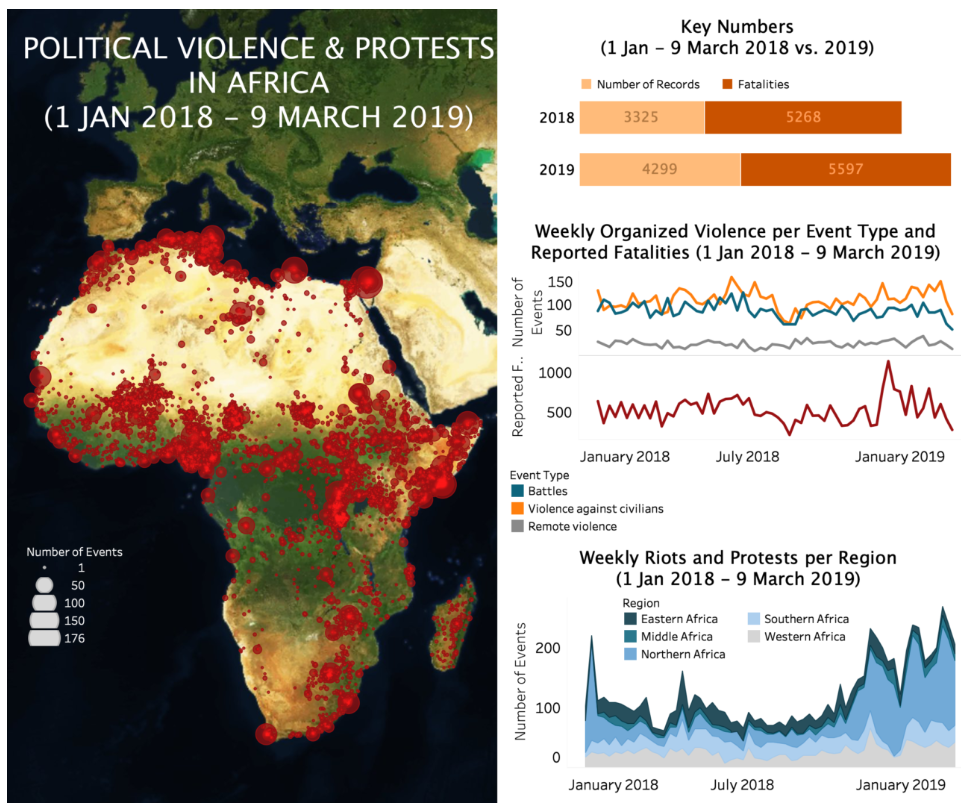
the USNIblog refers to a new website about political violence/protests in all parts of Africa.

ACLED data website.

here is an example of their data:


Monday, February 18, 2019

Mine collapse: 8 rescued

Al J has the story. 8 rescued, 24 dead, and many other missing.


it was a closed mine where men were working on their own.


Monday, January 28, 2019

Too many Africans: Now Bill Gate's money is pushing the meme

Interview with a Nigerian Human Rights activist about how the west wants to depopulate Africa, now with oodles of money via Bill Gates, whose wife has decided there are too many Africans around.

LINK

My grandfather had seven children, and they were poor — but not due to the size of their family. During the colonial era, he had no education or training. He couldn’t speak English and get into the proper employment pool. My parents have six children, almost the same as my grandfather. Yet my father got an education and rose out of poverty. The difference from father to son was education.
Our values are to protect human life and family. Faith is also very important. We cannot do without it, because we know that we are not God. There is always someone higher than us and in control of things. If you have that, then everything else is added on to it.
Mobilizing in Africa
Over the past six years, has the Gates Foundation responded to your concerns or shifted in their policies?Ekeocha: No, the Gates Foundation and similar groups have not responded. But they do know about our projects. They have branches in Nigeria and Ghana. Through the grapevine, we hear that they lament and complain about the work we do. Perhaps it’s undermining some of their work. But they have not responded to me directly and have never tried to reach out.
We have traveled to ten African countries to raise awareness. Definitely there is always room for more. We wish that mainstream media would cover these things, but they don’t. Thank goodness, we have social media where we are putting out information. Working with many African Bishops, I find sometimes they did not get specifics quick enough or have a full picture of what’s going on. Culture of Life Africa gets information to people who should know.
Before I started this group, we were moving in the dark. I have seen a lot of difference and change in that we have managed to get the word out. Now when the Gates go to Africa and throw a few million dollars in for this or that project, several leaders like me have more than critical thoughts about it. We have evidence and confidence to speak out.
Positive changes have happened since the Trump administration. President Trump reinstated the Mexico City Policy, which was amazing. Yet other countries have responded negatively. The Canadian government has given even more to sexual and reproductive rights which includes abortion. The British government funds one of the biggest abortion organizations in the world, Marie Stopes International. Australia has funded that group as well.

actually nothing new here.

When I worked in Zimbabwe 35 years ago, every village had a "pill lady" to give out birth control pills (which by the way increased malnutrition because the pill lowers the amount of breast milk).

but there was no clean water in the villages so kids continued to die of diarrhea.

But I must confess: We did give DepoProvera to our lactating moms to increase breast milk. So was this birth control (since breast feeding does stop ovulation, and in traditional Africa where we worked, vaginal intercourse was taboo during the period of breast feeding). So maybe we were guilty too.

But our idea was to space babies, consistant with African culture, not to stop babies from being born.

Tuesday, January 15, 2019

Fuel problems in Zimbabwe

BBC article:

the price of petro has gone up: and it is hurting people


The reason for the hike, the government said, was to avert fuel shortages that have created national angst. The hike means petrol prices rose from $1.24 (£0.97) a litre to $3.31 , with diesel up from $1.36 a litre to $3.11. Zimbabweans were not pleased by these changes, hundreds of them went to the streets of the capital, Harare and the southern city of Bulawayo, to protest against the new prices.

and it has to do with the problem of the Zim currancy:

The sudden increase is symptomatic of price distortions Zimbabweans have to deal with on a daily basis. The price of fuel is fixed by the authorities. Unlike other businesses, fuel stations have to sell petrol at the same price in US dollars and the surrogate currency - bond notes - introduced more than two years ago to address a cash crisis. Thriving black market The government maintains that bond notes, which is only traded in Zimbabwe, is pegged to the US dollar. But the reality of the ground is different. There is a thriving black market where three bond notes fetch one US dollar....

The principal is "bad money drives out good", in other words, one currency will become more desired than the other. In the case of Zimbabwe and the US dollar, the desired currency disappeared as many withdrew their US dollar cash from the bank, and kept the notes under their mattresses. Most banks ran out of it, worsening a biting cash crisis.

Sigh.

And what worried me more it that my friend hasn't written/emailed me for three months: And hasn't picked up the money that I sent her via western union for three months either. Is she sick? Is there a problem in the bank?

Sigh.

Thursday, December 27, 2018

Albino pride

AlJ has an interesting article about Albino beauty contests in East Africa.


Organized by the Albinism Society of Kenya with partners in Uganda and Tanzania, the contest aims to demystify the condition of people living with albinism and affirm their inherent dignity while challenging myths, misconceptions and negative beliefs around the disorder. The main event was a culmination of auditions held in several countries and a 10-day boot camp where the 30 final participants trained to improve their modeling skills. The contest was aimed at facilitating positive interaction between people with albinism and the society.

Wikipedia article.  describes how they are persecuted and discriminated against in Central Africa. including the recent newspaer reports on the use of body parts of Albinos for ritual healing etc. by shamans.  BBC article.

witchdoctors "diagnose" witchcraft and advise treatment, but one aspect is that some of these people go bad and use human body parts in rituals (hence I use the word Shaman, because murder of anyone means you are a witch, casting a spell, not a witchdoctor).

I ran across a lecture where they said there are 100 thousand Albinos in centra Africa, and many flee to colonies because of prejudice.


When I worked in Liberia, there would be scattered reports about children, usually streetkids, going missing, and one 12 year old escaped and got the police to arrest the guy who was killing street kids for body parts. You put the body parts under the store you are building so that the spirits will give you success.

(even in the west, we frequently put holy medals or memorabelia in the foundations of houses etc. as a blessing, and many places use animal sacrifice for the same reason, e.g. in Santeria etc.).

but I worked in Africa before the HIV epidemic hit, and my friends tell me a lot of men sought witchcraft to cure their disease

(HIV epidemic wiped out much of the middle class in some African countries).

but with the HIV epidemic, a lot of shamans use criminal means to cure the disease, from rape of virgins to killing albinos for medicine.


the BBC article notes that most albinos die before the age of 40, and the photos of the AlJ site suggest why: Skin cancer.

Skin cancer is rarely fatal, but albinos might have dozens of large untreated lesions on their bodies.

Sigh.

When I worked in Zimbabe we had several in our area. One lady had a baby, a beautiful perfect black baby. I was surprised that she found a husband, and asked who would marry her, and was told: Her husband was a blind man.

Apparantly , he lost his sight in a mining accident and had a pension.

They seemed quite happy.


related article: Albino village in Indonesia.

Monday, December 03, 2018

HIV in Zimbabwe

AlJ reports the economic crisis is making treatment of HIV difficult for patients.


Pharmacies and hospitals are not able to keep consistent stocks and, even when they do have the medicine, some will only accept payment in US dollars because the local currency loses value daily. Doctors in Zimbabwe worry that if patients are unable to take or stop taking their medication, they will develop drug-resistant strains of HIV that are harder and even more expensive to treat.

Wednesday, July 18, 2018

Book Review: Angola's warrior Queen

Book review at StrategyPage:


Queen Njinga of Ndongo-Matamba rule her kingdom, a considerable region in what is now northern Angola, for an impressively long period (1624-1663), but is today largely forgotten.

In this, the first ever biography of Njinga, Prof. Heywood (Boston University) reveals an able woman, who was as adept a ruler as any in history. Njinga effectively combined wily diplomacy,
commercial dealings (including slave trading), military power, and even religious policy, to cope with ambitions of Portuguese colonialists, rival kingdoms, and even some envious kinfolk, keeping herself on the throne and her realm independent in the face of numerous threats, at her realm, at times even maintaining relations with to the courts of Portugal and Spain, and even the Vatican.

To tell this story, Heywood draws upon a large body of documentary evidence, primarily Portuguese, as well as many traditional accounts, some of them recorded long ago. As she tells Njinga’s story, Heywood also offers insights into the origins of the kingdom, its political organization, social structure, culture, dynastic connections, and religion.

Wednesday, July 04, 2018

Central Africa is a mess, but Rwanda is thriving.

StrategyPage on Central Africa notes that there is a polio epidemic, thanks to BokoHarum, a small Ebola outbreak, and lots of refugees fleeing political infighting. Sigh.

the bishops are doing what they always do: documenting human rights problems and trying to get people to make peace:

June 28, 2018: Congolese Catholic Church bishops and lay leaders have accused the Kabila government of neglecting the starvation and general chaos in the southwest (Kasai region). About 14 million people have fled the violence and millions are still unable to return home. Several hundred thousand children in the Kasai region are suffering from malnutrition. The bishops provided documentation collected by priests and nuns in the region.

but there is some good news: Volkswagon is making cars in Rwanda:


June 27, 2018: Volkswagen has opened what it calls a “small vehicle assembly plant” in Rwanda’s capital, Kigali. The facility will assemble cars from parts manufactured in South Africa. The facility can assemble from 5,000 to 10,000 cars a year. The cars will be sold to fleet customers – government ministries, taxi services and other businesses. The government is touting the VW plant as evidence that Rwanda is stable, has a growing economy and is a good place to invest.

Monday, June 25, 2018

explosion in Bulawayo

who threw the bomb in Bulawayo?

AlJ report:

Although Mnangagwa pleaded for unity and peace after he survived the blast, Eldred Masunungure, a political analyst and academic, expressed scepticism about the possibility of a peaceful election next month. Masunungure told Al Jazeera that although the climate towards the polls seemed more promising of less violence compared to other elections since 2000, the explosion sullied hopes for an election free of tension.

 
Free hit counters
Free hit counters