Showing posts with label famine. Show all posts

Wednesday, March 01, 2017

Armyworm devestates crops

DW report on the Armyworm eating the corn crop.

Global warming? No. Imported from South America, probably by an imported plant, and spreading around the continent.

Slow government response, and farmers believe the rumor that pesticides won't work


most farmers are still not aware of what can be done to reduce it's damage. Some farmers in Gokwe district bought all kind of theories about a mysterious worm due to lack of information and clear guidance from the government. As a result some healthy looking crops were left at the mercy of the devouring fall armyworm. Many of the farmers are now counting huge losses....
FAO warned that Zimbabwe is likely to be the hardest hit with 130,000 hectares of maize and corn crops largely affected. So far the fall armyworm has spread in at least 10 provinces in Zimbabwe.
Despite the farmers' concerns, the government sees no urgency or panic regarding the armyworm. The head Plant Protection Research Institute at Zimbabwe’s Ministry of Agriculture, Godfrey Chikwenhere, said the yield reduction obeserved was minimal. "The only issue now is that we are using a substantial amount of money on chemicals," he said."
Though from the casual observer when you see the worm and all the plant being [attacked] you might estimate that the yield is very high," Chikwenhere added.
The caterpillar stage is the dangerous one that eats the crops. Ah, but then it turns into a moth, which is how it can migrate so quickly into new area.


this WIKIHOW is more about how gardeners can control it in rich countries

BBC article:

Why is it such a threat to farming? It is very hungry (and not picky) - This pest targets maize (corn) and other cereal crops, like its African namesake, but it also attacks cotton, soybean, potato and tobacco crops. When it does invade, up to three-quarters of the crop can be destroyed.
Unknown enemy - Governments, communities and farmers have no previous experience of dealing with the new pest, which may be even harder to deal with than its native equivalent.
  • It is fast - According to the UN's Food and Agriculture Organisation (FAO), it has taken only eight weeks for the pest to spread to the six southern African countries where there are suspected infestations.
  • It travels far and wide - The caterpillar stage does the damage but "it's the adult moth that migrates long distances and that's how it's managed to get round Africa," says Professor Ken Wilson, an expert on armyworms.
  • It is not just targeting any old crop - Maize is the primary food staple in many of the areas where the pest has been identified.
  • It is hard to find - The fall armyworm burrows right into the stem of maize plants, concealing itself from view and preventing farmers from spotting the problem early.
  • Bad timing - It comes after two years of record droughts, which have already affected more than 40 million people in the region, making 15% less food available, according to the UN.
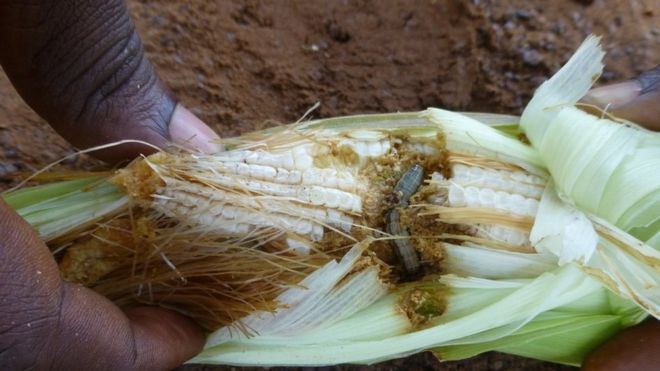
often outside the crop looks good, until you open the cob.


Gizmodo articcle on efforts to control the pest. They blame global warming of course.

As if the drought/rain cycle was due to global warming, not a normal event that has been going on for years.

Actually all they say is that the moth didn't spread quickly during the drought, but once the rain came and there was a lot of good crops to eat it spread.

Nature article on droughts in Africa:


Our data indicate that, over the past millennium, equatorial east Africa has alternated between contrasting climate conditions, with significantly drier climate than today during the 'Medieval Warm Period' (approx ad 1000–1270) and a relatively wet climate during the 'Little Ice Age' (approx ad 1270–1850) which was interrupted by three prolonged dry episodes.
We also find strong chronological links between the reconstructed history of natural long-term rainfall variation and the pre-colonial cultural history of east Africa4, highlighting the importance of a detailed knowledge of natural long-term rainfall fluctuations for sustainable socio-economic development.

Wednesday, February 17, 2010

Let them eat Cuy

one of my essays at BNN discusses using guinea pigs as a cheap protein source in Africa:


small headline in the news: Guinea pig touted as solution to Congo food crisis.

…it’s not known how or when guinea pigs — native to South America — arrived in Congo, but CIAT (the Colombia-based agricultural research institute, the International Center for Tropical Agriculture) researchers discovered them last year being kept as “micro-livestock” in the nation’s hard-hit North and South Kivu provinces, which border Uganda, Rwanda and Burundi.

“Small and easy to conceal, guinea pigs are well-suited to (Congo’s) conflict zones, where extreme poverty and widespread lawlessness means that the looting of larger domestic livestock is commonplace,” the group said in a statement.

Very interesting…

(with the war in Central Africa, there are major problems with finding meat to supplement the diets, and )  the “animal rights” people have been lamenting about it for awhile, since it seems that one source of food is monkey meat, and eating monkeys into extinction upsets them a lot more than dead black babies.

Finding cheap protein to feed growing children is an ongoing problem, and not only in war zones.

When we worked in Africa, we had a nutrition center to “feed up” children who were losing weight. Usually the kids did well until they were weaned, but then the local diet didn’t provide enough protein. The result was Kwashiorkor, protein malnutrition. Kids would come in bloated, lethargic and with red hair. If the case was severe, they died even after feeding. So we had our village health workers screen local children for malnutrition, and then helped with cheap protein supplements for the diet. In severe cases, we admitted them to be”fed up” in our Nutrition village, where we trained our mothers to add peanut butter to porridge, to raise chickens in cages for their eggs (free range chickens laid eggs where they were often stolen or broken, and of course free range chickens ended up as meals by the free range dogs). We also introduced rabbit breeding. We didn’t introduce food that would be new to the area, because village people are conservative in what they eat, so you build good nutrition on what they already are comfortable eating.

Yet in the Andes regions of South America, guinea pigs– actually a larger version of what Americans raise as pets, which are called cuys– are commonly eaten to supplement the diet.

My oldest adopted son told me that his “first mom” kept the cuys in the kitchen, where he used to sleep. At night, he would hear their soft chirps and would be comforted. She would feed them grass and scraps, and when they “felt weak” or otherwise needed a good meal, she’d kill a few of the younger cuys, and cook them for her family.

When I visited his home town, they treated me to a meal of one, and it was quite good.

So I find it interesting that a Colombian based NGO reports that locals have already started to breed and eat cuys in Central Africa. Yes, a Colombian would be more aware of this valuable source of protein than a European, and would recognize the importance of encouraging the trend. And the fact that locals already eat Cuys suggests that the locals will accept them as a food source.

If the idea catches on, it’s an idea for those working in other areas of Africa.

Better a cuy than the alternative: Eating monkey (which can spread disease) or having your child die of Kwashiorkor (caused by lack of protein in the diet).

Friday, February 05, 2010

Maize needed

from ReutersAfrica:

HARARE, Feb 3 (Reuters) - Zimbabwe needs to urgently import 500,000 tonnes of maize to avert shortages after the staple crop was hit by an extended dry spell, its agriculture minister was quoted as saying on Wednesday....

Wednesday, December 09, 2009

UN seeking $378M for food

from the WashingtonPost

U.N. deputy emergency aid chief Catherine Bragg said Monday at least 1.9 million Zimbabweans will need food aid in the first three months of 2010. Millions of others remain vulnerable from the erosion of basic services and livelihoods.

The U.N. also warned that cholera cases are re-emerging during the current rainy season. The water-borne disease killed more than 4,200 people last year...

Thursday, November 05, 2009

Grabbing up Africa's land

Via the Sydney Morning Herald (Australia):

...The food rights campaign officer for Action Aid, Alex Wijeratna, said: ''There's a new scramble for land in Africa. It's growing at an incredible rate. There's massive secrecy, poor communities can't get information and they're not being consulted....

Earlier this year the legendary speculator George Soros highlighted a new farmland-buying frenzy ... South Korea has bought huge areas of Madagascar, while Chinese interests have bought large swathes of Senegal to supply it with sesame.

''I'm convinced farmland is going to be one of the best investments of our time,'' Mr Soros said. ''Eventually … the bull market will end. But that's a long ways away yet.''


I'm not sure what to make of all of this: foreign investment and agribusiness is a no no to greens and local small farmers, but without agribusiness and modern techniques, Africa will continue to starve...my main question is if the aim is to sell to locals and make a profit or to export it while locals starve...

Thursday, October 08, 2009

Neocolonialism or new prosperity?

from the Economist, a long article on China, Korea and the Gulf states investing in Africa and poor Asian countries, to grow crops for biofuel or food...

"...If you assume that the land, when developed, will yield roughly two tonnes of grain per hectare (which would be twice the African average but less than that of Europe, America and rich Asia), it would produce 30m-40m tonnes of cereals a year. That is a significant share of the world’s cereals trade of roughly 220m tonnes a year and would be more than enough to meet the appetite for grain imports in the Middle East....

China has set up 11 research stations in Africa to boost yields of staple crops. That is needed: sub-Saharan Africa spends much less than India on agricultural R&D. Even without new seed varieties or fancy drip-feed irrigation, investment should help farmers. One of the biggest constraints on African farming is the inability to borrow money for fertilisers. If new landlords just helped farmers get credit, it would make a big difference.

Yet a certain wariness ought to be maintained. Farming in Africa is hard. It breaks backs and the naive ambitions of outsiders. To judge by the scale of projects so far, the new investors seem to be pinning their hopes on creating technologically sophisticated large farms. These have worked well in Europe and the Americas. Paul Collier of Oxford University says Africa needs them too: “African peasant farming has fallen further and further behind the advancing commercial productivity frontier.”

But alas, the record of large farms in Africa has been poor. Those that have done best are now moving away from staple crops to higher-value things such as flowers and fruit. Mechanised farming schemes that grow staples have often ended with abandoned machinery rusting in the returning bush. Moreover, large farmers are often well-connected and spend more time lobbying for special favours than doing the hard work. ...
The deals produce losers as well as winners. Host governments usually claim that the land they are offering for sale or lease is vacant or owned by the state. That is not always true. “Empty” land often supports herders who graze animals on it. Land may be formally owned by the state but contain people who have farmed it for generations. Their customary rights are recognised locally, but often not accepted in law, or in the terms of a foreign-investment deal....

Friday, May 08, 2009

Maize harvest

from Reuters Africa:

HARARE (Reuters) - Zimbabwe is expecting to harvest 1.2 million tonnes of maize this season, more than double last year's output, state media reported on Friday, but the figures are likely to be disputed by aid agencies and farmers' groups....


His comments contradicted Finance Minister Tendai Biti, who said in March the country needed assistance with around 80 percent of its cereal requirements....

The U.S. Famine Early Warning System in its last report in March said late rains had improved the harvest prospects of the late planted crops and that while overall output was likely to be better than last year, millions still required assistance.

Tuesday, December 30, 2008

Zim doomed to another bad harvest

from the UKIndependent

...

Zimbabwe's food comes, when it does come, by road: either emergency shipments of maize meal from the UN's World Food Programme or family remittances packed with loving care into the overloaded minibuses, which make up the lifeline to South Africa.

Brian (not his real name), formerly a senior official in Zimbabwe's Commercial Farmers' Union, estimates that only 5 per cent of the food production that peaked in the early 1980s, during Robert Mugabe's honeymoon with the white farmers, now remains.

The sophisticated agricultural sector that formed the backbone of the economy has been "stripped for parts", the irrigation systems destroyed, machinery and storehouses dismantled, he adds. Even if power were to change hands today, farming would take "more than five years" to recover.

Agriculture needs "inputs", he says, and it needs that at the right time. But the planning and know-how have been systematically dismantled. "This will be by far the worst harvest," Brian says. This sector was the one that Mr Mugabe, when he was a guerrilla leader, was famously warned by Mozambique's President Samora Machel not to destroy, otherwise "you will face ruin".

He heeded that advice, until it was expedient after 2000 to cash in the commercial farms to shore up his political base. The farms, almost all white-owned, were seized and after much anti-colonial posturing the lion's share of them was handed out to his cronies for them to treat as their playgrounds.

Since then farmland and food have been used as weapons to starve Mr Mugabe's enemies and enrich his allies. The country is in ruins, but the ruling clique is still in power.....

Monday, December 29, 2008

Operation shut them up

I sometimes write on Blogger NewsNet, and posted a couple essays on Zimbabwe in the last few days:

Operation shut them up
...according to the Zimbabwe Times, the chief of the “law and order” section of the police department, with help from the military and the Central Intelligence Organization, is behind the kidnapping and intimidation of political activists and journalists. The operation even has a name: Operation Chimumumu (Shona for a dumb person, i.e. one who is unable to speak).

Jestina Mukoko, an ex newslady who runs the Zimbabwe Peace Commission, was kidnapped on December 4th when a dozen armed men appeared at her residence.Her only “crime” was to document human rights abuses during the elections.

Since then, many voices have been petitioning the government for her release, along with others who have been similarly kidnapped.

Just before Christmas, JudgeYunus Omarjee ordered the police to release Mukoro and 32 other activists and take her and 8 others whose lawyers alleged that they were tortured to be taken to the local hospital for evaluation and treatment.

The government however has refused to obey the court, instead taking Mukoro and 8 others, including a two year old baby, to a maximum security prison...

The high profile arrests might be the tip of the iceberg. One wonders how many ordinary people are intimidated or threatened, without any reports of what has happened.

Zimbawean activist Reverend Hove, who now lives in South Africa, reports that his family’s home has been firebombed, luckily those inside managed to escape without injury. However, the police response to the assault was a clue that this was not an isolated incident:

They called the Police and all the Police asked was, “Is there anyone who does Opposition Politics here?” When told “Yes” they said “That could be why” and left!

Things are so bad that even Nobel Prize winner Archbishop Desmon Tutu has suggested that the international community use threats of force to oust Mugabe.

-------------------------------

Mugabe smuggling arms via the DRC

While the world is busy shipping in vital supplies including food and medicine to help the people of Zimbabwe, the UN reports that President Mugabe, who allowed the Harare area water system deteriorate because they “couldn’t afford” supplies, nevertheless managed to buy guns and other military weapons from China, smuggling them in from his friends in the Democratic Republic of the Congo. This is despite an embargo forbidding shipments of arms to that country.

The reason for this deception is that an earlier shipment in April was discovered and diverted after South African Trade Union workers refused to unload the shipment. It eventually was reported to have been offloaded in Angola and flown to Harare.

In this case, the arms were sent to the DRC and flown to Harare......

----------------------

Zimbabwe situation deteriorating

The good news in Zimbabwe: The rains have at last started. It’s a bit late to save the first planting, but at least in the north, December rains will allow people to do a second planting to get a crop.

The bad news? The rains will probably worsen the Cholera epidemic which has killed at least a thousand people, and probably more, since I suspect many rural people will die at home and not be included in the count.

The news keeps getting worse.

South Africa, with the aid of Russia, has blocked any attempt by the UN to alleviate the situation....

But at least Russia has an excuse: They are making mischief against the west. What is South Africa’s excuse? By blocking UN intervention, they are condemning not only Zimbabwe but much of South Africa to more refugees, bringing with them cholera…and there is an election coming up....


Wednesday, December 17, 2008

Rains worse cholera risk

AP via the IHT:

GENEVA: The onset of seasonal rains in Zimbabwe has increased fears that the cholera epidemic could turn into a catastrophe with tens of thousands more sickened and further spread into neighboring countries, the Red Cross federation said Tuesday.

"We've already got a very serious situation and rain will only make it much, much worse," said Matthew Cochrane, a spokesman for the International Federation of Red Cross and Red Crescent Societies.

The rainfall, which usually brings floods to the southern African country, has started in the northern provinces, he said.

Aid agencies have been warning the rains could spread cholera further in a population already weakened by disease and hunger...


on the other hand, my friend wrote me she was worried because the rains were late, and people were starving...so it is good news that the rains have finally arrived.
Rain, by spreading sewage, makes cholera more widespread into the water supply.

Wednesday, November 12, 2008

UN agency struggles for donations

from the CBC (Canada)

The UN's World Food Programme warns that it will have to cut food rations for hungry people in Zimbabwe this month in order to make its stretched resources go further.

The relief agency reports that it will have to feed four million people in November, compared with the two million people who received rations in October, the first month it was operating on a large scale in the country during the current crisis.

Because of the cuts, each person will now receive a cereal ration of 10 kilograms per month, down from 12 kilograms, and one kilogram of pulses (a porridge made of peas or beans) per month, down from 1.8 kilograms.

Emilia Casella, a spokeswoman for the World Food Programme, says the situation will only get worse, because the agency has not received any funding commitments to cover relief for the country past December.

Tuesday, November 04, 2008

Zim sells Ivory to raise money

from the AP


JOHANNESBURG, South Africa (AP) — Zimbabwe's sale of almost 4 tons of ivory Monday raised $450,000 for conservation in a country whose economic crisis has left authorities battling to maintain vast reserves and protect elephants, rhinos and other game...

Last year, the Convention on International Trade in Endangered Species ruled that Botswana, Namibia, South Africa and Zimbabwe could sell 108 tons of stockpiled ivory to approved Japanese and Chinese buyers. The final sale will take place in South Africa this week.

The funds from Monday's sale will be used for elephant conservation and to help authorities better manage the country's national parks, said Morris Mtsambiwa, director-general of the Zimbabwe Parks Authority.

Zimbabwe's economic crisis, which has led to a critical shortage of food, fuel and other basic goods, has had a devastating effect on a country once known for its natural beauty and wealth of wildlife.

Endangered rhinos are being killed by poachers while the illegal trade in game meat is flourishing as hungry Zimbabweans turn to alternative sources of food.

Friday, September 26, 2008

Children eating roots, rats

From Reuters:


LONDON, Sept 25 (Reuters) - Children in Zimbabwe are eating rats and inedible roots riddled with toxic parasites to stave off hunger because of chronic food shortages, an aid agency said on Thursday....

Jacobs said many people in the Zambezi Valley, the poorest and driest area, were now surviving on a vile-tasting, fibrous root called makuri.

"It's got no nutritional value whatsoever. It tastes disgusting and it also has a parasite which attaches to it which is toxic," said Jacobs, who has just returned from the region.

"This is all they have to eat. You see babies eating it and toddlers eating it, and it's not digestible. It creates terrible stomach pains."

People were eating anything to survive, she said. She had come across one child who had died after eating a poisonous root and young children eating tiny rats they caught in their huts....

------
It should be noted that Children may catch and roast them as snacks...the article doesn't distinguish this from eating due to hunger...
it would be like eating dog here in the Philippines: The rich eat dog as a gourmet item, but the poor just eat dogs because they are available.....

As for roots, during famines, people will eat "famine food"...this includes fruits, tubers, vegetables, etc. I am trying to find what the article means by "makuri"....some roots contain oxalic acid that need to be processed to remove the toxin.

Tuesday, August 26, 2008

Man Made famine looming in Zimbabwe

from BloggerNews:

.....But apparantly, the mere threat of violence was not enough to ensure the correct vote: Mugabe also banned the distribution of food aid by NGO’s in early June.

This was a twofold threat: One, it meant that after a poor harvest, villagers would know that if they didn’t vote correctly, no food aid would be coming to keep them alive, and two: It meant that there were fewer outsiders to report on atrocities.

The dirty little secret about missionaries and NGO’s is that they write about what they see. Mugabe is trying to intimidate his population, and keep it a secret. That is why he bans outside reporters from entering the country, and why letters and emails are assumed by locals to be monitored.

So since June, NGO’s have been banned from giving out food aid. After the farce election, and the South African mediated talks to try to get a coalition government, Mugabe agreed to stop the suspension of the NGO’s. This did not happen, although in early August a small amount of food was allowed to be distributed to HIV patients. But if things don’t change, Zimbabwe, which once exported food and with irrigation and modern tecniques could be the breadbasket of Africa, will become a state with massive starvation. From the report by the Crisis in Zimbabwe coalition:

“The suspension of humanitarian operations is estimated to have put the lives of more than 1.5 million marginalised Zimbabweans at risk already,” said the report. “Without the immediate resumption of food aid across the country, widespread hunger and worsening malnutrition are unavoidable.”
It noted that the two main international food agencies, the World Food Programme and the Food and Agricultural Organisation, estimate that 2.04 million Zimbabweans in rural and urban areas do not have enough food now. By January, the organisations say that 5.1 million will be at risk of starvation – about 45% of the population.
“The government has always maintained a stranglehold on food distribution with a view to ensuring that those receiving the food associate this generosity with the government, rather than the donors,” the report noted.

.....

Millions starve as food aid begins to rot

from SWRadioAfrica:

The Memorandum of Understanding signed between ZANU PF and the MDC last month called for the lifting of all restrictions on the work of aid groups. A subsequent joint statement condemning violence also called for all humanitarian assistance to be allowed into the country and for aid to reach thousands of victims of political violence.

But despite the statements and agreements, aid agencies have remained barred from operating in Zimbabwe, leaving millions of Zimbabweans, with no other resources, to face the reality of starvation..... At the same time, the Zimbabwe Crop and Food Security Assessment report says the number of people in need could rise to five million by January because of the poor crop projections. Meanwhile in comparatively wealthy areas such Harare, food is becoming increasingly scarce, and because of a severe currency shortage, people cannot buy basic food to survive.


Thursday, August 07, 2008

Zim faces food supply disaster

From ABC (Australia)

Almost half of Zimbabwe's population could face severe food shortages by the beginning of next year.

The warning comes from the International Red Cross which has launched an emergency appeal.

Zimbabwe's economic collapse, combined with drought and crop failures, have left two million people short of food.

The International Federation of Red Cross and Red Crescent Societies is warning that figure could rise to five million by January next year.

It's launched a $26 million appeal to try to prevent a humanitarian catastrophe from unfolding.

Meanwhile, Zimbabwe's ruling and opposition parties have united in calling for an end to the political violence which is tearing the country apart.....

Monday, June 09, 2008

Grace shops while Zim burns

Robert Mugabe is now 88. He continues to spout nonsense and everyone was surprised when he went to the Rome conference on Food last week.

His wife, however, is only 44. If Robert goes, so might his money. So while Mugabe was busy spouting conspiracy theories on the world stage, his wife Grace, copying our own Imelda Marcos, went on a shopping spree. I guess she just had to have a couple more pairs of expensive shoes.

Photo by AP.

Hmm...she needs to learn some makeup tips from Imelda, an ex beauty queen, but never mind.

Since the long delayed vote count that managed to find a recount was needed, we see the repeat of the "food for votes" and generalized intimidation of rural voters similar to earlier elections. But this time, the level of intimdation is worse than before.

Human Rights Watch has issued a report "Bullets for Each of you" reporting the high level of voter intimidation by threats, attacks and even murder. Much of the violence is in Central Zimbabwe, in areas that previously had been strongholds for Mugabe's ZANU PF party, but whose votes had switched in the last election......

go to link for the rest of my essay.


No havest, no NGO food either...

from the UKTelegraph

Hours after Zimbabwe's President Robert Mugabe told foreign charities to stop distributing food, the United States warned that Zimbabwe faced its worst ever harvest.

The Famine Early Warning Systems Network, an American government agency, said the crop of maize - the country's main staple - was the smallest on record, 60 per cent lower than normal.....

"Unless imports and international assistance are made available, households in urban areas and the more deficit rural districts in the south and west will face severe food access problems beginning in June," said the network....

June should be the height of the harvest, but this winter it is a time of despair. In urban areas no maize meal is available in supermarkets.

Well-placed political sources say Mr Mugabe's decision to bar foreign aid agencies was taken to help him fight the June 27 presidential election run-off against Morgan Tsvangirai, who leads the Movement for Democratic Change.

Political donors have given Mr Mugabe's party the Zanu PF maize to splurge on voters in the run up to the poll as a crude form of bribery.

"There will be masses of food in the next three weeks and for the month after the election which will be distributed by the Zanu PF government," said a former government member.

"They don't want the aid agencies doing it. They want to be the benefactors."...

Saturday, June 07, 2008

Vote for me or starve

From ABC news (US)

Millions rely on food aid in Zimbabwe, but yesterday the regime ordered that foreign aid organizations cease operations. The Zimbabwean government's own food aid programs are now the only source of sustenance for much of the population.

McGee told reporters during a videoconference from the capital, Harare, this morning that his embassy has solid evidence that in order to receive food aid from the government, Zimbabweans must first show their party registration cards.

If they have a card from Mugabe's ruling party they can have access to food, but if they only have opposition cards they must turn over their national identification cards in order to receive the food they need.

The government holds onto the cards until after the June 27 election, McGee says — meaning opposition party members will not be able to identify themselves when they go to vote.

Vote for me or starve

From ABC news (US)

Millions rely on food aid in Zimbabwe, but yesterday the regime ordered that foreign aid organizations cease operations. The Zimbabwean government's own food aid programs are now the only source of sustenance for much of the population.

McGee told reporters during a videoconference from the capital, Harare, this morning that his embassy has solid evidence that in order to receive food aid from the government, Zimbabweans must first show their party registration cards.

If they have a card from Mugabe's ruling party they can have access to food, but if they only have opposition cards they must turn over their national identification cards in order to receive the food they need.

The government holds onto the cards until after the June 27 election, McGee says — meaning opposition party members will not be able to identify themselves when they go to vote.
 
Free hit counters
Free hit counters