Showing posts with label hunger. Show all posts

Wednesday, March 01, 2017

Armyworm devestates crops

DW report on the Armyworm eating the corn crop.

Global warming? No. Imported from South America, probably by an imported plant, and spreading around the continent.

Slow government response, and farmers believe the rumor that pesticides won't work


most farmers are still not aware of what can be done to reduce it's damage. Some farmers in Gokwe district bought all kind of theories about a mysterious worm due to lack of information and clear guidance from the government. As a result some healthy looking crops were left at the mercy of the devouring fall armyworm. Many of the farmers are now counting huge losses....
FAO warned that Zimbabwe is likely to be the hardest hit with 130,000 hectares of maize and corn crops largely affected. So far the fall armyworm has spread in at least 10 provinces in Zimbabwe.
Despite the farmers' concerns, the government sees no urgency or panic regarding the armyworm. The head Plant Protection Research Institute at Zimbabwe’s Ministry of Agriculture, Godfrey Chikwenhere, said the yield reduction obeserved was minimal. "The only issue now is that we are using a substantial amount of money on chemicals," he said."
Though from the casual observer when you see the worm and all the plant being [attacked] you might estimate that the yield is very high," Chikwenhere added.
The caterpillar stage is the dangerous one that eats the crops. Ah, but then it turns into a moth, which is how it can migrate so quickly into new area.


this WIKIHOW is more about how gardeners can control it in rich countries

BBC article:

Why is it such a threat to farming? It is very hungry (and not picky) - This pest targets maize (corn) and other cereal crops, like its African namesake, but it also attacks cotton, soybean, potato and tobacco crops. When it does invade, up to three-quarters of the crop can be destroyed.
Unknown enemy - Governments, communities and farmers have no previous experience of dealing with the new pest, which may be even harder to deal with than its native equivalent.
  • It is fast - According to the UN's Food and Agriculture Organisation (FAO), it has taken only eight weeks for the pest to spread to the six southern African countries where there are suspected infestations.
  • It travels far and wide - The caterpillar stage does the damage but "it's the adult moth that migrates long distances and that's how it's managed to get round Africa," says Professor Ken Wilson, an expert on armyworms.
  • It is not just targeting any old crop - Maize is the primary food staple in many of the areas where the pest has been identified.
  • It is hard to find - The fall armyworm burrows right into the stem of maize plants, concealing itself from view and preventing farmers from spotting the problem early.
  • Bad timing - It comes after two years of record droughts, which have already affected more than 40 million people in the region, making 15% less food available, according to the UN.
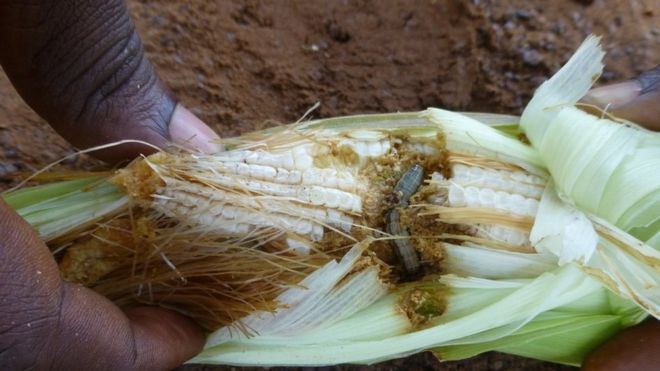
often outside the crop looks good, until you open the cob.


Gizmodo articcle on efforts to control the pest. They blame global warming of course.

As if the drought/rain cycle was due to global warming, not a normal event that has been going on for years.

Actually all they say is that the moth didn't spread quickly during the drought, but once the rain came and there was a lot of good crops to eat it spread.

Nature article on droughts in Africa:


Our data indicate that, over the past millennium, equatorial east Africa has alternated between contrasting climate conditions, with significantly drier climate than today during the 'Medieval Warm Period' (approx ad 1000–1270) and a relatively wet climate during the 'Little Ice Age' (approx ad 1270–1850) which was interrupted by three prolonged dry episodes.
We also find strong chronological links between the reconstructed history of natural long-term rainfall variation and the pre-colonial cultural history of east Africa4, highlighting the importance of a detailed knowledge of natural long-term rainfall fluctuations for sustainable socio-economic development.

Friday, December 03, 2010

Africa could feed the world


from the BBC, pointing out that if modern methods of crop growing and hybrid seeds were used, Africa could feed the world.

"...He (Professor Calestous Juma Harvard University) estimates that while food production has grown globally by 145% over the past 40 years, African food production has fallen by 10% since 1960, which he attributes to low investment.

While 70% of Africans may be engaged in farming, those who are undernourished on the continent has risen by 100 million to 250 million since 1990, he estimates.

The professor's blueprint calls for the expansion of basic infrastructure, including new road, irrigation and energy schemes...."


of course, the "Green" lobby so beloved in many NGO's will swallow their teeth over this part of his speech:

"Tree crops like breadfruit, which is from the Pacific, could be introduced in Africa because trees are more resistant to climate change."

He also envisages genetic modification playing a growing role in African agriculture, with GM cotton and GM maize, which are already being grown on the continent, just the start of things to come.

"You need to be able to breed new crops and adapt them to local conditions... and that is going to force more African countries to think about new genomics techniques."


oh well...maybe China will help them copy their own investment in GM foods LINK

Saturday, October 31, 2009

Food Crisis set to worsen

from SwRadioAfrica


The food crisis that is threatening to leave millions of Zimbabweans once again facing severe hunger in the coming months is set to worsen, as the country’s remaining commercial farmers continue to come under both physical and legal attack....

Commercials farmers themselves have warned that a failed farming season is on the cards, as a direct result of the state sponsored, ongoing efforts, to drive farmers from their land. Since the formation of the unity government in February there has been an intensified wave of attacks on commercial land owners, by thugs working for top ZANU PF loyalists, all in the name of land ‘reform’.... This year alone, at least 80 farms have been seized, more than 150 farmers have faced prosecution and over sixty thousand farm workers have lost their jobs.

CFU President Deon Theron explained this week that the culprits behind the illegal land seizures are from all walks of state-connected life, including government ministers or related families, army, police and CIO officers and senior businessmen.

Wednesday, April 01, 2009

Gold for bread


from March 2009...
------------------------------------

And guess who's birthday party? From AlJezeerah.28 Feb 2009

Zim prisons: Hell on Earth

from the UKTimes

A horrifying investigative film, shot undercover in Zimbabwe, has exposed how prisons under President Mugabe have become death camps for thousands of inmates who are deprived of food and medical care.

The documentary, shown last night on South Africa's state broadcaster SABC, documented the “living hell” for prisoners across 55 state institutions. The result, Hell Hole, was a grim account of a crisis in which dozens of inmates die each day.

Describing the conditions in two of the main prisons in the capital, Harare, in late 2008, a prison officer said: “We have gone the whole year in which - for prisoners and prison officers - the food is hand-to-mouth. They'll be lucky to get one meal. Sometimes they will sleep without. We have moving skeletons, moving graves. They're dying.”

Sunday, January 25, 2009

Zim slaughters elephants for Army meat

from the Sunday Nation Kenya:

Zimbabwe’s cash-strapped government has resorted to slaughtering elephants to feed thousands of hungry soldiers, sources told ZimOnline.

The state Parks and Wildlife Management Authority has since last week supplied elephant meat to army barracks across the country that have run out of food, our sources who are senior officers in the army, said....

Africa

Zimbabwe slaughters elephants for army

Share Bookmark Print Email
Email this article to a friend

Submit Cancel
Rating

A cholera patient drinks treated water at Budiriro Polyclinic in Harare January 22, 2009. Zimbabwe's cholera epidemic is spreading to rural areas because people with the preventable disease have quit heavily-infected urban centres for the countryside, an agency official said on Wednesday. PHOTO/ REUTERS

By ZimOnlinePosted Friday, January 23 2009 at 16:50

In Summary

  • The country is facing acute food crisis after poor harvests

However, analysts rule out the possibility of a military coup against Dr Mugabe – at least for now – because all top commanders are still relatively comfortable.

Thursday, November 20, 2008

Hungry in Zimbabwe

from MSNBC

At a school for villagers visited by The Associated Press, enrollment is down to four pupils from 20. The teachers still willing to work in this once thriving farming and mining district 160 miles northeast of Harare, the capital, say parents pay them in corn, cooking oil, goats or chickens. One trip by bus to the nearest bank to draw their government salaries costs more than teachers earn in a month.

Political paralysis
Meanwhile, the country is in political paralysis following disputed elections in March. A power-sharing deal signed two months ago has stalled over the allocation of ministries between Mugabe's party and opposition leader Morgan Tsvangirai's Movement for Democratic Change.

Shingirayi Chiyamite is a trader from Harare who brings household goods to the countryside to barter for crops. He says a 12-inch bar of laundry soap exchanges for 22 pounds of corn. He crisscrosses the land in search of the few villages that have corn to spare, hauls his purchases to the highway and hitchhikes back to the city. Some of the corn will feed his family, the rest he sells. He is constantly on the move....


ah yes, again we see the non judgemental "Disputed elections" and "power sharing deal has stalled"....

They haven't figured out all it takes is one sociopath to cause the problem...

Tuesday, May 20, 2008

Buying food in South Africa

The article from the ChristianScienceMonitor starts with Zimbabweans buying food to sell back home...and then mentions some in SA blame this for the increase in food prices.

But here in the Philippines, our food is going sky high too...and our president has given poor people cards to buy discount rice etc. and distributing cheaper rice via churches and schools...so why isn't South Africa doing this?

From the article:

You know it's bad when you have to go to another country to buy bread.

That's just what Bellarms and his brothers do every day, buying enough loaves of bread in the South African town of Musina to fill the back of his pickup truck and take it back across the border to his native Zimbabwe to sell for 200 million Zimbabwe dollars (roughly $1 US) a loaf.

"Eish, it's bad there," says Bellarms, who declines to give his full name because of possible reprisal from Zimbabwe police. "We come every day except Saturday, buying boxes of soap, cooking oil, the same commodities that you just can't find in Zimbabwe anymore. We just wait for God now. He knows that we face trouble here."

In a country where many farmers have stopped farming, where a chicken can cost a quarter of a teacher's monthly salary and bread half that – if you can even find it – hunger is a looming crisis that is sending increasing numbers of Zimbabweans out of the country for their mere survival.

The rising number of Zimbabweans in South Africa – estimated to be nearly 3 million – has created growing anxiety among the working-class South Africans who compete with them for jobs. This anxiety has recently turned to anger, as a wave of antiforeigner attacks in Johannesburg townships such as Alexandra and Diepsloot, and even downtown Johannesburg itself have killed 22 in the past few days, and left 217 others injured and nearly 6,000 homeless.

"If you listen to the reasons given by the people who have participated in the violence, you hear about how foreigners have taken their jobs, foreigners have taken their houses, foreigners are committing crimes, so you see there are socioeconomic concerns in the communities where the violence is taking place," says Prince Mashele, head of the crime and justice program at the Institute for Security Studies (ISS) in Tshwane, as Pretoria is now called.

The longer Zimbabwe's political crisis continues, the greater the economic hardship on the Zimbabwe people, and the more those people come to South Africa and other countries for relief....

Wednesday, June 06, 2007

We survive by the grace of God

......"This is how I've been surviving," she told me. "My daughters in South Africa send me groceries and 700 rand a month. If it had not been for them I would be dead by now."...

in Zimbabwe today who, with inflation running above 2,000 per cent, can only survive thanks to their family members who have fled Mugabe's rule to find a better life in South Africa, Botswana, Britain, and, of late, Dubai.

Celiwe's next-door neighbour is 55-year-old Memory Khuphe. Memory will also be pleased to see the car, because she knows that Celiwe will share a little of what she has with her. In modern Zimbabwe, beleaguered communities have spontaneously developed their own support systems for those who are desperate.,,,

Her son Mandla occasionally harvests wild berries in the bush, but they are not in season now. Bushmeat was once a source of protein, obtained from a nearby farm. But the farm has been taken over by so-called War Veterans, who have poached every animal on the place.

Europeans who contribute to charities providing food aid to Zimbabwe may wonder why Memory doesn't benefit from it. Sometimes she does.....

Memory's rare hand-out comes thanks to the Christian charity World Vision. It is rare because it is distributed by the Zimbabwe government. And Memory and Celiwe's village is in Gwanda, in Matabeleland South - ...

Mugabe loathes and fears the Matabeleland people.

So he ensures that the food aid trucks make few trips in their direction. And people like Memory suffer the consequences of his hatred...
 
Free hit counters
Free hit counters