------------
in contrast to this, a discussion of how Women in Rwanda helped rebuild their country:
Saturday, March 03, 2018

Tuesday, February 20, 2018
blood cobalt
StategyPage discusses the chronic civil war (and refugees and starvation and disease caused by the chaos of the war) in Central Africa, partly tribal and partly because President Kabila refuses to leave. The bishops devised a peaceplan there, but were ignored, so it appears it will continue.
The MSM ignores it (just another civil war, folks, just move on)..
But how many in the MSM will cover this: President Kabila plans to tax mining companies taking out cobalt (and copper).
and then there is the corruption angle:
so what does this have to do with Zimbabwe?
well, there will be a need to find cobalt elsewhere:
Well there is a lot of rare minerals in Zimbabwe too, and the mining companies see the new president as business friendly.
-----------------------
WSJ laments China's race to get rare earth metals including cobalt

The MSM ignores it (just another civil war, folks, just move on)..
But how many in the MSM will cover this: President Kabila plans to tax mining companies taking out cobalt (and copper).
So what, you might say? Well this is why:
February 10, 2018: Congo confirmed it intends to raise taxes on minerals as well as raise the royalty rate mining companies must pay the government. Parliament approved legislation to raise mining taxes as part of a new "mining code." ... Most of the mining companies affected are European, North American and Chinese. Cobalt will become more expensive and so will copper. Why? In 2016 the world produced an estimated 123,000 tons of cobalt and 57 percent came from Congo. ..
Cobalt has many uses, but it is critical in the production of rechargeable lithium-ion batteries, the type used to power mobile digital devices and electric vehicles...and who is buying all that cobalt?
China has been a major buyer of Congolese cobalt so that increase will hit Chinese manufacturers particularly hard. In the first nine months of 2017 China imported an estimated $1.2 billion worth of Congolese cobalt.
and then there is the corruption angle:
..Gecamines, the stare owned mining company, plays a key role in mismanagement and "diverting" mining revenues. Gecamines officials are beholden to the Kabila government. (Austin Bay)------------------
so what does this have to do with Zimbabwe?
well, there will be a need to find cobalt elsewhere:
The foremost risk, and perhaps the most challenging to solve, is geopolitical. Sixty-two percent of the world’s cobalt comes from the Democratic Republic of Congo, and combined with production from Zambia, Madagascar, South Africa and Zimbabwe, the five countries mine more than 71 percent of the world’s cobalt. Companies process ore locally and export more than 90 percent of the total to China for further processing and refining to produce commercial cobalt compounds used in batteries.------------
This exclusive trade between African countries and China exposes the market to Chinese regulatory volatility and export restrictions, a recent example being that of the rare earths market, which saw extreme shortages after the Chinese enacted export restriction in 2010. Since then, countries and private industries have had to resort to alternate sources and materials, and stockpiling.
Well there is a lot of rare minerals in Zimbabwe too, and the mining companies see the new president as business friendly.
Mnangagwa, Zimbabwe’s former spy chief, became president in November with military backing and has offered to hold elections by July.more here:
His administration abolished rules that mining operations must be at least 51% owned by black Zimbabweans for all minerals other than platinum and diamonds.
Zimbabwe is geologically rich, with deposits of gold, chrome, lithium, coal, diamonds, platinum and iron ore.
Mine development stalled under Mugabe, whose policies led to a collapse in the economy and hyperinflation.
‘Zim could become hub of battery mineral revolution’
With Zimbabwe sitting on a lucrative mineral treasure trove and angling to attract foreign direct investment (FDI), Australian listed firm, Prospect Resources, is on course to spending an estimated US$55 million on a new lithium plant in the southern African country. Zimbabwe Independent business reporter Tinashe Kairiza (TK) spoke to Prospect Resources executive director Paul Chimbodza (PC, pictured) on how attractive Zimbabwe is as an investment destination and how the lithium plant will add impetus to government’s efforts to grow the economy
-----------------------
WSJ laments China's race to get rare earth metals including cobalt
e companies dominate the cobalt supply chain that begins at mines in Congo

Miners pushing their cobalt-laden bicycles through a mine near Kolwezi, Congo, last June. They often sell to Chinese wholesalers. PHOTO:DIANA ZEYNEB ALHINDAWI FOR THE WALL STREET JOURNAL
KOLWEZI, Democratic Republic of Congo—Miners push bicycles piled high with bags of a grayish-blue ore along a dusty road to a makeshift market. There, they line up at wholesalers with nicknames such as Crazy Jack and Boss Lee.
Most of the buyers are Chinese. Those buyers then sell to Chinese companies that ship the bags, filled with cobalt, to China for processing into rechargeable, lithium-ion batteries that power laptops and smartphones and electric cars.
There is a world-wide race to lock up the supply chain for cobalt, which will likely be in even greater demand as electric-car production rises. So far, China is way ahead.
Chinese imports of cobalt from Congo, the world’s biggest producer of cobalt, totaled $1.2 billion in the first nine months of 2017, compared with just $3.2 million by India, the second-largest importer, government data show.
“We’re realizing that the Congo is to [electric vehicles] what Saudi Arabia is to the internal combustion engine,” says Trent Mell, chief executive of exploration company First CobaltCorp. , based in Toronto. Chinese firms are keenly aware of Congo’s importance to electric vehicles, he says, and “trying to control the whole ecosystem…from cobalt mining to battery production.”
From Congo to China
Saturday, February 17, 2018
Morgan Tsvangirai
Morgan Tsvangirai has died.
AlJ has this article on the man and his work:
BBC article.
what's new for the MDC ...
AlJ has this article on the man and his work:
It's a dark moment for Zimbabwe. Iconic opposition leader and former Prime Minister Morgan Tsvangirai has died after a two-year battle against colon cancer. His death will remain as one of the rare moments that has united Zimbabwean politicians from across the political divide. His loyal supporters are inconsolable at the loss of their icon, but perhaps the greatest tribute is that those from the ruling elite, who have opposed and ridiculed him as a politician, have shown him respect.
Tsvangirai has, without doubt, been one of the greatest and most influential political figures in Zimbabwean history. He has always fought for the underdog, starting his activism as a trade unionist while working in a nickel mine.
BBC article.
what's new for the MDC ...
The death of Morgan Tsvangirai, Zimbabwe's totemic opposition leader, has left supporters in mourning - and his party having to navigate a precarious leadership transition ahead of landmark presidential elections. In Tsvangirai's place, the Movement for Democratic Change (MDC) installed on Thursday Nelson Chamisa as its acting president for 12 months.
Friday, February 16, 2018
Family News
Good news: The lesion was benign, so the Dermatologist did a simple cautery and removal, and I don't need the specialized surgery.
While in Manila we checked out replacement tablets, but the new ones are still beyond my budget so I bought instead an ASUS convertible tablet. Older design and slower but larger, which is good for my eyes to read ebooks. A newer version of the convertible that my granddaughter had in the past (and lost when her car got caught in a flash flood from a typhoon five years ago).
we also ate hamburger and taco salad at Chilis. I saw the steak but passed... no I couldn't finish the hamburger either, but we cut it in half and shared. Since it was Chano's birthday we sang him Happy birthday, and the staff, hearing this, asked if it was, and then brought him a free ice cream and sang happy birthday to him.
the Mall had wonderful stuff to window shop. But somehow designer Italian furniture and decor doesn't go with our house, which is basic Filipino with rattan. Never mind. It does remind me that there is another world out there. This was in Makati, the business area of Manila and quite upbeat.
The meal cost more than we pay our cook for a week: at least her "official salary", which doesn't include if she can buy cheaper food and pocket the difference, or the money I pay for her grandchildren's school fees, and medicine as needed for her family.
If I ate like that every day I'd feel guilty, but it's only twice a year. Usually hamburger is cheaper: The 2 for 25 pesos (50cents) at the palanke or at McDonald for 100 pesos (2 dollars).
But it does give one a pause about the gap between rich and poor here: essentially two economies, the rich, which cost about the same as in the USA for goods, and the poor, which is cheap: subsidized rice, limited fruits and veggies, and shoddy housing.
but since I moved here, things have improved: Few rich in our town but lots of people like us who are "middle class", so we now have more upscale shops and malls.
And the tricycle drivers and maid now have cellphones, and of course access to used TV's and radios.
The middle class tends to be excessive in buying stuff, probably because like the 1950's in the US, they remember when they were poor and couldn't afford anything.
Wednesday, February 14, 2018
StrategyPage links on Africa
I usually find this site is good at analyzing stuff going on in countries where I have worked or lived.
Recent essays on African wars include:
Sudan Stumbling along
Congo Bloody Borderlands
mostly sad news on wars, but does note that Volkswagon is setting up a factory in Ruanda.
Somalia
the good news is that Zimbabwe is not on their list of warzones.
black superheroes? We haz that
Well, we had lots of Tarzan/Phanthom/She type white heroes ruling in over black populations, often using advanced tech to do it. So I guess I shouldn't worry that the Panther is using high tech,
( probably bought from China who is trying to get dibs on all the African rare minerals).
but I had to laugh at the modern pushup bras worn by the lovely ladies in the dances.
And I wonder: is the Panther Bantu, Nilotic (like Papa Obama) or Masai?
supposedly he united five tribes, but the name of the country suggests a Bantu origin.
but with all the Nollywood talent out there, why are the set designers etc seem to have western names? (African-Americans are considered Americans in Africa, because the culture is different).
then I ran into this:
The design of the movie’s setting—the fictional African nation of Wakanda—mostly comes from production designer Hannah Beachler (Moonlight, Beyoncé’s Lemonade) and costume designer Ruth Carter (Amistad, Selma). “The challenge was imagining how something futuristic looks in Africa,”
Beachler says. “What would Africans have done given reign over their own culture, without having been colonized?
Uh, presumably she never heard of Ethiopia?
The cultures of Cush and Ethiopia go back 5000 years, with links to Egypt and the Middle East. Memnon was at Troy, for example. Ancient Egypt, and although traditional Egyptians were mixed race, the pharoahs got their bowmen from there, and they had pyramids, and their own script (one of the "undeciphered scripts alas). They almost took over Egypt during the Hyksos era, and later did take over Egypt. Black Pharohs? yup. The latest kerfuffle is if Nefertiti was Black: Probably not, but since her husband Ahkenatan's mom came from a "military" family, she might have been From Cush. (And Ahkenatan was the dad of King Tut).
One more comment:, the "advanced civilization" seems to be very European/tech oriented, as in Silicon Valley. Fancy trains and super powers.
Uh, what about sewers, midwives, medicine for high blood pressure, insecticides? African culture places emphasis on family ties and cooperation and care for their sick and elderly. Did the producers put any of this into their "advanced" civilization, or is "advanced" defined as techology and power?
yes I know: it's the Marvel Universe. So give them a break.
as for superheroes: Yes Nollywood has done that.
but I probably won't see the movie until it hits HBO, and even then I may pass. I am not into the superhero genre: the last one I saw was Wonderwoman because my granddaughter wanted to see it and I was "duh".
Never mind.
The real super heroes in Africa:
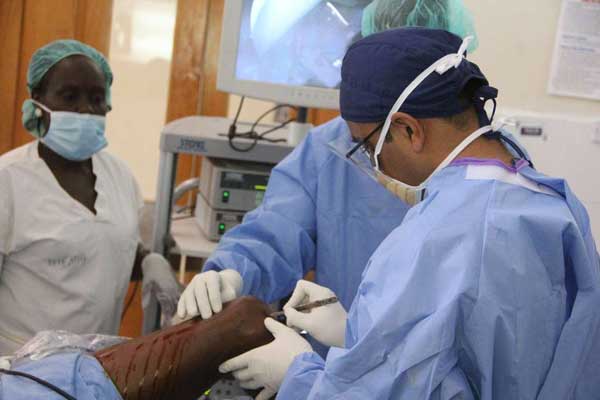 |
| Dr Vadgama Harsh, a consultant orthopaedic surgeon, operates on a patient at Moi Teaching and Referral Hospital in Eldoret on April 10, 2017.. PHOTO | JARED NYATAYA | NATION MEDIA GROUP |
Wednesday, January 24, 2018
faming and family problems
cross posted from my main blog.
A report on trying to stop slash and burn traditional methods of farming in Central America.
part is the need for land by the hungry, but I know in Africa, the problem was that usually the farm fields got lower yields with time, so they were left fallow for the cattle and goats, while the village moved to better land, burned it off, and then planted new fields.
With the increase in population, of course, the land got over used and ended up a desert. This was especially true when corn was grown.
The answer? Fertilizer.
this guy is pushing fonio: a Sahel crop....but no answer on what is the yield? I don't know much about the Sahel, but there are a lot of different ways to try to get things growing there... the problem is that many of the tribes are goat and cattle raising types, and they have a long history of destroying the crops of the local farmers so they can graze their cattle. StrategyPage report on this in Nigeria, about the casualties of this traditional range war, complicated by the fact that the herders are Muslim and the farmers are traditional or Christian...
Our people in Zimbabwe grew sorghum and other crops that grew better with drought, as a back up if there wasn't enough rain for corn. But the yield was lower... and there are other traditional African crops of course.
I should note that in smaller gardens the women grew peanuts and ground nuts as natural fertilizer, and also grew squash, between the corn plants. And could use the crops for their own use. But because plowing required an ox, the men usually plowed the larger fields which supplied most of the family's food.
Of course, nowadays, men in Africa have long been encouraged to migrate to cities or work in mines, disrupting the family, since they live in dormitories, and the wives are left behind to care for the family's land, which is owned by the tribe, not by the family: if no one is left home to tend the land, it is taken from them to give to someone else. Also since there is no social security, the men need the family to keep the land so they can retire back to their villages.
Am I the only one who notices how modern society destroys family life by separating families?
On the other hand, as the saying goes: How do you keep them down on the farm after they see Paree? Who wants to slave hoeing in the fields 12 hours a day when you can work 8 hours in a factory and go home and watch TV or drink and sing kareoke with your friends at the local bar?
Here in the Philippines, ten percent of our people work overseas, and often the kids are raised by extended family.
But even in China, the kids are left behind in rural areas when the parents work in the city, because government rules limit who can live in the cities...Wikip
Tuesday, January 23, 2018
Central Africa: war and progress
StrategyPage on the Congo: bloody borderlands.
Aid organizations estimate that 13 million people in Congo require some type of humanitarian assistance, primarily food and medical aid. A third of the 13 million are IDPs (internally displaced people)..
lots of depressing information about the wars and conflicts etc. in that area of the world.
and then goes on to point out corruption in Angola:
Meanwhile, in Angola, the new government's crackdown on corruption continues -- and at times it looks like an attack on the old regime. President Joao Lourenco has replaced Isabel Dos Santos as head of the national oil company, Sonangol. She is the daughter of former president Jose Eduardo Dos Santos. She is very rich with an estimated worth of $2.5 billion. Dos Santos was president of 38 years.
Again, people are urged to give money to charities to help people, but who is condemning the corruption that steals the wealth from the people?
However, not all the news is bad: Volkswagon plans a factory to make cars in Rwanda.
Volkswagen confirmed that in the second quarter of 2018 it will begin manufacturing cars in Rwanda. The first Rwanda-made vehicles may be available by late May. The manufacturing deal has been in the works since December 2016. According to senior management, Volkswagen chose Rwanda as a manufacturing site because the country has political stability, does not tolerate corruption, has a growth rate of almost seven percent a year and "a young and tech savvy population."
Yes, Rwanda of the major genocides, but which since then has tried to make peace among factions by promoting... forgiveness.
AlJ article on "peace clubs".
Friday, January 19, 2018
Also from the Zimbabwe Mail:
President Emmerson Mnangagwa says his country is open for business and that all foreign investment is safe, with investors able to repatriate profits.
Mnangagwa was speaking at a meeting with business leaders on Thursday ahead of his maiden trip to the World Economic Forum in Davos next week. He is under pressure from civic society, investors and opposition parties to implement political and economic reforms.
“I am aware that most of our business require injection of new capital from foreign investors and I want to reiterate that all investments will be safe and secure in Zimbabwe. Foreign investors will be able to repatriate profits from their all investments in our country and all Bilateral Investment Promotion and Protection agreements (BIPPA) will be honoured,” he said.
“Come and invest in our country.We are open for business.(For) those who want to do business, Zimbabwe is one destination you can do business comfortably. That is the message that we are taking to Davos.”
Roy Bennett RIP
Zimbabwe civil rights activist Roy Bennett has died in a helicopter crash (in Canada).
In 2006 he became the treasurer general for the mainstream faction of the MDC‚ led by Morgan Tsvangirai. He was also a spokesman in South Africa and made regular interviews on behalf of the MDC.
He returned to Zimbabwe in 2009‚ and Tsvangirai wanted him as deputy agriculture minister – but former President Robert Mugabe refused to swear him in.
He was later rearrested for treason‚ but then released. Afterwards‚ he left Zimbabwe for South Africa and never returned.
Tuesday, December 26, 2017
Cobalt mining in the DRC: the dirty little secret behind electric cars
All the American yuppies pride themselves that they will soon be forced to drive electric cars, which are "non polluting".
Well, ignore those local electric plants, of course.
But as AlJ points out: To make the batteries, you need cobalt, and Cobalt mining is destroying the local environment in the DRC.
Well, ignore those local electric plants, of course.
But as AlJ points out: To make the batteries, you need cobalt, and Cobalt mining is destroying the local environment in the DRC.
Cobalt is one of the key ingredients added in electric batteries, and more than half of it is currently mined in the Democratic Republic of Congo. Amnesty says children as young as seven work in dangerous conditions in Congo cobalt mines.
"At the present time, you'd have to say that there isn't a lot of regulation around the mining of cobalt," says Gavin Wendt, the founding director and senior resource analyst at Australia-based Minelife. "A lot of the cobalt that's mined is generated from illegally operated mines that employ almost slave labour: underaged workers, illiterate workers, workers that don't get paid very much ... They're controlled by warlords, and the industry is appallingly run."
Christmas in Africa
I have a Madonna and child that was carved at the Serima Mission school. If you look at Mary, you say: She is a Karanga: she has the facial features of the Karanga clan of the Mashona.
Alas, I don't have a photo of the statue, which I gave to my brother for safe keeping.
There is an article about the Serima school here: some of the students went on to be professional artists.
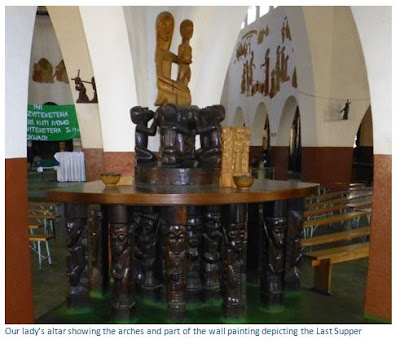

of course, the locals disliked the primitive art, and the educated , at least, preferred the more sophisticated stuff of the west: hopefully, as in music, they will combine both traditions as their culture evolves into today's world.
Even 40 years ago, many of our nurses came from urban middle class families who owned stores etc. One of our sisters wrote her PhD thesis on how the family structure and personal interactions were changing with education: I found a copy at a university in the US after I returned, and found it interesting, because she described what I actually saw in the changing society.
This was even more true when I went back to urban Liberia, where few had ties with their villages.
In other words, 90 percent of what Americans (or South Americans or Asians) think about Africa is nonsense, although the CNN reports in their "on Africa" segments are fairly good.
I mean, even my friend in Rural Zimbabwe has had a cellphone for years, and when she was teaching had access to their high school's computer.
-------------------
------------------------------
too often the west sees Africa via their own eyes, but now there is an active Nollywood to show African stories. Yes, in English because it is the "lingua franca" for Nigeria.
lots of "Nollywood" films on youtube, by the way.
Hopefully, Zimbabwe will have their diaspora return and get their film industry going again.
cross posted to my regular blog.
Alas, I don't have a photo of the statue, which I gave to my brother for safe keeping.
There is an article about the Serima school here: some of the students went on to be professional artists.

and here is a picture from the Zimbabwe National Gallery by an unknown artist: titled: Come let us adore him. Note the three kings at the left side.

of course, the locals disliked the primitive art, and the educated , at least, preferred the more sophisticated stuff of the west: hopefully, as in music, they will combine both traditions as their culture evolves into today's world.
Even 40 years ago, many of our nurses came from urban middle class families who owned stores etc. One of our sisters wrote her PhD thesis on how the family structure and personal interactions were changing with education: I found a copy at a university in the US after I returned, and found it interesting, because she described what I actually saw in the changing society.
This was even more true when I went back to urban Liberia, where few had ties with their villages.
In other words, 90 percent of what Americans (or South Americans or Asians) think about Africa is nonsense, although the CNN reports in their "on Africa" segments are fairly good.
I mean, even my friend in Rural Zimbabwe has had a cellphone for years, and when she was teaching had access to their high school's computer.
-------------------
------------------------------
too often the west sees Africa via their own eyes, but now there is an active Nollywood to show African stories. Yes, in English because it is the "lingua franca" for Nigeria.
lots of "Nollywood" films on youtube, by the way.
Hopefully, Zimbabwe will have their diaspora return and get their film industry going again.
cross posted to my regular blog.
Saturday, December 23, 2017
Good news of the year
Africans are getting fat.
and that doesn't even include the problem of high blood pressure from "western" foods that have a lot of salt in them.
why do I say this is "good news"? because the alternative is starvation, poverty, and dying of TB or other infections.
In Zambia, 12.4% of women and 3.6% of men are obese — still below the average for the continent and nowhere close to the U.S. rates of roughly 36% for each gender. But obesity rates here have grown rapidly enough over the last several years to have become a deep concern for national health officials. “It’s a very big issue,” said Chitalu Chilufya, the minister of health. “It is a challenge that needs to be nipped in the bud now or else it will grow out of hand.” With expanding waistlines has come a rise in health issues. Diabetes, barely heard of here not long ago, now affects around 4.1% of Zambians, according to the International Diabetes Federation. “We’re losing a lot of people due to strokes and heart attacks because of obesity,” the health minister said.
and that doesn't even include the problem of high blood pressure from "western" foods that have a lot of salt in them.
why do I say this is "good news"? because the alternative is starvation, poverty, and dying of TB or other infections.
Thursday, December 21, 2017
Update on Central Africa
Mugabe no longer runs Zimbabwe, and I have been away from that country for enough years I don't have inside information anymore.
But I will continue to update various things.
Today's update is about the Congo's civil war.an update from StrategyPage
Sigh.
This does have a "Mugabe" link however, since Mugabe sent his troops there as "peacekeepers" many years ago (since then they have left).
LINK:
read both articles if you have an interest in civil war, civil rights, refugees, or "blood diamonds".
But I will continue to update various things.
Today's update is about the Congo's civil war.an update from StrategyPage
December 18, 2017: As 2017 ends Congo faces the same problem it faced in 2016: President Joseph Kabila illegally remaining in office. The December Accord of December 31, 2016 (also called the Saint Sylvester agreement) was supposed to create a peaceful political path for Kabila's exit. Congo's Catholic bishops mediated the negotiations that led to the December Accord. New elections were to be held in 2017 -- that was stipulated. Kabila would leave office after the elections and civil war would be avoided. Despite the February 2017 death of opposition leader Etienne Tshisekedi, the Congolese opposition coalition Rassemblement continued to demand elections in December 2017 and stage occasional national strikes. UN officials in Congo and the Catholic Church supported the coalition's demand for new elections. However, no national elections are occurring in December 2017.
Sigh.
This does have a "Mugabe" link however, since Mugabe sent his troops there as "peacekeepers" many years ago (since then they have left).
LINK:
How Mugabe double-crossed Joseph Kabila & the DRC Way before Marange, Mugabe and his military men had already started rampant racketeering, illegal mafia-style smuggling, double-crossing, double dealing, as well as illegal arms peddling with Congolese rebels. In fact, Mugabe double-crossed Kabila by selling arms to the rebels in exchange for diamonds used to enrich, not Zimbabwe, but Mugabe and his security men."
read both articles if you have an interest in civil war, civil rights, refugees, or "blood diamonds".
Tuesday, December 19, 2017
Saturday, December 16, 2017
Tuesday, November 28, 2017
Arrests for corruption?
Zimbabwe's former minister of finance and economic development has been denied bail in his corruption trial....Ignatius Chombo, an ally of ousted Zimbabwean leader Robert Mugabe, is being held "in the interests of his safety" and to prevent any interference with state witnesses, a magistrate's court said on Monday evening.
then there is this:
Shortly before his arrest on the weekend, Chipanga, a close associate of former First Lady Grace Mugabe, was confronted by protesters who shouted threats at him for his pro-Mugabe stance.
He faces charges of fraud and slander for his criticism of the head of the Zimbabwe Defence Forces, General Constantino Chiwenga.
The charges carry a potential 20-year prison sentence.
Chiwenga had cautioned the then president against carrying out a series of purges within his ruling ZANU-PF regime, shortly before the military action that led to Mugabe's resignation.
Yes, Africans, they actually mean you
The New Yorker (magazine) has an article on an "anti natalist".
and he lists a lot of the frustrations of first world, affluent materialistic yuppies as the reason behind his screed:
so why put this in my Africa blog?
Because Benatar was born in South Africa in 1966. He is the head of the philosophy department at the University of Cape Town, where he also directs the university’s Bioethics Centre, which was founded by his father, Solomon Benatar, a global-health expert.
and his father was indeed a big shot at that school in the good old days, and involved in global public health policy.
according to the magazine, the guy is an atheist.
yes, without God you are an isolated individual.
The only reason I don't call the guy a Nazi for pushing nazi ideas is because Solomon and David are ethnically Jewish names.
But are they "Jewish/jewish" or part of the anti religion Jewish types who became rabid socialists/communists and gave conspiracy types ammunition for their own anti semitism?
With God, you are part of a family, and everything that happens works for the good.
and the NewYorker writer, who also has a Jewish name, made sure they passed the monument to the Irish who died in the potato famine... they read a few of the quotes from there, but that didn't get much of a rise from the good professor.
Why no: The professor probably would see the monument as proof why his philosophy (don't have kids: they'll only be miserable) is true, whereas most Irish Americans (and Jews and American Blacks) would see the monument and say: No, it is a warning to philosophers that ideas have consequences.
Because the reason the Irish died is because too many Brits believed in Malthus: that the poor overbred and helping them stay alive only meant more poor people, so don't help them.
so they died: Of starvation, of disease, in "coffin ships" fleeing that land, etc.
and like a lot of Yanks, we remember our heritage.
I checked the author of the magazine article, and he has a Jewish name. They also suffered from bad ideas (the holocaust was based on social Darwinism and Eugenics ideas of the early 20th century):
the population bomb hysteria is not new: if you read Eugenics history, the breeders they disliked back then tended to be the Irish in England, and the Jewish/Irish/Italian and Eastern European immigrants and blacks in the USA). And of course Jews and Gypsies and Slavs in Germany. Especially Jews.
but now, of course, the population control freaks are aiming at Africa.
In other words, not a new idea, but repackaged for affluent types.
Nothing new of course: When I worked in Zimbabwe, every village had a "pill lady" but no safe water or WHO Rehydration fluid until we supplied the money for these things.
And China's one child policy was from Ehrlich's population bomb ideas.
And here in the Philippines, the US pressured us to supply free contraceptives to all women (but one third of our women deliver with untrained birth attendents, one reason for the high mortality.. and even when midwives are "free" they ask for gifts: pre eclampsia is dangerous here, but few get prenatal care. Sigh).
and even the Vatican let a lot of these death promoting population types into their latest conferences.
But the, the joke "is the Pope Catholic?" is, alas, no longer joke.
headsup AnneAlthouse
David Benatar may be the world’s most pessimistic philosopher. An “anti-natalist,” he believes that life is so bad, so painful, that human beings should stop having children for reasons of compassion. “While good people go to great lengths to spare their children from suffering, few of them seem to notice that the one (and only) guaranteed way to prevent all the suffering of their children is not to bring those children into existence in the first place,” he writes, in a 2006 book called “Better Never to Have Been: The Harm of Coming Into Existence.” In Benatar’s view, reproducing is intrinsically cruel and irresponsible—not just because a horrible fate can befall anyone, but because life itself is “permeated by badness.” In part for this reason, he thinks that the world would be a better place if sentient life disappeared altogether....
and he lists a lot of the frustrations of first world, affluent materialistic yuppies as the reason behind his screed:
He provides an escalating list of woes, designed to prove that even the lives of happy people are worse than they think. We’re almost always hungry or thirsty, he writes; when we’re not, we must go to the bathroom. We often experience “thermal discomfort”—we are too hot or too cold—or are tired and unable to nap. We suffer from itches, allergies, and colds, menstrual pains or hot flashes. Life is a procession of “frustrations and irritations”—waiting in traffic, standing in line, filling out forms. Forced to work, we often find our jobs exhausting; even “those who enjoy their work may have professional aspirations that remain unfulfilled.” Many lonely people remain single, while those who marry fight and divorce. “People want to be, look, and feel younger, and yet they age relentlessly”: They have high hopes for their children and these are often thwarted when, for example, the children prove to be a disappointment in some way or other. When those close to us suffer, we suffer at the sight of it. When they die, we are bereft.
so why put this in my Africa blog?
Because Benatar was born in South Africa in 1966. He is the head of the philosophy department at the University of Cape Town, where he also directs the university’s Bioethics Centre, which was founded by his father, Solomon Benatar, a global-health expert.
and his father was indeed a big shot at that school in the good old days, and involved in global public health policy.
according to the magazine, the guy is an atheist.
yes, without God you are an isolated individual.
The only reason I don't call the guy a Nazi for pushing nazi ideas is because Solomon and David are ethnically Jewish names.
But are they "Jewish/jewish" or part of the anti religion Jewish types who became rabid socialists/communists and gave conspiracy types ammunition for their own anti semitism?
With God, you are part of a family, and everything that happens works for the good.
and the NewYorker writer, who also has a Jewish name, made sure they passed the monument to the Irish who died in the potato famine... they read a few of the quotes from there, but that didn't get much of a rise from the good professor.
Why no: The professor probably would see the monument as proof why his philosophy (don't have kids: they'll only be miserable) is true, whereas most Irish Americans (and Jews and American Blacks) would see the monument and say: No, it is a warning to philosophers that ideas have consequences.
Because the reason the Irish died is because too many Brits believed in Malthus: that the poor overbred and helping them stay alive only meant more poor people, so don't help them.
so they died: Of starvation, of disease, in "coffin ships" fleeing that land, etc.
and like a lot of Yanks, we remember our heritage.
I checked the author of the magazine article, and he has a Jewish name. They also suffered from bad ideas (the holocaust was based on social Darwinism and Eugenics ideas of the early 20th century):
the population bomb hysteria is not new: if you read Eugenics history, the breeders they disliked back then tended to be the Irish in England, and the Jewish/Irish/Italian and Eastern European immigrants and blacks in the USA). And of course Jews and Gypsies and Slavs in Germany. Especially Jews.
but now, of course, the population control freaks are aiming at Africa.
In other words, not a new idea, but repackaged for affluent types.
Nothing new of course: When I worked in Zimbabwe, every village had a "pill lady" but no safe water or WHO Rehydration fluid until we supplied the money for these things.
And China's one child policy was from Ehrlich's population bomb ideas.
And here in the Philippines, the US pressured us to supply free contraceptives to all women (but one third of our women deliver with untrained birth attendents, one reason for the high mortality.. and even when midwives are "free" they ask for gifts: pre eclampsia is dangerous here, but few get prenatal care. Sigh).
and even the Vatican let a lot of these death promoting population types into their latest conferences.
But the, the joke "is the Pope Catholic?" is, alas, no longer joke.
headsup AnneAlthouse
Wednesday, November 22, 2017
Mugabe: asylum? Money?
South Africa will face a lot of opposition if they allow him asylum.
the big question no one is asking: who gets the money?
UKGuardian lists his wealth.
and move over Imelda Marcos:
Ghana is thinking about it though.
Maimane said allowing Mugabe into South Africa on political asylum would be in contravention of the Refugees Act.
Maimane pointed out that the act excludes individuals from asylum if they had committed a crime against peace, a war crime or a crime against humanity, among others. "Mugabe has, like many other leaders on the continent, turned from liberator to dictator, with human rights abuses and crimes against peace being committed under his watch," said Maimane. "As such, he ought to be denied refugee status as per the law," Maimane said. "As long as Mugabe would not face torture or death penalty in Zimbabwe, the South African government must exclude him from asylum."
the big question no one is asking: who gets the money?
UKGuardian lists his wealth.
According to some estimates, Robert Mugabe has about £1bn-worth of assets, much of it invested outside Zimbabwe.
2001 US diplomatic cable, later released by the whistle-blowing organisation WikiLeaks, quoted this figure, and said that while reliable information was difficult to find, there were rumours that his assets “include everything from secret accounts in Switzerland, the Channel Islands and the Bahamas to castles in Scotland”.
Grace Mugabe is said to have bought a number of properties in the affluent Sandton suburb of Johannesburg and there are reported to have been property purchases in Malaysia, Singapore and possibly Dubai.
and move over Imelda Marcos:
The first lady is reported to have the sort of designer shoe collection that might be expected of a dictator’s wife and, notoriously, is said to have spent $75,000 (£56,000) on luxury goods on a single shopping spree in Paris.
Mugabe resigns!
BBC reports Mugabe, under threat of impeachment, has resigned.
The ruling Zanu-PF party says former vice-president Emmerson Mnangagwa will succeed Mr Mugabe, in power since 1980.
Mr Mnangagwa's sacking earlier this month triggered a political crisis.
It had been seen by many as an attempt to clear the way for Grace Mugabe to succeed her husband as leader and riled the military leadership, who stepped in and put Mr Mugabe under house arrest.
After the resignation announcement, lawmakers roared in jubilation.
Subscribe to:
Posts (Atom)