Sunday, July 27, 2014

ngo's

StrategyPage has a long article on NGO's.

The red cross is the "oldest" NGO, but they note:

 Actually, the Catholic Church could be considered one of the first major NGOs, as it organized large scale charity efforts over a thousand years ago.
 ah but the problem?

 Several decades ago, the main thing these outsiders brought with them was food and medical care. The people on the receiving end were pretty desperate, and grateful for the help. But NGOs have branched out into development and social programs.
These new activities caused unexpected problems with the local leadership. Development programs disrupt the existing economic, and political, relations. This is especially the case if the NGOs try to change the way things are done. The local leaders are often not happy with this, as the NGOs are not always willing to work closely with the existing power structure. While the local worthies may be exploitative, and even corrupt, they are local, and they do know more about popular attitudes and ideals than the foreigners
so although one sees a lot of criticism of churches that push religion with aid, a lot of NGO's push western ideas with aid instead.

. NGOs are no longer seen as just charitable foreigners come to help. The local leadership often sees the NGOs as a potential threat. While the material aid the NGOs bring is appreciated, the different ideas are not. And there are more NGOs showing up with more agenda than physical aid

Pushing birth control as part of the agenda is a big thing: I had to laugh when the flooding in Manila left many taking shelter in schools, and the UN came and gave out condoms...the locals were insulted, because it implied our women were sex crazed and couldn't refrain themselves. Then the UN defended this by saying it was because of rape, which locals got even more upset, since it implied Filipino men were sexually crazed rapists.

of course, if the aid is given to local politicians etc. a lot of it ends up in their pockets.

Yet paying huge salaries to western aid workers increases the overhead cost too.

 Often more than a third of it disappears into the pockets of government officials, their kin and friends. But letting the donors, and NGOs (Non-governmental organizations, like the Red Cross), handle the money also sees about the same portion lost. (italics mine)

This is because these donations often come with requirements that much of the money be spent on goods and services from the donor nation. This particularly bothers the locals as it means a lot of highly (especially by local standards) paid Western aid workers are supervising whatever is done in in the aid receiving nation. The higher NGO pay standards are very visible because the Westerners tend to live much better than locals.

StrategyPage is observing, not criticizing. Without the NGO's and church charities, the place would be worse, especially in times of disaster.

Crossposted from my main blog

Saturday, July 12, 2014

Africa update

Mugabe is throwing out the last of his "white" farmers.
Well, they stole the land fair and square so expect them to yelp.

But the rest of the Africa headlines are furthur north, where the war on terror is brewing a religious war (actually a war between the farmers and those who herd cattle).

And now, Ebola.

Saturday, May 24, 2014

Nigerian troubles

a good story on locals vs the terrorists  from the WAPOST


In fact, residents said a riot did break out briefly between young Muslims and Christians near the market after the blasts, but community leaders quickly helped police contain it and the tension subsided. “There will always be youths who drink or take drugs and act out, but I think we have reached a level of understanding among the leaders,” Begu said. “They know that Boko Haram is not made up of local Muslims.”
On Wednesday, as rescue workers and survivors picked through the rubble of more than 200 destroyed shops, a pall of horror and grief lingered in the smoke-
tainted air. Muslim-owned carpet stalls lay in ruins next to Christian-owned appliance shops. Hajjia Aisha’s snack stand was a charred shell; so was the Father X-Mass shoe shop next door.
Gabriel Ucheodum, 32, pointed to blackened yams and oranges in front of his electronics shop where a pair of elderly women had been selling produce when the bombs exploded. The first woman’s head and legs were blown off in front of him, he said shakily. The second woman was torn in half.
“I can barely believe God let me live,” Ucheodum said. “I saw such horrible things and I lost so many neighbors. Some were Christians like me, some were Muslims, but none of them deserved to die like this.”
Nearby, Muslim trader Alhajj Harun, 55, fingered his prayer beads and peered into the blackened shops. He said he had lived through some of the area’s ugliest sectarian clashes and then helped work to overcome them. He proudly mentioned that he had been to Jerusalem as well as Mecca and that he had three daughters in college or in professional jobs.
“There were problems between us, but everyone has worked hard to manage them, and things have been calming down,” Harun said. “None of us want to have our religion and our country blamed for these terrible things. If these barbarians want to divide us, let them die trying.”
© The Washington Post Company

Monday, May 12, 2014

ANC wins election inSouth Africa

One party state: what could go wrong?

Al Jezeerah link here.

Boko harum

The elites in the US just noticed them, and the Islamophobes are upset that the press there doesn't dare say they are radical Islamicists.

Uh, yes, and like other radicals wanting to impose Islam from the 8thcentury, they kill "moderate" Muslims, not just Christians... and the prophet would disown them too.

and they are so bad that even AlQaeda has disowned them.

Full background at StrategyPage includes this snippet:

Nigeria uses Britain as a model for its military, as Britain was the former colonial power in the region and helped establish the Nigerian military half a century ago. But the corruption that is endemic to the region eventually had its way with the armed forces. Leadership and training have suffered. But U.S. training teams (to improve peacekeeping and counter-terror skills) have been in Nigeria during the last decade, and report that the armed forces are not completely demoralized and debilitated by the corruption, and with some intense training, and elimination of the most corrupt officers, combat capabilities would be much improved.

Friday, April 25, 2014

A new tool to fight the tsetse fly


After 10 years of effort, a team led by scientists at Yale has finally decoded the genes of the tsetse fly, a bloodsucking scourge of Africa. With that knowledge, they hope to find new ways to repel or kill the insects, whose bite transmits sleeping sickness, a parasitic disease that, like rabies, drives its victims mad before they lapse into a coma and die. The flies also carry nagana, which weakens or kills cattle and renders whole regions of Africa inhospitable to most livestock.

it is a major cause of disease, but the real benefit would be to open large amounts of land so that it can be farmed.

Get rid of the tsetse fly and bring in irrigation, and Africa could feed the world. which is why China is buying up farmland and investing in Africa.


Tsetsefly collars for cattle? this Xinhua news story of a European funded initiative to stop cattle deaths:

Since time immemorial livestock farmers in most parts of Kenya have been forced to lighting fires to smoke away tsetse flies every day.
The well to do farmers have been using drugs (trypanocides) to help repel the flies away from the grazing fields and within the homesteads.
Because of this circumstance, the farmers have been forced to graze their livestock late in the morning hence completely avoiding early and late evening grazing everyday when tsetse flies, a routine that is hard to keep given that livestock especially cattle feed a lot.
But in a bid to help farmers solved this menace, the International Center for Insect Physiology and Ecology (ICIPE) has developed a repellent collar that is tied around the animal's neck and in the process repels tsetse flies.
"The repellents have been identified from odors of animals avoided by tsetse, like the waterbuck, a big antelope species that is common in tsetse-infested areas of eastern Africa but which is rarely fed on by the flies," the Principal Investigator of the project Dr. Rajinder Saini said.
He noted that these repellent collars slowly dispense the chemicals in them, thereby protecting the animals and their herders from the flies.
Saini observed that the disease levels in protected cattle had been reduced by more than 90 percent and that repellent collars performed better than traditional traps that had been used by the institution in areas such as Lambwe Valley in Homa bay County.
and that story notes why this is important


These flies carry the trypanosome parasites that cause human African trypanosomosis, commonly called sleeping sickness, and the livestock disease nagana.
The problem of tsetse and trypanosomosis thus lies at the heart of Africa's struggle against poverty.
About 60 million people are at risk of getting sleeping sickness in Africa and more than 300,000 are infected yearly, of whom 95 percent do not receive any treatment because of the remoteness of the affected areas.
Trypanosomosis currently causes annual losses of some 1.5 billion US dollars and over the long run has had the effect of limiting Africa's agricultural income to some 4.5 billion dollars a year below its potential level.
About 3 million cattle die annually due to the disease. The flies are one of the main reasons why 80 percent of the continent's land is still tilled by hand due to the absence of draught-power.
Few livestock also implies less availability of manure that could be used as organic fertilizer, consequently leading to lower yields of crop and fodder plants.
Almost more than any other disease affecting people and livestock, trypanosomosis thus straddles the ground between human health, livestock health and agricultural production, and thus rural development.

radiation has also been used to control the fly. from the VOA


After the sterilization, a plane spreads thousands of non-productive tsetse flies every Wednesday in various parts of Ethiopia, especially along riverbed breeding grounds. So far, more than a million laboratory flies have been released. Now sterilized flies outnumber fertile flies, eight to one.

Sacrificing children to get ahead.

BBC article on child sacrifice 


sigh. When I worked in Liberia, newspapers reported about two mangled bodies were found and one teenager managed to run away and talk to the press.

When HIV started hitting the elites, many went to these shamans (not witch doctors: witch doctors DIAGNOSE witchcraft...those who do things like this are witches).

headsup TurtleBay and beyond blogspot, who note that Americans and Europeans have no problem sacrificing children so they can succeed...the difference being, of course, that Americans and Europeans sacrifice their own children before birth.

Saturday, April 05, 2014

Central African Republic

It's not a "religious" war unless it is pay back for previous atrocities.

From StrategyPage

Most of the mayhem is in the largely Christian south and especially in and around the capital, where most of the Moslems are in the south. This all began when the capital was captured by Moslem rebels in early 2013. That was followed by rebels engaging in extensive looting and other crimes. Most of their victims were Christians. This included some deliberate attacks on churches. That resulted in Christians forming militias to fight the rebels. In the last year over 2,000 people have died, most of them in the last six months. Now the Moslems remaining in the south are arming themselves and fighting back at Christian civilians. This caused the number of refugees in and around the capital to go from 20,000 to over 200,000 in March.
The Christian militia are also angry because the peacekeepers failed to curb rebel violence against Christians last year. The general chaos of the last few months has caused over a million people (a quarter of the CAR population) to flee their homes

Friday, February 28, 2014

Punishing the poor to force Africa to be PC

From the (gov't run) Zim Herald:

An article about Uganda passing an "anti gay bill"

In a speech after signing the law, President Museveni warned Western nations not to meddle in the east African nation’s affairs — and that he was not afraid of aid being cut.
Some donors were quick to punish Kampala by freezing or redirecting aid money, while Sweden’s Finance Minister Anders Borg, who visited the country on Tuesday, said the law “presents an economic risk for Uganda”.
The Netherlands froze a seven-million-euro subsidy to Uganda’s legal system, while Denmark and Norway said they would redirect around six million euros each towards private sector initiatives, aid agencies and rights organisations.


expect those "rights" organizations to push to change the law.

But Opondo said Uganda’s government was not worried.
“Western ‘aid’ to Africa is lucrative and (a) profitable trade, they cannot cut off completely,” Opondo said.
“Slave trade, slavery, colonialism, imperialism, and exploitation, Africa must stand up to Western domination.”

expect China to fill in the gap.

This 2010 article from Xinhua new agency says China is the second largest invester there.

This 2009 article from the ChinaInAfrica website notes how China is active in the Ugandan economy.

Another field to benefit from Chinese interest is agriculture. China has evolved the best technique of growing rice to yield bumper crops, and has passed on this technique to Uganda as well. The first rice-farming project has been in Kibimba in eastern Uganda spread over 1721 acres of land.
China is interested in the oil deposits recently discovered in Uganda. As of now Uganda exports leather goods to China, along with timber, agricultural products, cotton, copper and fish. The total trade between the two countries amounted to $247 million in the year 2008. However, this includes Chinese exports amounting to $230 million, and Uganda has the remaining share of $17 million. The present division is extremely lopsided, and this is not perceived as advantageous to Uganda. Chinese goods have also replaced the domestic products since they are so much cheaper.

so all the "greens" who work with aid agencies are pushing organic and natural ways of growing traditional methods, while China is actually changing their agricultural infrastructure.

And Chinese shops are all over, replacing the previously owned shops run by immigrants from India and their children that were widepspread in colonial days.

This is bad and good: cheap goods can make local manufacturing wither (as we see here in the Philippines), and the ability of Chinese immigrants to money (in the past, via family links these shops essentially took over the small business shops in SEAsia) mean they crowd out locals trying to run such businesses. (cultural problem too: A kid brought up by business oriented parents will be more likely to succeed, and as I noted in colonial times, the opportunities for locals were limited due to the Indian shops...no, this is not "racist", since in places like the Philippines, where only locals could own land or businesses, the merchants quickly intermarried, which is wny many of our families who run the place are part Chinese).

This article discusses the resentment against this neocolonial push:

from the WATimes (Right wing US paper):

KAMPALA, October 3, 2012 - Chinese, the renowned ‘investors’ in Africa have shifted positions, turning to small retail trade in massive numbers.  This is especially true in Uganda’s capital Kampala, where they are suffocating the local traders who are calling for government intervention through regulation of trade to foreigners.
Taking advantage of favorable terms of trade and reduced costs of imports, Chinese traders who are widely present in Kampala’s arcades sharply cut prices for their products, undercutting the prices charged by local traders.
The loathed Chinese cheaply import from their home country to the detriment of Ugandan traders who import the same products at much higher prices from China.  The local sellers lament that the practice is completely unfair, and that they need government support to even the playing field.
Ugandan traders bitterly complain that they are on the verge of losing their businesses, thanks to price slashing by their Chinese competitors.  In July, the traders staged a demonstration against the increasing Chinese suffocation, calling for the government to intervene before local traders are forced from business.

 the Monitor (Uganda) discusses this from a local viewpoint, published Feb7 2014:


“China gives aid without political ties. African leaders don’t want to be dictated upon. That is why they like China not the Western countries which insist on democracy and social freedom,” Prof Makara said at a workshop organised by Makerere University department of Journalism and Communication, Bergen, Norway and Chr Michelsen Institute with support from the Norwegian Embassy in Kampala.
“Over dependence on China exploitation of natural resources is unsustainable in the long term. Taking minerals and oil to China doesn’t create jobs in Africa and Uganda in particular. They are Chinese who benefit. They are exporting our minerals to China. If they are exported and they are over, will they still need us? Sustainable development may not be realised in the long term.”

also on that paper: There is an anti obscenity law and the police have had to save women from roaming mobs undressing women  to punish them for wearing miniskirts.
This is happening in Iganga which is a city in the SE area of Uganda.
According to Wikipedia, that is an area with a large Muslim population.

the Iganga District in eastern Uganda has the highest percentage of Muslims. The rest of the country has a mix of religious affiliations.[107


and although the US activists point to "fundamentalists" for being behind the "anti Gay" law, the population doesn't have a large percentage of them. Again, from Wikipedia:

Religion in Uganda[2]
Religion

percent
Christianity
  
84%
Islam
  
12%
Other or None
  
4%

Church in Entebbe
According to the census of 2002, Christians made up about 84% of Uganda's population.[106] The Roman Catholic Church has the largest number of adherents (41.9%), followed by the Anglican Church of Uganda (35.9%). Evangelical and Pentecostal churches claim the rest of the Christian population. There's a growing number of Presbyterian denominations like the Presbyterian Church in Uganda, the Reformed Presbyterian Church in Uganda and the Evangelical Free Church in Uganda with hundreds of affiliating congregations. The next most reported religion of Uganda is Islam, with Muslims representing 12% of the population.[106]

 and, as the local paper the Monitor points out: While you were being distracted, lots of other scandals are going on.

mainly economic problems but this one caught my eye:


* We heard that about Shs40 billion of your taxes and mine given to the Presidential Initiative on Bananas is missing. This was always going to be an exercise in modern-day alchemy; what large global market is out there for banana flour? Why not spend it on coffee or tourism?

 Two items in this snippet:

One: Notice the money gone missing? One of the biggest problems in Africa and Asia (including the Philippines and China) is graft and corruption.

Two: the "initiative" is "modern day alchemy" because the local scientists are using gentic modification to try to save a threatened banana plague.

ALL bananas have a narrow genetic spectrum, and could easily be wiped out, resulting in a famine resembling the Irish Potato famine.

The UKGuardian, which is a left wing paper that usually pushes the green agenda, has a nice article on that here.

In recent years a devastating bacterial disease has swept across Uganda and, to a lesser extent, neighbouring countries, causing annual banana crop losses to the region of more than $500m (£310m). The rapid spread of banana Xanthomonas wilt, or BXW, which destroys the entire plant and contaminates the soil, "has endangered the livelihoods of millions of farmers who rely on banana for staple food and income", according to an article in the journal Molecular Plant Pathology last year.
With no resistant varieties or chemical cures available, growers such as Kamenya have been forced to destroy large sections of their plantations. For smaller farmers the damage has been so severe many have given up on the fruit.
But local scientists have not. On a sprawling campus outside Kampala, Wilberforce Tushemereirwe and his colleagues at the National Banana Research Programme have been on a quest to defeat the disease by building a better banana. This has involved adding to the fruit a sweet pepper gene that has already improved disease resistance in several vegetables.
There are plenty of human rights problems in Uganda, but essentially the law is popular because of the perception that gays are predators.

Like other rural areas, often kids go to boarding schools, which have a bad reputation for letting kids be abused, be they the "fagging" in the UK public school system, the abuse of Canadian Aborigenes that got a lot of publicity there (not as much in the US, since most of the schools were Anglican etc). This article discusses the abuse of missionary's kids at African boarding schools (presumably for the elites.) And yes, I know a missionary whose son was abused this way in South America at a Christian boarding school

Christianity today has an article here.

this is of white kids in Christian boarding schools for the elites.

Are we supposed to think that black kids weren't abused?

The reason I think there is a big story here is:

One: Homosexual rape was probably common in pre colonial times, but we have no documentation except for the case of the Uganda martyrs, whose major "sin" was refusing to be abused by the king and his court.

Two: Many British families sent their problem sons to Africa in colonial times. The sexual shennanigans of the colonists was notorious in the more chaste Bantu neighbors, who have taboos on who you can and cannot sleep with. (I have no information on the Nilotic or Masai tribes, except to note that the high rate of infertility in Masai women was from STD related PID, which is why in the good old days they kidnapped and/or married the women from other tribes).

Three: It is a hierarchical society, where you obey your superior. This includes your teacher, your relatives, and of course your employer. So if your employer "hits" on you, you say "Yes"...and although this is more common with women (which is why tribes only allowed "houseboys", I know of cases where the boys were used sexually by their employers).

Four: by taking men from their villages and making zoning laws that didn't encourage women to accompany them (and tribal laws that meant you lost your land if your wife didn't work it for you), you encouraged not only family breakup but homosexuality in the huge worker's dormatories.

Five: There have been wars and revolutions in Central Africa including Uganda.Female rape has resulted in a lot of reporting, but male on male rape is also being done, mainly as a way of punishment.
Time magazine report here. 
NYTimes article here. 
UKGuardian report here.

and few of these rapes are reported, because of the stigma.

Six: Sex tourism. All sorts of sex tourism, because of all those lovely beaches. If you google, you will find articles on western women seeking love from local men while on vacation (reminds me of the film "Shirley Valentine"). But it also includes the nasty problem of enticing poor children into a risky life of prostitution. Western liberatarian see this as a free choice, but hunger sort of obscures the free choice part.

from ask.com:

If you are gay or lesbian and wish to travel to Africa it is wise to do a little research before you plan your trip. Homosexuality is illegal in almost every African country (bar South Africa) and is considered a criminal offense in several top tourist destinations like Egypt, Morocco and Kenya. 

and the BBC in 2010  asked for comments on pedophilia in Africa: read the comments and weep.
most of this is about girls, but the boys are at risk too.

A lot of this depends on when you decide it's pedophilia or if you count sex with teenagers over whom you have power. That too can result in great rage by the boy but often he keeps quiet from shame.


Monday, December 09, 2013

Why Mandela was a great man


 from the Diplomad:


He seemed to have an understanding that whites and other non-blacks were essential for a peaceful and prosperous South Africa. He also, surprise, did not go full Mugabe. He won election--although the vote counting was suspicious--served his term, trying to unite blacks, whites, Asians, and others into accepting the new post-apartheid South Africa. He did not try to drive the whites out, and did not go around confiscating farms and businesses. He did not encourage revenge against whites and sought a reconciliation of the races. A practical politician, he turned a blind eye to the rampant corruption among the ANC, finding it better to let the party members expend their revolutionary fervor making money. At the end of his term, he stepped down. Yes, he stepped down. That is an amazing thing in Africa; he stepped down on completing his term of office.

Thursday, September 05, 2013

China in Africa

The ChristianScience Monitor, whose overseas reporting on the background of the news is usually excellent, has a long article on China in Africa.

Congo is increasingly influenced by the penetration of all things Chinese, and that in turn is bringing high hopes for development.
But it is also raising wariness here that Africa's new benefactor may sometimes be driven by the same self-interested motives as the Western nations that preceded it in the colonial and postcolonial periods.
Like most Chinese here, Wei lives a separate life, socializing exclusively with his Chinese co-workers except for an occasional foray down the street to buy groceries and exchange pleasantries with a Congolese street vendor.
Yet to the Congolese, the Chinese have increasingly become a necessary part of everyday life. To buy a cellphone, people go to Chinese electronics shops that offer knock-off Blackberry models at a third of the market price. When people want to enjoy a soccer game, they take a seat in the bleachers at Kinshasa's "Martyrs Stadium," a gift from China in 1993. A drive through downtown Kinshasa runs along a grand central boulevard, newly widened and repaved by a Chinese construction company.

read the whole thing

Tuesday, August 06, 2013

Zimbabwe article

In First Things magazine, an article on the history of Zimbabwe under Mugabe

But why, with many articulate opposition leaders, do they use a photo of a white Zimbabwean? And stress the evil deeds of Mugabe (such as the slaughter of the Ndebele opposition in the 1980's) without mentioning that the Ndebele are traditional warriors, and could have started a civil war for his opponent?

Did this small genocide prevent a much larger genocidal civil war?

As for European farm seizures: a bad move economically, but the hysteria by the UK was ridiculous. This did not require sanctions that ruined the economy. I mean, Nixon didn't put sanctions on the Philippines when our land was seized and "sold" to our tenant farms (who were given years to pay us for the land, and never did).

As for the opposition: They seem to have shot themselves in the foot too many times.

Yet the punishment of the democratic opposition (beatings, arrests, destruction of Hatfield and other suburbs where too many voted for the opposition), the economic collapse, the fleeing of the educated class can mostly be put at the foot of Mugabe.

Wednesday, June 26, 2013

China in Africa

A long article in StrategyPage discusses how China's investments in Africa might fail:

the problems?


Instead of hiring locals, they import their own workers, who live in segregated compounds.


Support of hated dictators (and folks will remember this long after they forgot what the development projects helped: The USA is learning this over and over again in the Middle East).

But mainly Chinese racism against Africans.

Neocolonialism, anyone?

The Chinese were mainly after raw materials, especially oil. A lot of that $13 billion was bribes for local officials. As usual, the average African was getting screwed by these deals. For example, a lot of the investment was for infrastructure (roads, bridges, structures), and a lot of those deals stipulated the use of Chinese labor for most of the work. There was never any intention of employing many Africans. The Chinese pay such low wages that they could afford to fly in Chinese for many jobs. China is also flooding African markets with inexpensive goods. Both of these tactics are hurting local businesses, and causing unrest among African business owners and workers. As a result, it's become common for opposition parties in Africa to accuse China of "neo-colonial exploitation." The accusation fits, and the Chinese will pay for it down the road, as will peacekeepers brought in to help clean up the mess.
Chinese merchants have been doing this to SE Asia for a couple hundred years: And even as late as World War II, their kids were called "Chinoys", and there is an Asian hospital in Manila that was started to treat them.

Of course, here in the Philippines, the rule is that foreigners are not allowed to own land or businesses, so usually the Chinese married Filipinas from rich families and put the businesses in their names (local custom allows women to run businesses). So most of the elite who run the country have Chinese ancestry (you can identify them by their paler complexion and round faces).

This intermarriage is not being done in Africa, so makes the Chinese more vulnerable to being ousted, similar to Idi Amin's deporting the many Indian merchants who ran the country, or Indonesia's ethnic cleansing of their Chinese community years ago under the guise of fighting a communist takeover.

As for Chinese exports: here in the Philippines, the exports have ruined a lot of local industries because of the Chinese low wages and their artificially low currancy. The good news is that they are cheap. The bad news is that they are poor quality. For example, our American plumbing fixtures bought 20 years ago still are okay but the ones we had installed in the new area of the house have deteriorated in two years, so we had to replace them from the hardware store in the mall (and have to hope that they are not counterfeit). Ditto for shoes, clothing, and (alas) drugs. Counterfeit and sub standard drugs (originating in China and India) kill hundreds of thousands every year, including Africa,  but when the US "green" types discuss the need to replace the expensive US/European brand names with "generics" for the HIV and other aid programs, this fact tends to be ignored.

Elections

I am lax in posting to this blog about Mr.Mugabe mainly because I no longer ave the time or energy or contacts to know if what I read in the papers is accurate enough to post.

so I will limit my links to articles from places I trust, mainly about the development in Africa.

As for Zimbabwe, my last contact there now has a cellphone and internet access from the high school where she teaches, so things seem to be improving.

Saturday, June 08, 2013

China in Africa

from StrategyPage:


These unreported economic problems (because the chinese overreport their economic success) are one reason over a million Chinese have headed for Africa. But that place has not always been the land of opportunity. For example, Ghana recently cracked down on illegal gold mining and among the many people arrested were 134 Chinese. This was not unexpected as the Chinese are displacing Arabs as the main facilitators of illegal activities (mining, logging, poaching, smuggling, and so on) in Africa.

Sunday, June 02, 2013

Male rape and gay laws

Instapundit cluelessly suggests Obama pressure Africa to stop passing laws against Homosexuality.

Which only proves he lives in an equal society, where gay sex is assumed to be consensual between equals.

Yet in Africa (and to a lesser extent, here in the Philippines) we have a hierarchical society, where inferiors are supposed to obey superiors.
And, with tribal conflicts, rape, including homosexual rape, is a weapon of war:

So what about nowadays?

From AlJazeerah: a report on male rape in tribal conflicts.
The use of rape as a weapon against women in Congo's many conflicts has been widely reported. However, the number of male victims is also suspected to be high. Most cases remain unknown because men, like women, are often too ashamed to come forward and talk about their ordeal.

From IRIN
CAPE TOWN, 13 October 2011 (IRIN) - Sexual violence against men, including rape, is under-reported, poorly addressed and has a severe impact on both men and their families, according to a presentation at the annual Sexual Violence and Research Initiative (SVRI), held in Cape Town, South Africa...
Male rape is here often associated with homosexuality, which in Uganda is condemned and stigmatised. Men also choose not to speak out for fear of being branded homosexuals, and victims cannot get proper support because they are accused of being gay.


Yet this is the tip of the iceburg.


So sleeping with the maids in the third world is "normal" (which is why most of our maids insist we hire them in pairs, for a chaparone), and if your employer is "gay" and you are an attractive  male, well, watch your back... literally....And then there are the boarding schools and high schools, where teachers prey on their student (including pressuring girls or boys to become prostitutes).


However don't point fingers:

One of the unreported story of Africa is the sexual outlet of the "white bwanas". The Dominican sisters entered Rhodesia to nurse the first settlers. They soon were setting up schools, not just for the white students, but for the "coloured" children who quickly appeared. When the whites objected, sister said sarcastically that they were "their" children (and hinted she'd name names) so they'd better provide money...

Yet another unreported story of colonialism is that many of the white settlers (at least in British colonies) were exiled there because of their behavior: They were "gay". And of course, in Africa, your employees don't dare say no to a superior.

And gay abuse predates colonialism, as the story of the Uganda martyrs shows.

Yet colonial policies imposed taxes for money on village people, so essentially forced men to work to pay taxes, and colonial policies hired men without making accomadations for their families. Under Apartheid, where pass books were needed, this was even enforced by law.

Then you have the problem of old age: No social security, so an aging man would have to support himself or be supported by his family on his land. But in African custom, the land is owned by the tribe, so this meant you had to leave your wife at home to care for the land or the land would be given to another, meaning you would have no way to support yourself when you returned if she went with you. And although polygamy was legal, few men were rich enough to buy more than one wife.

So where did the men get sexual release? Prostitutes cost money...

Despite all the American talk of "cross cultural understanding", few medical studies of the problem seem to realize that Africans or Asians might not think the same as upper middle class white educated Americans.

Western investigations of gay identity such as this one from Princeton see the problem via western white culture.

This report also discusses MSM in South Africa but ignores the elephant in the living room: The fact that men are pressured by the system to leave their families behind while they go to work in the cities.

Teenaged boys who have sex with each other may not be gay, but merely not have access to girls: ditto for factory workers or those whose wives are at home in the villages caring for the family land. And in rural areas, if a tribe has taboos against vaginal intercourse with a pregnant or nursing wife, one would expect some MSM to be going on to relieve sexual tension (yet without putting that into context you are again missing the problem)

Then there is the problem of street children. When I adopted, we were told to assume if we adopted an older girl we should assume that they had been abused, and we were warned that many of our boys had also been abused.

One report said the MSM abuse rate was 25% among street kids in Addis Ababa

which, by the way, is the same rate as reported among inner city kids in the USA.
(in contrast, a broader survey shows that only 5% of teens admit sex below age 13, but 20 plus percent of gay kids...this does not include rape or sex under threats of violence, 10%).

What is going on in Africa is that with modernization (and the fruits of colonialism) you see a break down in tribal rules. You get chaos and all sorts of immoral behavior (not just sex but monetary corruption and violence) that were limited by tribal laws and customs in the past, but now have few ways for the community to protect itself from predators and sociopaths.

These countries however do have an alternative: religion.

Christianity, which for years was seen as an outside influence, is now indigenous (including many indigneous Christian churches). Even the hated "boko Haram" of Nigeria, seeking Sharia law, is more about stopping the epidemic of Nigerian corruption/bribery than about Islam per se.

The mosques and churches teach strict religious rules, and use shame to enforce them.

The breakdown of the family, a lot of which can be laid at the foot of an oppressive colonialist system that destroyed tribal ties and customs, is a major problem, and the churches are trying to solve it by preaching strict behavioral rules that encourage marriage between equals.

 So the "anti gay" laws are part of a spectrum of laws trying to redevelop and heal the culture from the chaos and immorality inherited from colonial times.

And outsiders who see this as a "gay rights" problem are missing the point. It's not about two equals chosing to marry each other, even though they are the same sex. It's about trying to reestablish morality on many levels.

Westerners who assume  it is about sex between equals are merely making things worse, because the average African sees this an merely another western plot against Africa.

And the revulsion against gays is visceral,

You see sex between equals, so whenwhen you say "don't make homosexual actions illegal", you are saying: "Let those born gay be able to have sex with one another as equals without punishing them".
But Africans interpret it differently: They hear: Let men rape our boys and get away with it.

Given the sex tourism with boys we see here in the Philippines, one could suggest they may have a point.


Saturday, May 25, 2013

Zimbabwe's new constitution

From aljazeerah.

VIDEO
Approved overwhelmingly in a referendum in March this year, the constitution clips the powers of the president, limits presidential tenures to two five-year terms and does away with the post of prime minister.

However, it does not apply retroactively so the 89-year-old Mugabe could technically extend his three decades in office by another 10 years.
"This day is an historic day, it's about the future,"  Eric Matinenga, the Constitutional Affairs Minister said at the signing ceremony.

"I can assure you that this document which is before us is a good document."

A new constitution is one of the pre-conditions for elections to pick a successor to the shaky compromise government Mugabe formed four years ago with  Tsvangirai.

Monday, May 06, 2013

Kony update

Strategypage reports he is hiding out in the disputed area between Sudan and South Sudan.


April 27, 2013: New reports claim that LRA commander Joseph Kony is hiding out in the Kafia Kingi region of Sudan. Kafia Kingi is a territory claimed by both Sudan and South Sudan. The enclave is (from South Sudan’s perspective) at the very western edge of South Sudan’s Western Bahr al-Ghazal state. Sudan currently occupies the enclave. Human rights organizations and the Ugandan government have frequently claimed that Sudanese military has provided the LRA with weapons, equipment, and money. The new reports (based on statements made by LRA defectors) claim that the Sudanese Army has given Kony safe haven. Kony may have used Kafia Kingi as a hideout in 2010. There are reports that he returned to the area briefly in 2011 and 2012.

Friday, April 05, 2013

speaking English

From the African Executive:

The fact that we still shun that which is clearly local and homegrown is a manifestation of the low regard we have for ourselves and one another.  We prefer to use firms with English sounding names rather than vernacular ones and we associate Western or “white” tastes and ideas with superior quality. In what other country would a Shona-speaking mother and a Shona-speaking father produce an English-speaking child? Where does this low self image come from?  Is it a result of being disappointed one too many times by some of our own? Is it a product of our early experiences which inform our foundational beliefs about ourselves?
Yes, it is a problem here in the Philippines too. Which is why Filipino ("tagalog") is the official langauge.

But if you speak English, it opens you to the world of ideas (and jobs in other countries where you can live in comfort and send money home to support the family). In grade schools, local books will be available, but if you want to get more information, you need English.

This is similar to Latin in  the Middle Ages: it was the language of scholarship that enabled educated men to talk to each other.

The polyglot of western Europe started with Dante, and was accelerated with the Protestant revolt against the Catholic church, when Protestants decided to translate their version of the bible into the venacular for ordinary folks to read (and alas interpret wrongly due to lack of scholarship, but that's another argument altogether).

I don't think wanting to learn English is the problem. The real problem is that local goods tend to be shoddy, mainly due to corruption. I am aghast at how things here in the Philippines stop working quickly, because they are made locally, or more commonly, in China . So a Filipino can work in a Korean factory and make high quality goods, but here the same item is poor quality, and everyone knows it.

My husband even refused to buy a cheaper European make car (BMW) that was made in the Philippines, even though the Germans kept an eye on the place for quality control.

Prefering "european" (or here, Korean or Japanese or American) goods may not be from low self esteem, but because they usually are better.


Tuesday, March 26, 2013

Africa to pass the Middle East in prosperity?

TPMBarnett's blog keeps an eye on globalization, and in an article about the Middle East he includes this comment:

 The Arab world has an enormous amount of catching up to do WRT globalization, and it will be awful in execution (and with Africa leaping ahead on many fronts, the Middle East and North Africa - or large portions of it - risk becoming globalization's long-term basket case).

he has several other African and South African analyses on his blog, many about North Africa's war on terror, but in this article about cellphones, he has this comment:

Biggest analytic mistake I've ever made was overestimating how slowly (yes, my original post had me mis-stating this) Africa would embrace globalization and succeed with it.  Totally blew it.

Police seizing radios in Zim

also from the BBC:


She and two other villagers were made to identify their neighbours who had radios, capable of picking up FM, AM and shortwave signals, which had recently been handed out by a small non-government youth organisation that had been in the area building a road and some community toilets.
"They took my cell phones and demanded to know the identity of people in my phone," she said, explaining how bedrooms and kitchens were thoroughly inspected.
"A lot of people were taken to the police station and we were warned that those that would be found with the radios [in future] will disappear."
The confiscations have left some people fearing that in the run-up to elections, the free media guarantees in the newly approved constitution will not be respected.


Eu suspends sanctions against most Zim officials

BBC article HERE.

Monday, March 18, 2013

Guess who got arrested?

From AlJazeerah: Zimbabwe police arrest PM's aides Top lawyer and four officials from prime minister Tsvangirai's party detained, a day after constitutional referendum.

Saturday, March 16, 2013

Pushing drugs on Africans

From the African Executive:
Musician Chris Brown from the US got lots of money to give a concert, and praised smoking marijuana to the youth there.
As part of Ghana’s Independence celebration, Chris Brown who was billed to entertain the Ghanaian youth, took the entire nation by surprise as the American artist was rather busy smoking “wee” live on stage to the admiration of the security services and the crowd, mostly children below 16 years of age. Meanwhile the act of smoking marijuana in Ghana is a serious crime punishable by severe prison sentence. This is because marijuana has destroyed the lives of many of the youth, a challenge which has prompted the government of Ghana to declare a war on drugs.
The “Hope City Concert” was meant to be a once-in-a-life-time concert, an event specially designed to mark Ghana's Independence Day: a day which Ghanaians ought to have observed in honour of their forefathers who shed their blood in the struggle to rescue the motherland from a brutal and barbaric British colonial rule.

Thursday, February 14, 2013

Wednesday, January 23, 2013

Rinderpest

CIC is a list of trivia at Strategypage and includes this:
Rinderpest, an ancient animal virus that swept across sub-Saharan Africa in the late nineteenth century, devastating cattle, and thus facilitating European imperial expansion in many areas, was accidentally introduced to that continent in 1887, when infected cattle from India were landed at Massua in Eritrea to feed Italian troops on colonial service.
Of course, the reason for this was that, by decimating the wild beasts that allowed the tsetse fly to live, it allowed European cattle to thrive and allowed people to live without the worry of sleeping sickeness.

Wooden "bikes"

LA times article on wooden bikes used in Goma, not to carry people but to carry loads.

Except for termites, muddy roads, and wasting people's energy that could better be used for something else, what's wrong with this picture?

Sunday, January 20, 2013

Killing of the disabled in Ghana


also from AlJazeerah:


Thousands of children have been killed in Ghana because the communities they are born into believe they are evil spirits. When I first heard about this I could not believe it was happening in my country in the 21st century. The practice originally emerged as a way for poor families to deal with deformed or disabled children that they cannot look after. These families approach village elders known as concoction men and inform them that they suspect their child to be a so-called spirit child. The concoction man then takes the father of the child to visit a soothsayer who confirms whether or not the child is truly evil, without ever actually laying eyes on them.
Once this confirmation has been received, the concoction man brews a poisonous liquid from local roots and herbs and force-feeds it to the child, almost always resulting in death.
Over time, this practice has become a perceived solution to any problems a family might be having at the time of a child's birth. By blaming the child for sickness in the family, or the father's inability to find work or provide money to support his dependents, these communities have found an otherworldly explanation for their problems.
In this highly patriarchal society it enables heads of family to pass the blame for their struggles onto someone else. And by branding the child a spirit from outside the family, they can disassociate themselves and feel justified in murdering their own offspring, while telling those around them that now all will be well - the evil presence is gone.
But infanticide has always been a crime against humanity. I believe there is plenty of evidence of infanticide in the history of all human societies and its continued and widespread practice makes a mockery of the democratic credentials of the countries, including mine, where this crime still takes place.


---------------

In Zimbabwe, in years long past, often both twins were killed by the grandmother because twins were seen as diabolic or demon possessed. There was a cultural reason for this: An illness where someone got thinner and thinner and died was believed to be demon inspired, and even when we ran the hospital, our nutrition village (to feed up malnourished kids) was full of twins that couldn't get enough nutrition from mother's milk.

However, before you point fingers at primitive Africans, remember that children with Down's sydrome are often killed as late term abortions (when they are already viable) in the USA...the ever so humane Dutch kill kids with meningomyelocoel that could live with surgery, and of course the prominent Bioethicist at Princeton University proposes infanticide to be legalized for any reasons.

Zimbabwe leaders agree to a constitution

From Aljazeerah:

The new basic law would bolster the power of parliament, set a 10-year presidential term limit, and strip away presidential immunity.
"The finalisation of the draft is now being made," said Mugabe. He did not say when a referendum will be held.
The process of drafting the new constitution, which started more than two years ago, was plagued by chronic delays and violence at public meetings.
Tsvangirai's Movement for Democratic Change party has already endorsed the text.

Thursday, January 17, 2013

Guns in Africa


But there is actually a gun problem in the world, which is when criminal gangs get hold of guns.

StrategyPage has an article about a lot of AK47's in Africa used by gangs etc to kill people.


The cheap AK-47s resulted in traditional crimes, like stealing cattle or land, turning into bloody battles. The violence has caused millions to flee their homes and wrecked local government in many areas. Sending in additional police and soldiers, when available, quiets things down somewhat. But the local guys with the guns know where to hide and the government reinforcements usually don't. So, eventually, the police will leave and the AK-47s will still be there....

and anarchy/displacement can kill a lot more people than actual bullets:
The disruptive effect of all these guns has halted, or reversed, decades of progress in treating endemic diseases. Death rates from disease and malnutrition are going up. All because of several million Cold War surplus AK-47s getting dumped in Africa in the 1990s.


It gets worse. Read the whole thing.

Wednesday, January 16, 2013

Monday, January 07, 2013

Tutsi and Hutu and history

StrategyPage article on the history of tribalism in the central area of Afria.

The problem here is that the Tutsi are, by most measures, the good guys. There are only about 2.5 million Tutsi (in Rwanda, Burundi, Congo and Uganda) and they represent a distinct culture in the region. The Tutsi are more disciplined, better educated, wealthier and less corrupt. The Tutsi also dominate local governments, if only because they are better administrators and, when armed and organized, more effective fighters. Most other ethnic groups in the area are jealous, hostile or just afraid of the Tutsi.
The Tutsi problem goes back over 600 years. In the 1500's the Tutsi (plural- Watutsi) nomads moved south from their ancient home in the semi-desert Sahel. With a different complexion (an important point for the Tutsi) and a foot taller than the local Hutu, it did not take long for the Tutsi to take over and install their own brand of Apartheid. The area eventually evolved into two Tutsi ruled empires, each roughly covering the territory of modern Burundi and Rwanda. In 1899 the Germans moved in and made both areas colonies. The British replaced the Germans in 1916 and passed the area over to the Belgians in the 1920's. It was assumed that, when the areas became independent nations, the Hutu (over 80 percent of the population) would run the place. The more aggressive and warlike Tutsi had other ideas, and the Hutu knew it.

Saturday, December 29, 2012

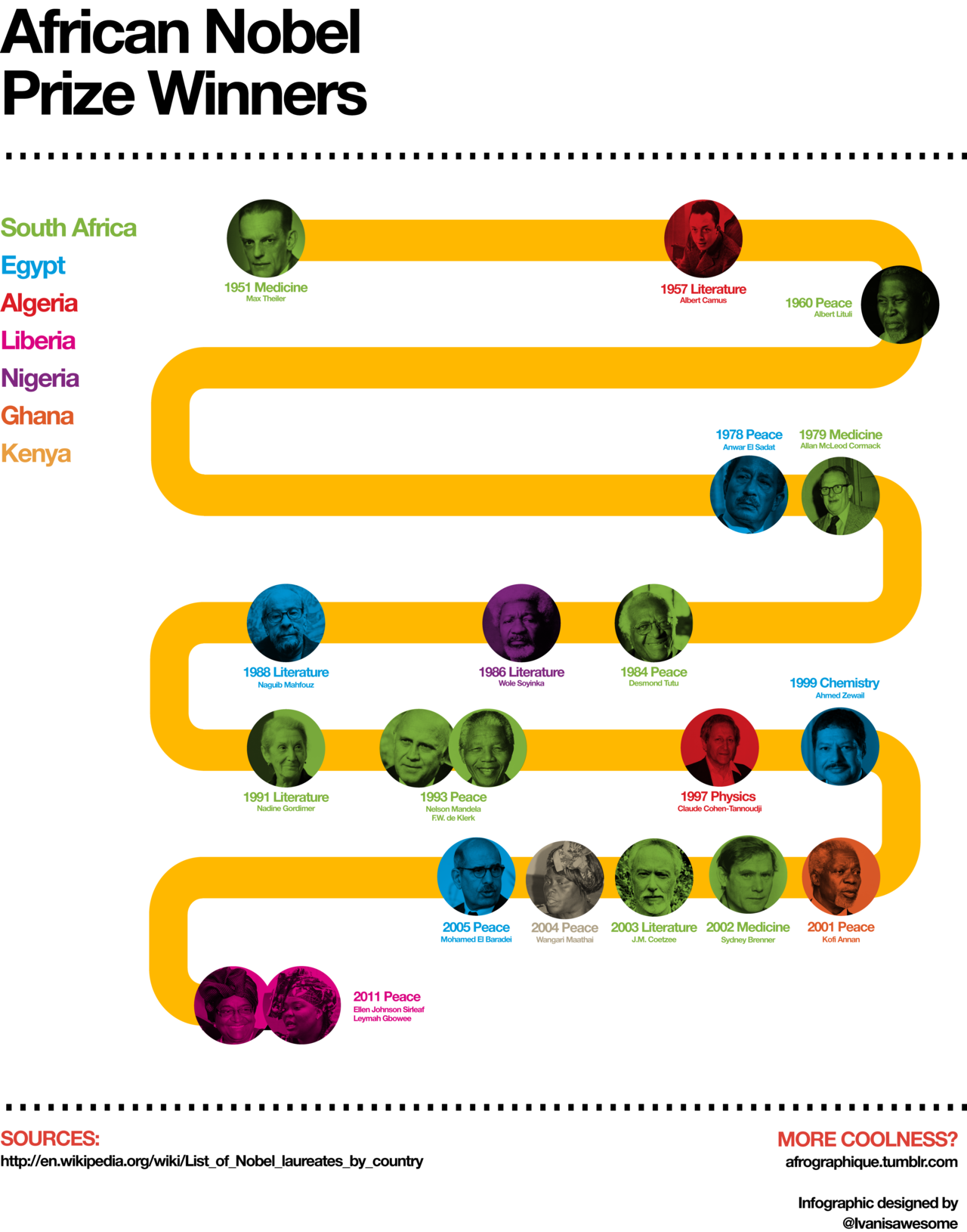
Africa's Nobel Prize winners

link

cellphones


Here in the Philippines, everyone has cellphones, but now Africa is catching up.

Strategypage's mainly depressing podcast on Africa points out how cellphones are making a difference (fast forward to 31 minutes). Honest banking!

---------------------------------------

the Heart of darkness

On my medical blog, I sometimes link to a CDC survey that shows 5 percent of heterosexual boys and 20 percent of "gay" boys have "had intercourse" below age 13.

By definition that is rape, and child abuse, but to call this a public health crisis might upset the gay lobby, who pretends it might be "risk behavior" but doesn't want to publicize it. So the survey blithely puts it into the same category as drinking soft drinks or not eating veggies. No judgementalism here, folks, just move along.

Yet since sexually abused children tend to have a higher risk of depression, alcoholism, suicide, drug use, violent outbursts etc, shouldn't someone connect the dots? No: these problems are blamed on "homophobia", and the churches.

A similar non judgementalism can be found in the US Army instruction booklet that tells American soldiers not to be judgemental against the rich in Afghanistan who exploit boys or kill girls.

What the cultural sensitivity program was trying to get across was that the Afghan attitude towards sex was very different than in the West. Moreover in the Islamic world, sex is, well classified; especially illicit sex. Some enterprising Western journalists have already done some reporting on the ancient practice (in the entire region, from North Africa to India) of using young (well, teenage down to about ten) boys for sex and other entertainments (dancing, cross dressing, camel jockeys). This has been a thing with the rich and powerful in the area for thousands of years. In some places it is sort of legal, but generally it is tolerated, even if officially forbidden. That's because this sort of thing is most popular among the wealthy and powerful. 
again, we are not talking about consensual sex in men, but the rape of children by the rich and powerful.

Ah but such things never happened in Africa did they:

UKIndependent article on sexual abuse of male prisoners in Kenya's MauMau period.

this left wing website says the numbers were even higher (but might be exaggerating the numbers for their agenda).

The rape of women in Africa has gotten publicity, but but not that of males.

a more recent report shows a lot of men and boys being raped in the wars of Central Africa.


An estimated 23.6 percent of men from the eastern DRC regions of Ituri, North Kivu and South Kivu have been exposed to sexual violence during their lifetime, according to an August 2010 study titled, the Association of Sexual Violence and Human Rights Violations With Physical and Mental Health in Territories of the Eastern Democratic Republic of the Congo, in the Journal of the American Medical Association (JAMA).

However, few organizations are assisting male survivors of sexual violence, focusing instead on sexually abused women. 
why am I putting this here and not on my medical blog?

Mainly to bookmark the links. You see, the Obama administration is pushing gay rights on to Africa. When the Africans protest, they are called "homophobic". Because it is simply not polically correct to mention that many gay American men are raping 13 year old boys (unless they are Catholic priests or boyscout leaders, then the accusations are trumpeted to destroy these organizations, who dare to oppose the gay sex/promiscuity/abortions for all agenda)...and I won't even mention the gay sex tourism here in the Philippines....


and if Americans can't get anyone in the mainstream media to notice a CDC report on rape of boys, why should they bother to ask if Africans might oppose the "gay agenda" because too many know victims of such things, and see the need to strengthen sexual morality, not to destroy it, in the name of protecting their children.

Political correctness comes before children, you see...

related item:

The Hearts of Darkness; Why Most of the Mayhem Is in Pushtunstan and Central Africa - 12/20/2012
Jim and Austin talk about the Congo and other places in the world where anarchy rules.
MP3 Download

Sunday, December 16, 2012

Ancient trade links

From a PBS site

Given all the racism, finding Cohen DNA among the Lemba doesn't mean that "white people" built Zimbabwe, but that Africa was not the "dark continent" but had trading links with the Middle East for at least 2000 years, maybe longer.

And the story of African kingdoms and the trading routes (including alas the Arab slave trade) is not a well documented story in the west.


Friday, December 14, 2012

Nigeria news

Strategypage has an article on Nigeria's problems.

summary: "insurgents" who kill civilians, government military/police who kill almost as many civilians as terrorists, kidnapping civilians for money, and politicians stealing everything in sight.

Sounds like the Philippines but ten times worse.

Wednesday, November 28, 2012

Africa for Norway

First Things has a link to a video satire on western do gooders saving Africa.


actually, Africa can save Norway and the rest of Europe by sending them Christian missionaries...

Saturday, October 13, 2012

South African miners

I haven't been following the strike and violence in South Africa, but I was under the impression it was over.

No it's not, says this fides article:
Johannesburg (Agenzia Fides) - "Violence is growing and I do not know what will happen. The unions are losing control of the miners in protest. The miners are abandoning unions and want to choose their own representatives. One is risking now to overcome the regulations adopted by the Government and the trade union centers to control labor conflicts" says to Fides Agency His Exc. Mgr. Kevin Dowling, Bishop of Rustenburg (South Africa), where yesterday, October 11, two people were killed in a slum close to a platinum mine. Meanwhile, workers in gold mines have rejected, deeming inadequate, an increase in offer put forward by the employers.

the full story at link

Tuesday, October 09, 2012

Could Africa become the world's bread basket?

PhysOrg article on wheat growing potential of African countries.

answer: Yes, especially in countries with uplands, if they use irrigation in the dry season.

Zimbabwe already does this and is one of the most productive wheat producing countries in Africa.

Not mentioned: If the tsetse fly is controlled, could a lot of those "wildlife parks" be used to grow wheat?

Tanzania report on wheat growing. notes that wheat could be grown in many areas but notes

Tanzania's population is about 20 m and nine tenths of the people depend on agriculture, directly or indirectly, for their livelihood. The inhospitably long dry season, and the infestation of large areas with tsetse fly, restrict two thirds of the population to one tenth of the area of the country.
Zimbabwe is one of the most productive of the wheat-growing nations in Africa, but wheat farmers there are almost entirely dependent on irrigation.

Read more at: http://phys.org/news/2012-10-significant-wheat-production-potential-african.html#jCp
Plos study on Kenya:

tsetse fly not only spread sleeping sickness which kills humans but destroys cattle.

AAT also affects rural sub-Saharan Africa, and the effects of AAT most heavily impact sub-Saharan Africa's poor as 85% of these individuals live in rural areas, with over 80% relying on agriculture for their livelihoods [7]. AAT is responsible for over 3 million cattle and other livestock deaths each year across sub-Saharan Africa [8] with more than 46 million cattle at risk of contracting the disease [9] leading to a considerable impact on the agricultural economy. Direct production losses amount to approximately $1.2 billion each year [10]. Estimates rise to as much as $4.7 billion a year [11] when indirect losses from the inability to use land and livestock to their fullest potential, such as drawing on livestock for traction, are considered. Livestock productivity is necessary if poverty is to be reduced and health improved; livestock provide food (meat and milk), assist in crop production, and provide a source of income for some of the most marginalized rural citizens [12]. Moreover, if nutritional requirements are compromised in populations, morbidity and mortality from other types of infectious diseases increases [13]. Accordingly, AAT is a proximate contributor to poverty, food insecurity, and nutritional deficiencies in rural areas across sub-Saharan Africa.


Zimbabwe is one of the most productive of the wheat-growing nations in Africa, but wheat farmers there are almost entirely dependent on irrigation.

Read more at: http://phys.org/news/2012-10-significant-wheat-production-potential-african.html#jCp
In three countries in southern Africa—Mozambique, Angola and Zimbabwe—increased wheat production in rain-fed areas may not be feasible, and irrigation would be required to grow wheat in the cool winter months. Zimbabwe is one of the most productive of the wheat-growing nations in Africa, but wheat farmers there are almost entirely dependent on irrigation.

Read more at: http://phys.org/news/2012-10-significant-wheat-production-potential-african.html#jCp
Huh? the IAEA helped eradicate the tsetse fly from southern Ethiopia? (The IAEA is the atomic energy part of the UN).

more HERE.
which says they are only doing the preliminary studies of the habitat with the idea that they will release sterile tse tse flies to cut down the number of flies in these areas.

The Government has selected the Sterile Insect Technique (SIT) to be used as the final component of the eradication because of its non-polluting and environmentally friendly nature.

there are also reports of using old fashioned pesticides in that area.

the TseTse plan
computer program from 2004 here.

Thursday, October 04, 2012

A Drop in Fertility? Some observations

from TPMBarnett's website:


this is not a map of actual fertility, but of the drop in fertility rates since 1970.

Zimbabwe's drop is huge: under the white gov't they had an active family planning program, but it was run by an outside funding that used "pill ladies" in every village: usually they were the wives of local school teachers who could talk "woman to woman". Because if the gov't had run it, it would have allowed the Marxist insurgents to claim that family planning was a form of genocide.

I worked at a Catholic hospital, so we were not allowed to give out birth control.
But we did have an active nutrition program that stressed food/eggs/veggies and that moms should breast feed for two years.

Breast feeding is nature's way of spacing children, and in past days, wives who got pregnant too quickly would often lose their newly weaned child from kwashiorkor, since there was not enough protein in the child's diet.

In the past, continence, R rated methods and polygamy would help the woman space their children, but as all the men started working in the mines and cities, they expected sex when they came home on their leave, especially the men who came home to plow the fields and stayed for a few weeks. (Men plowed with oxen, a dangerous animal, for the main crop; women had smaller fields and used hoes to cultivate their own garden, which they controlled).

So we gave out Depo Provera in baby clinic: Depo Provera has a lot of problems in ordinary women (i.e. non nursing women) such as constant bleeding or no period at all. But when given after a delivery, it would prolong the infertility/non ovulation phase that is normal after a pregnancy (i.e. no periods). It also made one put on weight, and did not decrease the amount of breast milk for the baby: indeed, it probably increased it a bit.

So we only to nursing mothers, to increase their breast milk, and prolong post partum amenorrhea (no periods after you give birth). In other words, we gave it out to keep the children fed, and if it stopped pregnancy as a side effect, well, the bishop and nuns looked the other way.

If you didn't have a baby on the bosom, well, there were pill ladies in every village if all you wanted was to stop from getting pregnant.

But anyway,the birth control was not pushed by the government clinics, because no one trusted the government.

The pill ladies were women, usually schoolteacher's wives or shopkeepers who were respected by the ladies. Since most Educated Zimbabweans were also known to be against the Smith government, they were trusted to give you facts to help you, not the hated white run government.

They would talk to you and instruct you how to take the pill. No pap smear or exam: if you had a history of problems, they would send you to us for a checkup, or to the local gov't hospital for a tubal ligation or IUD, and answer your questions about side effects etc.

We didn't have HIV back, and no one had pap smears, so no problem.

African woman, even village women, are fairly independent in these things, so it was ideal. And the husbands? Well, traditional husbands living at home could be reminded of the alternative: No hanky panky until the child was weaned. And those visiting three times a year from their work in cities? Well what they don't know won't hurt them...

There was not a big taboo against birth control in Africa, but there was a desire to have children. Pointing out that spacing children meant healthier, better educated children than losing kids because they came too quickly was the way to encourage smaller families.

There is a course on Population at Yale that discusses how thie "pill lady" approach worked in what the experts thought was the hardest population to reach: pious illiterate Muslim ladies in the villages of Bangladesh. These ladies were subservient to their husband and family, and could not even see the doctor without the husband's permission.

But what mother in law would say "no" to a visit from an esteemed lady teacher or businesswoman?

The pill lady would talk to the woman (with her bossy mother in law sitting in on the session). But the mother in law's presence actually turned out to be a help because (woman to woman, and when the men aren't around), even the most pious women will admits having 12 kids is just too much... so often the result will be that the mother in law would become a partner with the woman and support her choice to limit children even  if her husband objected.

Similarly, when the Mullahs took over Iran, they faced a population boom, and decided to slow it down until the wealth was spread around a bit better. So they encouraged the idea to space children to protect the mother's health and have fewer babies so they could be cared for and educated, as the way a responsible Muslim should act. They even cited the holy writings that insisted a man should care for the health of his wife and family as saying family planning is not just allowed but encouraged in Islam.

Do the mosques with Sunni preachers from Saudi agree with this? I don't know (haven't worked with many Muslims recently).

Maybe those Muslim countries who are having problems convincing the local governments to allow family planning need to import family planning experts from countries that have had successful programs.

However, I do agree with Barnett that in Subsahara Africa and Islamic countries, the appoach to fertility will change as urbanization occurs and globalization changes culture.

I have to laugh at StrategyPage pointing out how the simple cellphone is changing culture in Afghanistan:
the Taliban is hostile to education and cell phones (especially the ones that can access the Internet, and most can). Any Afghan who becomes literate and gets a cell phone soon discovers there is a huge world out there and it is different
or as Spengler of the Asian Times quipped: As soon as Muslim women become literate, they learn to read the instrutions on the birth control pills.

Indeed, if you look at the map, the countries in sub Saharan Africa without drops in fertility tend to be those who have few people per square mile (Namibia), little development (Mali), or chronic problems with civil wars and.or the post civil war lack of civil society (Nigeria, Mozambique, DRC).

But again, the family planning folks will have to work with the culture.

Ann Coulter once quipped the way to get rid of Islamic terrorism was kill the terrorists and convert them all to Christiantiy. Uh, she went a bit far, but her point, that changing culture is needed, is actually the idea behind Bush's war in Iraq and Obama's support of the Arab Spring: to encourage a moderate secular Muslim government, where the "secular" governments tended to be plutocracies or worse.

Now, globalization will change people at the village level in many ways, not just cellphones, TV and the internet. (even Sister Eurphrasia now has a cellphone and Email in her small town in Zimbabwe).

But a lot of the real problem of globalization is culture change, and culture shock: and this often happens when folks leave the clan and villages to go to the city, where they are lost.

Europe went through this a century ago, and see all the wars/revolutions and terrorism it spawned. Yet some Americans, with their limited attention span, think the Middle East/Africa/Asia can do it is a generation, not a century, and not have problems.

This is where religion can help: the problem is which religion? The religion of communism? The religion of Fascism? the religion of Islamic fundamentalism?

Yes, but the dirty little secret is that most Americans don't see that there are other answers.

Why not a religion that fits the culture, strengthens what is lacking, and helps people to live productive lives?
The Sufi version of Islam, with it's emphasis on personal holiness, not rules and dogma, is one answer. The bad news is that no one is spending millions of petrodollars building mosques and madrasses that promote a modern Islam. 

Here is where Christian countries have an advantage.

I used to get mad at all the American protestants "converting" poorly educated Pinoys to become Protestant, until I realized the alternatives was communism...or maybe drugs.


In the "Catholic" Philippines and South America, many city folks tend to be attracted to "born again" churches, which become the replacement for the extended family of the villages, which support people in need with material but also emotional support. Before, if you needed a job or a handout in an emergency, you went to a relative, now you go to a fellow church member...and the preacher also promotes the values of honesty thrift, and hard work along with their theology.
the Philippines,  learning from your protestant neighbor that you don't have to have a lot of babies, and indeed God expects you to only have the children you afford, may be a new idea, but it is one that individual women will welcome. The result will be a lower population in the Philippines no matter how many "RH bills" pass or don't pass the Senate.
Indeed, fertility has dropped from the average of 6 to less than three kids per woman in the Philippines. And one doubts the days of 6 kids per family will come back, even among pious Filipinas,  no matter how often Father preaches about the wonderfulness of children and the evilness of the pill on Sunday.

One small problem that could cause a setback: I fear that Hillary and her PC friends from America will muck up the RH bill passage by linking it with abortion on demand, which is abhored by all and sundry. Nor does the idea of teaching promiscuity in high schools under the guise of HIV prevention, and promoting gay rights, when gays here are accepted if they are quiet about what they do. In other words, if you promote family planning, not as a population measure or as part of a larger American agenda of destroying the countries morals, there would be a better chance of passing the RH bill...

But what about Muslims in  the Middle East ad Sub Sahara Africa?

 Again, I don't know the culture of these various lands, but I suggest instead of importing American or British style "population control", that instead they Iran to send good Muslim Family planning workers to instruct them in the Muslim tradition of limiting fertility for health reasons.


Wednesday, October 03, 2012

Obama okays child soldiers

the "it's nice to be king" article of the day:
The Washington Post October 27, 2010 headline read, "Obama waiver allows U.S. aid to 4 countries using child soldiers." The ABC news October 5, 2011 headline read, "Obama waives child soldier ban in Yemen and Congo." The Cable, from Foreign Policy.com October 1, 2012 headline read, "Obama waives sanctions on countries that use child soldiers"
isn't the president supposed to enforce the law?

This is about sending aid to the Congo and Yemen to prop up governments that are probably the least worse choices, but it also sends a message that they don't have to change their ways.

 
Free hit counters
Free hit counters