Thursday, February 18, 2021

and now they canceled Australis

The tech companies are blocking mainstream conservative stories, no problem.

But now facebook is saying they will block any news from Australia.
Something to do with their copyright law.  

And Australia investigating them under anti trust laws. 

https://mattstoller.substack.com/p/australia-strips-googlefacebook-to

And they are going after google too.

https://youtu.be/Fsu4dQbHKOc

Last month, China tried to bully Australia into submission and lost.


Thursday, February 11, 2021

Fertilizer? We don't need no stikin' fertilizer

 that is sarcasm and refers to this meme


in recent years, the Chinese have moved to Africa in search of mineral resources and farmland. 

In Zimbabwe, they took advantage of the self righteous "sanctions" against Mugabe, who "stole" the farm land of the white farmers (who of course had stolen their farm lands a couple of decades ago from the local Africans). But China ignored the sanctions, and was not above giving gifts to move in.

I am ambivalent about Chinese investment: They are neocolonialists when it comes to exploiting the mines (so Chinese exploitation instead of European exploitation) and their shops sell cheap Chinese goods that make local factories uncompetitive (something we see here in the Philippines).

 But China is helping the agricultural sector by introducing modern high yield methods (fertilizer, "green" hybrids and GM hybrids and working with farmers who own their own land, 

and yes, Bill Gates is helping supply the much needed fertilizer in some areas.

this goes against the meme of the powerful "organic" ecology movement. of course who see traditional practices as sustainable and pollution free (just ignore the kids dying of kwashiorkor).

The modern "green revolution" hybrids (that required fertilizer) and especially now the even more productive GM seeds have been discouraged by some governments in Africa, because of powerful NGO's and church groups that believe in the myth that change is bad, and primitive farming methods and tribal customs should not be changed.

NatGeo on China who now has pollution problems (but hey they are feeding their people). But when it comes to Africa, note that one lady scientists said they can't afford it.

“Africa cannot afford massive amounts of fertilizer,” says Sieglinde Snapp, a crop scientist at Michigan State University. A more sustainable approach, she says, is greater reliance on nitrogen-fixing plants.
Summary: Fertilizer? we don't need no stinkin fertilizer. (pun).


as for the Chinese takeover/looting of Africa's mineral resources: This is from StrategyPage:

February 3, 2021: China has continued to expand its dominant control of African raw materials. Currently Chinese firms control about 70 percent of Congo’s mineral deposits and mining industry. Chinese state-owned firms own most of this, which includes substantial portions of the global supplies of copper and cobalt. Since 2012 Chinese companies have invested at least $12 billion in Congolese mineral assets.
Some of those billions go to enrich Congolese officials who make possible Chinese ownership and protect it from local or foreign interference. The eagerness to gain control of so much cobalt is driven by Chinese plans to become the major producer of electric vehicles. Congo is the world’s biggest cobalt producer, each year producing between 55 percent or 65 percent of the world’s total cobalt. 
Chinese companies control around 40 percent of Congo’s cobalt deposits and means of extraction. Cobalt is critical as a stabilizer in rechargeable lithium-ion batteries. It takes about ten kg (22 pounds) of cobalt to manufacture an electric car battery. China is committed to producing electric vehicles (EVs) of all types.


Wednesday, December 23, 2020

Nigerian massacres

GetReligionblog discusses the many sources of the killing of mainly Christian peoples: by the Islamic militants and the tribal conflicts between the Muslim cattle herders and the Christian farmers.

Of course, both these terrorist groups kill fellow Muslims, but not so much.

The press coverage is spotty of course.

sad.

But of course they left out the terror by southern "terrorists" who mainly are Christian and object to the oil wealth being siphoned off.

And I'm old enough to remember when the mainly Christian Biafiran tribe sought to seceed and were literally destroyed by the government forces (estimated 2 million killed by famine) (rumor: with the help of the western companies that wanted their oil wealth). This is worse than it seemed since the tribe was also highly educated. Ironically, the best coverage of this was by the Irish, since many local missionaries were from that country.


Monday, August 10, 2020

Rwanda: Big brother?

Global voices, a site that publishes independent bloggers, has a report about how Rwanda is monitoring all their citizens.

a story complicated by their history of the massive slaughter during their civil war, and the impressive rebuilding of the country.

I have no expertise here so advise you just to read the story.


Sunday, July 26, 2020

covid in Zimbabwe

An article in Global voices (independent bloggers) on Covid in Zimbabwe, and the protests against corruption (stealing money meant to go to the folks suffering from the virus).

and AlJ has an article on the crack down on dissenters.

Chin'ono is accused of inciting public violence. He denies the allegations and says journalism is being criminalised.
He has written articles alleging corruption in multimillion-dollar deals to combat coronavirus that have been awarded to powerful individuals close to the government.

Monday, June 08, 2020

Coronavirus in Africa

AlJ link


There are 183,474 confirmed infections and 81,367 recoveries, according to the Africa Centres for Disease Control and Prevention. Experts warn fragile healthcare systems in many African countries could be overwhelmed in the face of a severe outbreak of COVID-19, the highly infectious respiratory disease caused by the coronavirus.
if you believe that the number of "confirmed" cases is the same as the actual number of cases, then you are a fool.

most of the cases are in Egypt and South Africa. Ah, but how many are dying in villages or in the neighborhoods and aren't getting a diagnosis? Especially if they are elderly (and in Africa, elderly means 50 years old) or have HIV.

One thing I haven't read much about: is the use of Chloroquin being done as prevention? Are people still taking Chloroquin for malaria prevention (even when I worked in Africa, Falciparum malaria was becoming resistant).

And what about those taking retroviral drugs for HIV? Are they dying at a higher rate (HIV affects T cells, which are the cells that fight Covid) or are the retroviral drugs protecting people?

Just wondering.

Saturday, June 06, 2020

Black Lives matter (but not if they live in Africa)

StrategyPage summarizes the latest news from Central Africa.

Ebola is back, alas.

 While Ebola is one of the most lethal epidemic diseases ever encountered, a much less lethal visitor from China has recently shown up in Congo. The covid19 has, in three months, inflicted around 3,400 confirmed cases of covid19 virus in Congo and 72 confirmed deaths. That’s 37 per million people and 0.8 deaths per million. For all of Africa (including North Africa) there have been 120 cases per million and 3.4 deaths per million people. That’s far lower than anywhere else...
the only problem: the numbers are not accurate you know.

 There may be more cases in Congo but the country has little or no access to modern medical care and people regularly die of undiagnosed afflictions. Since most of these involve a fever, caused by the immune system trying to fight off some kind of infection, people call many fatal conditions an unspecified fever, and such fatal fevers are common.
Sigh. This is probably true here in the Philippines too. One of our neighbors had a fever and shortness of breath but died in the hospital of a "heart attack". I am pretty sure that he had Covid, but they didn't test him. I have no proof, but maybe because if a known case was found in that (private) hospital then no one would go their for routine illnesses.

Saturday, April 11, 2020

shut down economies from virus could lead to massive starvation

on my main blog, I have written about the increase in poverty and need for food aid here in the Philippines: my latest report HERE.


but not much is being written about how it might affect Africa.

There are some reports that genetics makes Africans less likely to get the virus, but that hasn't been the case in the USA. And in Africa, one wonders if the climate//sunshine might lower the spread (i.e. when it is warm, you don't have people indoors as much, but in todays' world of buses, factories, schools, etc that might not be true).

Virtueonline, an Anglican website, has posted an article about the virus in Africa: not a lot of numbers next to the many thousands who die from malaria or other common diseases, but the pressure to use western style prevention methods might make things worse.

and yes, many of these countries will stop planting the next crop for prevention of virus spread: but I wonder if this is overdoing it: Here in the Philippines after some mix ups about food and rice delivery trucks being allowed to go though check points, things have improved. And our farmers are harvesting here, even though we have a strict lockdown of our town (although one suspects family members won't be able to come back from Manila to help with the harvest, our people here in town can drive out to the farm in cars to help with the harvest... I don't know if this is true in other areas.

but this report of strict urban style lockdowns in rural areas is disturbing: If true, more will die of starvation than any virus.

Pastor Campos Afonso's report from churches in Angola is repeated throughout the continent where most states are in lockdown. The President of Angola declared a quarantine and State of Emergency from 27 March-11 April. All church meetings are closed. Pastors, leaders and members are observing the measures in their homes to combat the virus from spreading.
If the lockdown situation of COVID-19 continues it will affect the 2020 harvest because people will not be able to work in the fields. The lockdown means a shortage of work, tools and transport to take products from the countryside to the cities.
Lack of transport also means people cannot get from the cities to work on their family land to gather the harvest. Products collected this year will rot in the fields. New seeds will be in short supply for cultivation in the next year.
People are consuming the products that were being reserved as seeds for planting in 20202021 after having sold the December and January production. Most have nothing to eat in this period of isolation. Many could die of hunger instead of being killed by COVID-19. Locals say that church intervention is needed to help the most vulnerable people and poor Christians.

Tuesday, March 24, 2020

DRC response to coronavirus

globalvoices has a report on the cases in DRC, which were imported from Europe.

 DR Congo has banned large gatherings, ordered school and university closures for four weeks and closed its border with Rwanda, all measures taken to stem the spread of the virus. The government also suspended all international flights from countries with a high number of cases of COVID-19.

Genetic puzzle on coronavirus

I had read a couple articles that mentioned Africans having fewer Corona virus cases and deaths, and I assumed that this was because of the sunlight/living outdoors instead of inside houses in the winter as in China and the USA/Europe, or maybe because a lot of Africans take anti malarial medicine to prevent getting that disease, or maybe just that they haven't done enough tests and people are sick without going to hospitals and getting counted.

But StrategyPage notes:

...Chinese researchers found that Africans are less likely to catch covid19 because they have one fifth as many cellular receptors in their lungs than Chinese. That difference enables covid19 to cause breathing problems more, or less, readily. ...
  Lung damage is the most frequent cause of death among covid19 victims. So far Africa, with 18 percent of the world population has only suffered about 0.3 percent of the covid19 infections. Africans are not immune, just less likely to get in infected or suffer the breathing problems that cause most covid10 related death

this doesn't mean they can't get sick or die, but merely that the disease might be less fatal in certain populations.

One wonders if this observation is seen in the African diaspora on other continents.


Wednesday, March 04, 2020

the chaos in the DRC

LINK

stategypage discusses ebola and other disease, locusts, and war.


You think you have it bad?

the Congo and other central African areas are fighting disease, war, and locusts.

Disease: unlike Liberia, the WHO has fought the Ebola epidemic with local health care workers, and is now using vaccines.

the churches are doing a lot of the developmental work, but  are not mentioned in most of the lay press reports, but when I was in Africa, most of the rural hospitals and clinics were either church sponsored or run by medical personnel trained in church hospitals. I suspect it is the same in Central Africa, but of course the secular "doctors without borders" get most of the publicity in the news reports, probably because they are European/American (i.e. white).

the bad news: Corona virus is expected to hit (maybe via China, since China has a lot of their people doing work on various projects in Africa). But since there is now a medical infrastructure in place (to fight ebola), it mwans maybe they will be able to handle this better than more African countries.

SP latest news is that cases are down:
The number of new Ebola “cases per day” has dropped. From February 18 to 23, there was only one new confirmed case in North Kivu Province. As of February 23, there have been 3,444 total cases,

but ebola is not the only killer here. From SP:
February 14, 2020: The UN issued a report examining malaria in Burundi during 2019. From January through December 2019 Burundi had 8,892,300 malaria cases. The disease killed 3,294 people or 37 per 100,000 infected.
and measles has killed at least 6000 in the area:

Under the leadership of the DRC Ministry of Health, WHO, Gavi, the Vaccine Alliance, and other partner aid agencies vaccinated more than 18 million children under five across the country in 2019. '
However, in some areas, routine vaccination coverage remains low and 25% of the reported measles cases are in children over the age of five. ....
Since the start of 2019, around 310 000 suspected measles cases have been reported. The epidemic has been aggravated by low vaccination coverage among vulnerable communities, malnutrition, weak public health systems, outbreaks of other epidemic-prone diseases, difficult access by vulnerable populations to health care and insecurity that has hampered response in some areas.
see that comment about "insecurity?

This is from gangs/ irregular tribal insurgencies and wars.

when I was in Africa, our main danger was not from government soldiers, or even the regular insurgents, but from deserters or rogue groups from both sides who had guns and who used them to rob/rape/kill.

Again the SP article includes reports of various groups who killed people.


But note that these are being fought. China got into the news saying they will export 100 thousand ducks to eat the locusts, but I wonder if that will work: I suspect most will die during transport, and those that survive the trip might not adjust to the climate. More likely the locals and the dogs will eat the ducks.

but the dirty little secret is that pesticides are being used (don't tell western greenies). Again from SP:

On February 11 the Ugandan government deployed around 2,000 Ugandan Army soldiers to fight the locusts. Here’s how an army counter-locust operation works. When locals detect a swarm they report it. Uganda is also employing drone aircraft to monitor locust swarms and their movements.
When a swarm is identified, several dozen soldiers armed with manual and motorized pesticide spray pumps move to the infested area. Ugandan military officers report that locust swarms don’t move at night, which means the pre-dawn hours are the optimal time to spray pesticide on an infested field to insure killing adult locusts. 
Speaking of "greenies":  one of the reasons I dislike "animal conservation" is that they take the side of animals against the locals.

Usually this means stopping locals from killing predators or elephants who eat them or their crops, but SP notes:

February 6, 2020: European media are citing a draft report that alleges “ecoguards” in the Republic of Congo (Brazzaville) are physically assaulting and intimidating Baka pygmy tribesmen who live near a national park the guards patrol. Ecoguard is shorthand for “ecological guard.” The ecoguard program is partially funded by international conservation groups. According to reports, the ecoguards carry firearms. For thousands of years, pygmies have been persecuted by the majority of Africans of normal height. As a result, the pygmies lived reclusive lives, often deep in forests away from majority populations.

Sigh.

Friday, January 31, 2020

voter biometrics in Zimbabwe (China link)

from Global voices:


In previous elections, citizens could visit any polling station and vote just by showing their conventional ID cards, which contained their name, ID number, date and place of birth and date of issue. After voting, one's finger would be smeared with indelible ink to avoid double voting. Now, citizens suddenly had to submit their photos, fingerprints, national identity numbers and home addresses into one integrated and digitized system. If they did not do this, they were told, they might be barred from voting. This increased public fears of monitoring and intimidation, already a common theme for elections in Zimbabwe. The system was touted both by ruling party and opposition voices as a strong guard against “ghost” voters and other types of election fraud.

But its underlying technology was not built with these issues in mind. Nor was it built in Zimbabwe. China’s ‘AI foray’ into southern Africa
The government of Zimbabwe signed a strategic partnership with CloudWalk Technology, a Chinese company that has become a leader in the field of facial recognition, in March 2018. The objective of the partnership was to commence a large-scale facial recognition program in Zimbabwe, which government officials said would be used to preserve “law and order,” and then expanded to other public sector programs.
oh, by the way, the UKGuardian calls the famine "man made". Duh.

Saturday, December 21, 2019

Blood cobalt

Slashdot reports: Apple and google were named in a lawsuit over the death of children mining cobalt in the DRC (DRCongo).

(Headsup Instapundit)

Original report is in the UKGuardian.

The extraction of cobalt from DRC has been linked to human rights abuses, corruption, environmental destruction and child labour. The lawsuit argues that Apple, Google, Dell, Microsoft and Tesla all aided and abetted the mining companies that profited from the labour of children who were forced to work in dangerous conditions – conditions that ultimately led to death and serious injury.
the children were not physically "forced to work there: They work there because of extreme poverty forces them to work if they want to eat.
The families argue in the claim that their children were working illegally at mines owned by UK mining company Glencore. The court papers allege that cobalt from the Glencore-owned mines is sold to Umicore, a Brussels-based metal and mining trader, which then sells battery-grade cobalt to Apple, Google, Tesla, Microsoft and Dell.
Other plaintiffs in the court documents say they worked at mines owned by Zhejiang Huayou Cobalt, a major Chinese cobalt firm, which the lawsuit claims supplies Apple, Dell, and Microsoft and is likely to supply the other defendants.

so the tech giants who are going around the US and the world funding "progressive" causes are getting rich on the blood of children. So what else is new?

But one of the substories in here is that China is trying to get a monopoly on Cobalt and other rare earth metals used in high tech.


Bloomberg report from Dec 2018: not only are 8 of the 14 largest cobalt mines in the DRC owned by China, but they essentially own the supply chain to companies that use the mineral in their batteries, metal alloys, etc.

essentially they own most of the cobalt refineries, and many of the factories that make batteries for Tesla and electric cars.

Here, LimacharlieWord discusses the importance of cobalt to the Chinese economy.

They also note European and Chinese corporations and governments are "lobbying" to stop the country from taxing the metal in order to keep the price down. They also note China is not only investing in the country, but sending in a lot of Chinese to do the work.

and they note half the money for infrastructure sent there by China is "unaccounted for" (duh), and the political instablity partly caused by a president who refuses to leave and wars going on in the area.


Thursday, December 19, 2019

Chinese investments in Africa

,,,,,,,,,,

one advantage: China doesn't worry about supporting corrupt and murderous politicians.

Another advantage: The US MSM hasn't noticed what is going on.

A third advantage: Unlike the US State Department, they aren't going to push African countries to accept homosexuality, which translates to letting pedophiles (both local and sex tourists) to abuse their youth.

Saturday, September 07, 2019

Thursday, June 13, 2019

Kill the elephants


Nderiki and her husband had been married 65 years before he was killed by an elephant in 2014. Like nearly everyone else in this cluster of villages, it has been years since her fields weren’t trampled and eaten up by what she calls “the giants.”
She used to grow more than 100 bags of sorghum in a season. Last harvest, she salvaged three.
Growing resentment toward the animals among farmers here and around Botswana is upending the country’s politics and prompting the reversal of policies that turned tourism into Botswana’s second-biggest earner after diamonds.
The furor has also spilled into a larger debate over race in a country where white foreigners and the descendants of colonialists control much of the conservation and tourism sectors while many who live outside the national parks eke out a living on government subsidies....
The country’s president, Mokgweetsi Masisi... said that in his view, the numbers of elephants are now “far more than Botswana’s fragile environment, already stressed by drought and other effects of climate change, can safely accommodate,” leading to a “sharp increase” in conflict between humans and elephants. He believes a limited, permit-based return to hunting can solve the crisis.....

headsup AnnAltnouse.

I was going to make the headline "kill the F....." but this is a G rated blog.

You see, all those "national geographic" etc. specials in Africa love wild animals and lament the "loss of habitat.  (translation: Those dang locals keep plating crops to feed their kids) and poachers (translation: Those dang locals kill animals to make a living),

Ah but wait a bit: You will start seeing elephants dying of starvation after the eat everything in the area, When food disappears either from overgrazing or the periodic droughts in that part of Africa, they then travel to people's farms and eat the food of the locals, and/or they starve to death.

NYTimes article from 1992:

Zimbabwe kills starving elephants for food.


Faced with the worst drought in southern Africa this century, the wildlife authorities at a national park here are proceeding with what they call the grim but essential step of killing thousands of elephants and impalas so other animals as well as starving people can survive.
While animal kills are common here and elsewhere as a form of habitat management -- wildlife officials prefer the term "culling" -- rarely if ever has a drought forced the authorities to act on such a scale and with such human urgency as in the program under way at the Gonarezhou National Park.
In the coming weeks, the park authorities plan to shoot 2,000 elephants and give the meat to farmers and their families. In addition, an operation to kill 5,000 impalas and distribute the meat from them has begun. Also under way is the large-scale relocation of rhinoceroses, hippopotamuses and other exotic animals that are in danger of dying from hunger. Unlike other African nations, Zimbabwe does not have a major elephant-poaching problem, so the authorities have long resorted to such kills to control the growth of its large elephant population.

nor is this the first time this happened:


Mr. Wright of the World Wildlife Fund said a situation comparable to the one here developed in Kenya in the early 1970's. The wildlife authorities decided then not to kill elephants during a drought in Tsavo National Park, even though they were deemed too numerous and many people living in the area of the park were in need of food. In the end, thousands of elephants died of thirst and hunger, and that in turned stirred resentment among the peasants living nearby, Mr. Wright said. When the good weather came, the elephant population in Tsavo never recovered because the angry peasants cooperated in poaching.

Periodic famines due to drought are not unknown in that area:

This article notes that it appeared to be rainer in the 19th than in the 20th century, although droughts did occur.

Article on the "great famine" of the 1870s.


The Great Drought actually was several droughts, Singh found, beginning with a failure of India's 1875 monsoon season. East Asia's drought started in the spring of 1876, followed by droughts in parts of South Africa, northern Africa and northeastern Brazil. There were also droughts in western Africa, Southeast Asia and Australia. The length and severity of the droughts prompted the Global Famine, aided in no small part by one of the strongest known El Niños, the irregular but recurring periods of warm water in the tropical Pacific Ocean. That triggered the warmest known temperatures in the North Atlantic Ocean and the strongest known Indian Ocean dipole -- an extreme temperature difference between warm waters in the west and cool waters in the east. These in turn triggered one of the worst droughts across Brazil and Australia. Because the drought was induced by natural variations in sea-surface temperatures, says Singh, a similar global-scale event could happen again. Moreover, rising greenhouse gas concentrations and global warming are projected to intensify El Niño events, in which case "such widespread droughts could become even more severe."
The socio-political factors that led to the famine no long exist, she notes. Still, she writes, "such extreme events would still lead to severe shocks to the global food system with local food insecurity in vulnerable countries potentially amplified by today's highly connected global food network."

and then there was the drought 4200 years ago. 

article on the desertification of Africa.

article about Chinese project to fight desertification in Namibia.

Under instruction from Chinese technicians, Nakanyala dug grooves into the ground and filled them with grass, skillfully using a spade to build a stretch of grass pane sand fence, a proven method to alleviate shifting sands and conserve water. "Nearly a quarter of Namibia is covered by sand. It's a matter of primary importance to learn effective techniques against desertification so that we can solve food problems," said Nakanyala. The training program has been held in Gansu for almost 30 years, with nearly 1,000 technical workers and government officials from 87 countries trained, including those in Africa. The government-sponsored training courses combine in-class learning and field practice, focusing on theories and techniques of desertification control as well as ecological restoration....China has reversed the expansion of its deserts. An average of 4,400 square kilometers of desertified land has been restored each year since 2000, according to statistics. "China is at the forefront of sand prevention and control," Liu said. "It is urgent to share our methods with other parts of the world."

Wednesday, June 12, 2019

iMusic from Zimbabwe

this is Library of Congress, but there are lots of Youtube videos of music from Zimbabwe. ........

Monday, March 25, 2019

Troubles all over

The floods in Zimbabwe and Mozambique have affected many.

Mozambique also reports out break of cholera and malaria.

There is a drought in Kenya that could cause starvation there.

Ebola has spread to a new city in the DRC.

Sigh. No links, sorry.

But these are natural disasters.

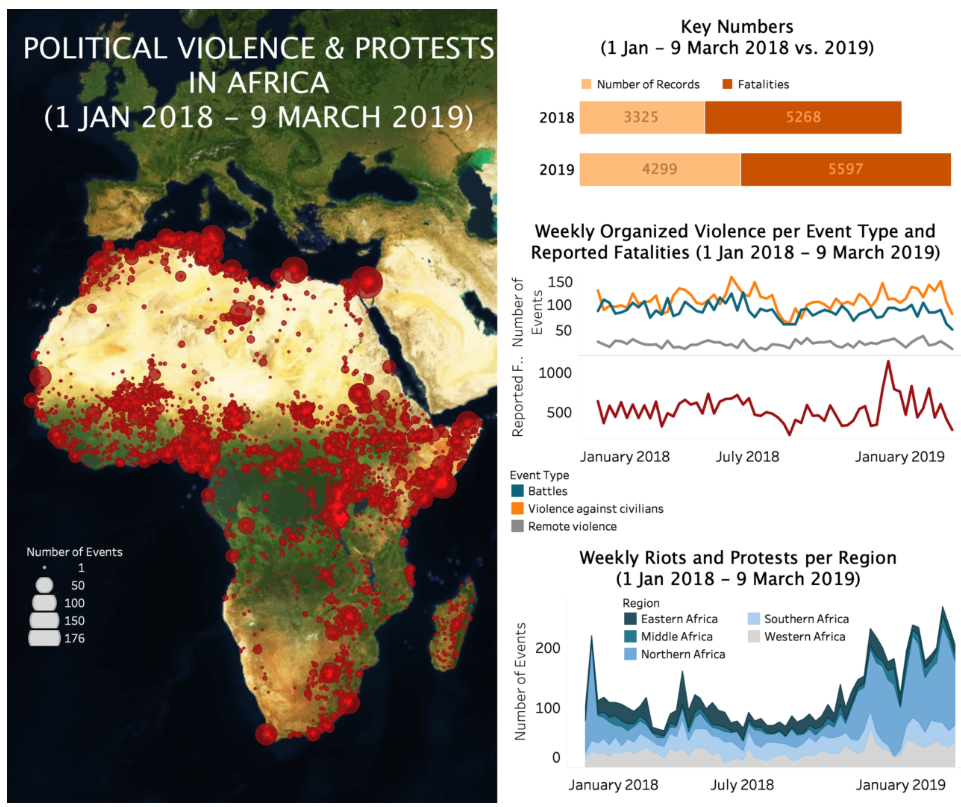
the USNIblog refers to a new website about political violence/protests in all parts of Africa.

ACLED data website.

here is an example of their data:


Free hit counters
Free hit counters