Sunday, June 02, 2013

Male rape and gay laws

Instapundit cluelessly suggests Obama pressure Africa to stop passing laws against Homosexuality.

Which only proves he lives in an equal society, where gay sex is assumed to be consensual between equals.

Yet in Africa (and to a lesser extent, here in the Philippines) we have a hierarchical society, where inferiors are supposed to obey superiors.
And, with tribal conflicts, rape, including homosexual rape, is a weapon of war:

So what about nowadays?

From AlJazeerah: a report on male rape in tribal conflicts.
The use of rape as a weapon against women in Congo's many conflicts has been widely reported. However, the number of male victims is also suspected to be high. Most cases remain unknown because men, like women, are often too ashamed to come forward and talk about their ordeal.

From IRIN
CAPE TOWN, 13 October 2011 (IRIN) - Sexual violence against men, including rape, is under-reported, poorly addressed and has a severe impact on both men and their families, according to a presentation at the annual Sexual Violence and Research Initiative (SVRI), held in Cape Town, South Africa...
Male rape is here often associated with homosexuality, which in Uganda is condemned and stigmatised. Men also choose not to speak out for fear of being branded homosexuals, and victims cannot get proper support because they are accused of being gay.


Yet this is the tip of the iceburg.


So sleeping with the maids in the third world is "normal" (which is why most of our maids insist we hire them in pairs, for a chaparone), and if your employer is "gay" and you are an attractive  male, well, watch your back... literally....And then there are the boarding schools and high schools, where teachers prey on their student (including pressuring girls or boys to become prostitutes).


However don't point fingers:

One of the unreported story of Africa is the sexual outlet of the "white bwanas". The Dominican sisters entered Rhodesia to nurse the first settlers. They soon were setting up schools, not just for the white students, but for the "coloured" children who quickly appeared. When the whites objected, sister said sarcastically that they were "their" children (and hinted she'd name names) so they'd better provide money...

Yet another unreported story of colonialism is that many of the white settlers (at least in British colonies) were exiled there because of their behavior: They were "gay". And of course, in Africa, your employees don't dare say no to a superior.

And gay abuse predates colonialism, as the story of the Uganda martyrs shows.

Yet colonial policies imposed taxes for money on village people, so essentially forced men to work to pay taxes, and colonial policies hired men without making accomadations for their families. Under Apartheid, where pass books were needed, this was even enforced by law.

Then you have the problem of old age: No social security, so an aging man would have to support himself or be supported by his family on his land. But in African custom, the land is owned by the tribe, so this meant you had to leave your wife at home to care for the land or the land would be given to another, meaning you would have no way to support yourself when you returned if she went with you. And although polygamy was legal, few men were rich enough to buy more than one wife.

So where did the men get sexual release? Prostitutes cost money...

Despite all the American talk of "cross cultural understanding", few medical studies of the problem seem to realize that Africans or Asians might not think the same as upper middle class white educated Americans.

Western investigations of gay identity such as this one from Princeton see the problem via western white culture.

This report also discusses MSM in South Africa but ignores the elephant in the living room: The fact that men are pressured by the system to leave their families behind while they go to work in the cities.

Teenaged boys who have sex with each other may not be gay, but merely not have access to girls: ditto for factory workers or those whose wives are at home in the villages caring for the family land. And in rural areas, if a tribe has taboos against vaginal intercourse with a pregnant or nursing wife, one would expect some MSM to be going on to relieve sexual tension (yet without putting that into context you are again missing the problem)

Then there is the problem of street children. When I adopted, we were told to assume if we adopted an older girl we should assume that they had been abused, and we were warned that many of our boys had also been abused.

One report said the MSM abuse rate was 25% among street kids in Addis Ababa

which, by the way, is the same rate as reported among inner city kids in the USA.
(in contrast, a broader survey shows that only 5% of teens admit sex below age 13, but 20 plus percent of gay kids...this does not include rape or sex under threats of violence, 10%).

What is going on in Africa is that with modernization (and the fruits of colonialism) you see a break down in tribal rules. You get chaos and all sorts of immoral behavior (not just sex but monetary corruption and violence) that were limited by tribal laws and customs in the past, but now have few ways for the community to protect itself from predators and sociopaths.

These countries however do have an alternative: religion.

Christianity, which for years was seen as an outside influence, is now indigenous (including many indigneous Christian churches). Even the hated "boko Haram" of Nigeria, seeking Sharia law, is more about stopping the epidemic of Nigerian corruption/bribery than about Islam per se.

The mosques and churches teach strict religious rules, and use shame to enforce them.

The breakdown of the family, a lot of which can be laid at the foot of an oppressive colonialist system that destroyed tribal ties and customs, is a major problem, and the churches are trying to solve it by preaching strict behavioral rules that encourage marriage between equals.

 So the "anti gay" laws are part of a spectrum of laws trying to redevelop and heal the culture from the chaos and immorality inherited from colonial times.

And outsiders who see this as a "gay rights" problem are missing the point. It's not about two equals chosing to marry each other, even though they are the same sex. It's about trying to reestablish morality on many levels.

Westerners who assume  it is about sex between equals are merely making things worse, because the average African sees this an merely another western plot against Africa.

And the revulsion against gays is visceral,

You see sex between equals, so whenwhen you say "don't make homosexual actions illegal", you are saying: "Let those born gay be able to have sex with one another as equals without punishing them".
But Africans interpret it differently: They hear: Let men rape our boys and get away with it.

Given the sex tourism with boys we see here in the Philippines, one could suggest they may have a point.


Saturday, May 25, 2013

Zimbabwe's new constitution

From aljazeerah.

VIDEO
Approved overwhelmingly in a referendum in March this year, the constitution clips the powers of the president, limits presidential tenures to two five-year terms and does away with the post of prime minister.

However, it does not apply retroactively so the 89-year-old Mugabe could technically extend his three decades in office by another 10 years.
"This day is an historic day, it's about the future,"  Eric Matinenga, the Constitutional Affairs Minister said at the signing ceremony.

"I can assure you that this document which is before us is a good document."

A new constitution is one of the pre-conditions for elections to pick a successor to the shaky compromise government Mugabe formed four years ago with  Tsvangirai.

Monday, May 06, 2013

Kony update

Strategypage reports he is hiding out in the disputed area between Sudan and South Sudan.


April 27, 2013: New reports claim that LRA commander Joseph Kony is hiding out in the Kafia Kingi region of Sudan. Kafia Kingi is a territory claimed by both Sudan and South Sudan. The enclave is (from South Sudan’s perspective) at the very western edge of South Sudan’s Western Bahr al-Ghazal state. Sudan currently occupies the enclave. Human rights organizations and the Ugandan government have frequently claimed that Sudanese military has provided the LRA with weapons, equipment, and money. The new reports (based on statements made by LRA defectors) claim that the Sudanese Army has given Kony safe haven. Kony may have used Kafia Kingi as a hideout in 2010. There are reports that he returned to the area briefly in 2011 and 2012.

Friday, April 05, 2013

speaking English

From the African Executive:

The fact that we still shun that which is clearly local and homegrown is a manifestation of the low regard we have for ourselves and one another.  We prefer to use firms with English sounding names rather than vernacular ones and we associate Western or “white” tastes and ideas with superior quality. In what other country would a Shona-speaking mother and a Shona-speaking father produce an English-speaking child? Where does this low self image come from?  Is it a result of being disappointed one too many times by some of our own? Is it a product of our early experiences which inform our foundational beliefs about ourselves?
Yes, it is a problem here in the Philippines too. Which is why Filipino ("tagalog") is the official langauge.

But if you speak English, it opens you to the world of ideas (and jobs in other countries where you can live in comfort and send money home to support the family). In grade schools, local books will be available, but if you want to get more information, you need English.

This is similar to Latin in  the Middle Ages: it was the language of scholarship that enabled educated men to talk to each other.

The polyglot of western Europe started with Dante, and was accelerated with the Protestant revolt against the Catholic church, when Protestants decided to translate their version of the bible into the venacular for ordinary folks to read (and alas interpret wrongly due to lack of scholarship, but that's another argument altogether).

I don't think wanting to learn English is the problem. The real problem is that local goods tend to be shoddy, mainly due to corruption. I am aghast at how things here in the Philippines stop working quickly, because they are made locally, or more commonly, in China . So a Filipino can work in a Korean factory and make high quality goods, but here the same item is poor quality, and everyone knows it.

My husband even refused to buy a cheaper European make car (BMW) that was made in the Philippines, even though the Germans kept an eye on the place for quality control.

Prefering "european" (or here, Korean or Japanese or American) goods may not be from low self esteem, but because they usually are better.


Tuesday, March 26, 2013

Africa to pass the Middle East in prosperity?

TPMBarnett's blog keeps an eye on globalization, and in an article about the Middle East he includes this comment:

 The Arab world has an enormous amount of catching up to do WRT globalization, and it will be awful in execution (and with Africa leaping ahead on many fronts, the Middle East and North Africa - or large portions of it - risk becoming globalization's long-term basket case).

he has several other African and South African analyses on his blog, many about North Africa's war on terror, but in this article about cellphones, he has this comment:

Biggest analytic mistake I've ever made was overestimating how slowly (yes, my original post had me mis-stating this) Africa would embrace globalization and succeed with it.  Totally blew it.

Police seizing radios in Zim

also from the BBC:


She and two other villagers were made to identify their neighbours who had radios, capable of picking up FM, AM and shortwave signals, which had recently been handed out by a small non-government youth organisation that had been in the area building a road and some community toilets.
"They took my cell phones and demanded to know the identity of people in my phone," she said, explaining how bedrooms and kitchens were thoroughly inspected.
"A lot of people were taken to the police station and we were warned that those that would be found with the radios [in future] will disappear."
The confiscations have left some people fearing that in the run-up to elections, the free media guarantees in the newly approved constitution will not be respected.


Eu suspends sanctions against most Zim officials

BBC article HERE.

Monday, March 18, 2013

Guess who got arrested?

From AlJazeerah: Zimbabwe police arrest PM's aides Top lawyer and four officials from prime minister Tsvangirai's party detained, a day after constitutional referendum.

Saturday, March 16, 2013

Pushing drugs on Africans

From the African Executive:
Musician Chris Brown from the US got lots of money to give a concert, and praised smoking marijuana to the youth there.
As part of Ghana’s Independence celebration, Chris Brown who was billed to entertain the Ghanaian youth, took the entire nation by surprise as the American artist was rather busy smoking “wee” live on stage to the admiration of the security services and the crowd, mostly children below 16 years of age. Meanwhile the act of smoking marijuana in Ghana is a serious crime punishable by severe prison sentence. This is because marijuana has destroyed the lives of many of the youth, a challenge which has prompted the government of Ghana to declare a war on drugs.
The “Hope City Concert” was meant to be a once-in-a-life-time concert, an event specially designed to mark Ghana's Independence Day: a day which Ghanaians ought to have observed in honour of their forefathers who shed their blood in the struggle to rescue the motherland from a brutal and barbaric British colonial rule.

Thursday, February 14, 2013

Wednesday, January 23, 2013

Rinderpest

CIC is a list of trivia at Strategypage and includes this:
Rinderpest, an ancient animal virus that swept across sub-Saharan Africa in the late nineteenth century, devastating cattle, and thus facilitating European imperial expansion in many areas, was accidentally introduced to that continent in 1887, when infected cattle from India were landed at Massua in Eritrea to feed Italian troops on colonial service.
Of course, the reason for this was that, by decimating the wild beasts that allowed the tsetse fly to live, it allowed European cattle to thrive and allowed people to live without the worry of sleeping sickeness.

Wooden "bikes"

LA times article on wooden bikes used in Goma, not to carry people but to carry loads.

Except for termites, muddy roads, and wasting people's energy that could better be used for something else, what's wrong with this picture?

Sunday, January 20, 2013

Killing of the disabled in Ghana


also from AlJazeerah:


Thousands of children have been killed in Ghana because the communities they are born into believe they are evil spirits. When I first heard about this I could not believe it was happening in my country in the 21st century. The practice originally emerged as a way for poor families to deal with deformed or disabled children that they cannot look after. These families approach village elders known as concoction men and inform them that they suspect their child to be a so-called spirit child. The concoction man then takes the father of the child to visit a soothsayer who confirms whether or not the child is truly evil, without ever actually laying eyes on them.
Once this confirmation has been received, the concoction man brews a poisonous liquid from local roots and herbs and force-feeds it to the child, almost always resulting in death.
Over time, this practice has become a perceived solution to any problems a family might be having at the time of a child's birth. By blaming the child for sickness in the family, or the father's inability to find work or provide money to support his dependents, these communities have found an otherworldly explanation for their problems.
In this highly patriarchal society it enables heads of family to pass the blame for their struggles onto someone else. And by branding the child a spirit from outside the family, they can disassociate themselves and feel justified in murdering their own offspring, while telling those around them that now all will be well - the evil presence is gone.
But infanticide has always been a crime against humanity. I believe there is plenty of evidence of infanticide in the history of all human societies and its continued and widespread practice makes a mockery of the democratic credentials of the countries, including mine, where this crime still takes place.


---------------

In Zimbabwe, in years long past, often both twins were killed by the grandmother because twins were seen as diabolic or demon possessed. There was a cultural reason for this: An illness where someone got thinner and thinner and died was believed to be demon inspired, and even when we ran the hospital, our nutrition village (to feed up malnourished kids) was full of twins that couldn't get enough nutrition from mother's milk.

However, before you point fingers at primitive Africans, remember that children with Down's sydrome are often killed as late term abortions (when they are already viable) in the USA...the ever so humane Dutch kill kids with meningomyelocoel that could live with surgery, and of course the prominent Bioethicist at Princeton University proposes infanticide to be legalized for any reasons.

Zimbabwe leaders agree to a constitution

From Aljazeerah:

The new basic law would bolster the power of parliament, set a 10-year presidential term limit, and strip away presidential immunity.
"The finalisation of the draft is now being made," said Mugabe. He did not say when a referendum will be held.
The process of drafting the new constitution, which started more than two years ago, was plagued by chronic delays and violence at public meetings.
Tsvangirai's Movement for Democratic Change party has already endorsed the text.

Thursday, January 17, 2013

Guns in Africa


But there is actually a gun problem in the world, which is when criminal gangs get hold of guns.

StrategyPage has an article about a lot of AK47's in Africa used by gangs etc to kill people.


The cheap AK-47s resulted in traditional crimes, like stealing cattle or land, turning into bloody battles. The violence has caused millions to flee their homes and wrecked local government in many areas. Sending in additional police and soldiers, when available, quiets things down somewhat. But the local guys with the guns know where to hide and the government reinforcements usually don't. So, eventually, the police will leave and the AK-47s will still be there....

and anarchy/displacement can kill a lot more people than actual bullets:
The disruptive effect of all these guns has halted, or reversed, decades of progress in treating endemic diseases. Death rates from disease and malnutrition are going up. All because of several million Cold War surplus AK-47s getting dumped in Africa in the 1990s.


It gets worse. Read the whole thing.

Wednesday, January 16, 2013

Monday, January 07, 2013

Tutsi and Hutu and history

StrategyPage article on the history of tribalism in the central area of Afria.

The problem here is that the Tutsi are, by most measures, the good guys. There are only about 2.5 million Tutsi (in Rwanda, Burundi, Congo and Uganda) and they represent a distinct culture in the region. The Tutsi are more disciplined, better educated, wealthier and less corrupt. The Tutsi also dominate local governments, if only because they are better administrators and, when armed and organized, more effective fighters. Most other ethnic groups in the area are jealous, hostile or just afraid of the Tutsi.
The Tutsi problem goes back over 600 years. In the 1500's the Tutsi (plural- Watutsi) nomads moved south from their ancient home in the semi-desert Sahel. With a different complexion (an important point for the Tutsi) and a foot taller than the local Hutu, it did not take long for the Tutsi to take over and install their own brand of Apartheid. The area eventually evolved into two Tutsi ruled empires, each roughly covering the territory of modern Burundi and Rwanda. In 1899 the Germans moved in and made both areas colonies. The British replaced the Germans in 1916 and passed the area over to the Belgians in the 1920's. It was assumed that, when the areas became independent nations, the Hutu (over 80 percent of the population) would run the place. The more aggressive and warlike Tutsi had other ideas, and the Hutu knew it.

Saturday, December 29, 2012

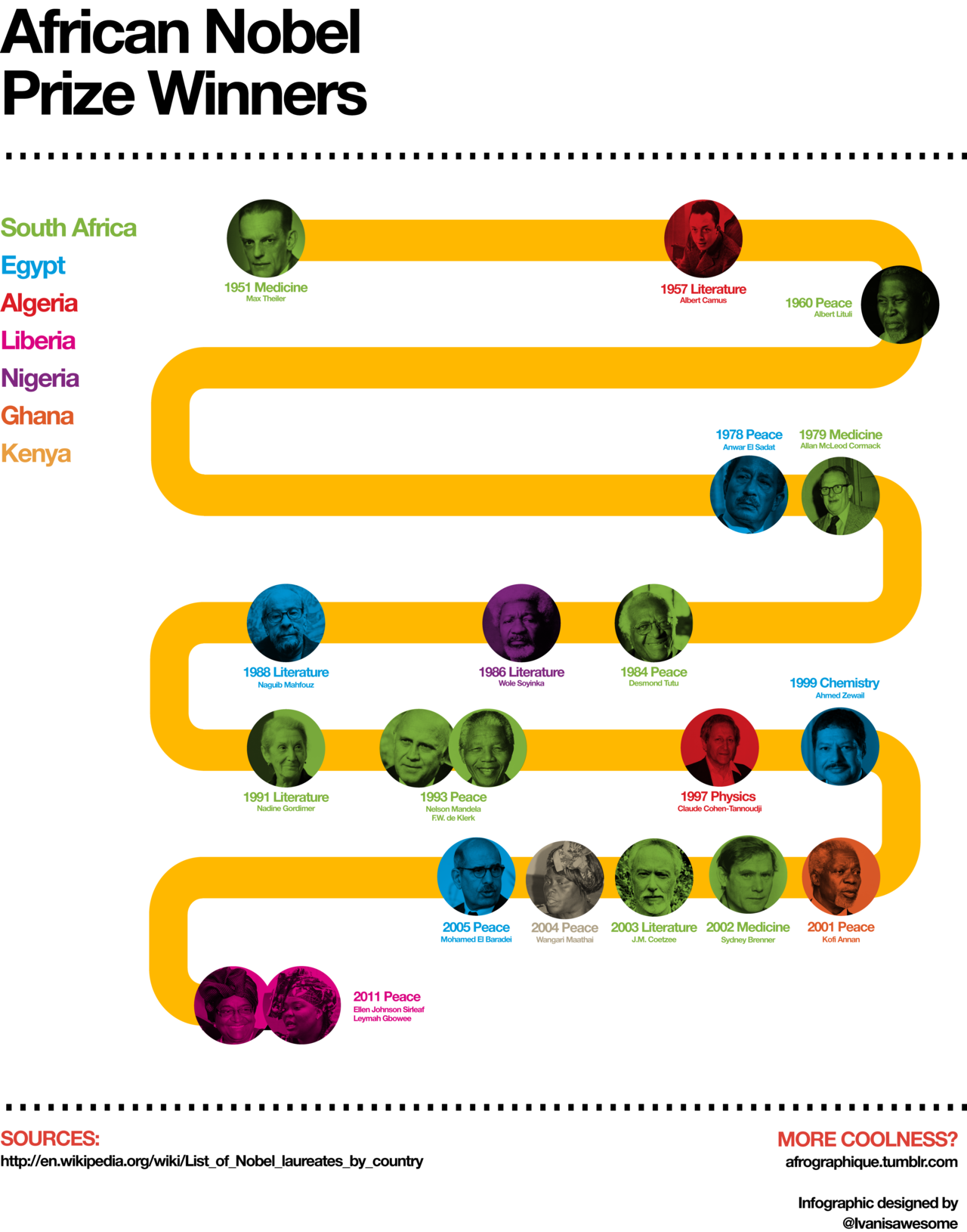
Africa's Nobel Prize winners

link

cellphones


Here in the Philippines, everyone has cellphones, but now Africa is catching up.

Strategypage's mainly depressing podcast on Africa points out how cellphones are making a difference (fast forward to 31 minutes). Honest banking!

---------------------------------------

the Heart of darkness

On my medical blog, I sometimes link to a CDC survey that shows 5 percent of heterosexual boys and 20 percent of "gay" boys have "had intercourse" below age 13.

By definition that is rape, and child abuse, but to call this a public health crisis might upset the gay lobby, who pretends it might be "risk behavior" but doesn't want to publicize it. So the survey blithely puts it into the same category as drinking soft drinks or not eating veggies. No judgementalism here, folks, just move along.

Yet since sexually abused children tend to have a higher risk of depression, alcoholism, suicide, drug use, violent outbursts etc, shouldn't someone connect the dots? No: these problems are blamed on "homophobia", and the churches.

A similar non judgementalism can be found in the US Army instruction booklet that tells American soldiers not to be judgemental against the rich in Afghanistan who exploit boys or kill girls.

What the cultural sensitivity program was trying to get across was that the Afghan attitude towards sex was very different than in the West. Moreover in the Islamic world, sex is, well classified; especially illicit sex. Some enterprising Western journalists have already done some reporting on the ancient practice (in the entire region, from North Africa to India) of using young (well, teenage down to about ten) boys for sex and other entertainments (dancing, cross dressing, camel jockeys). This has been a thing with the rich and powerful in the area for thousands of years. In some places it is sort of legal, but generally it is tolerated, even if officially forbidden. That's because this sort of thing is most popular among the wealthy and powerful. 
again, we are not talking about consensual sex in men, but the rape of children by the rich and powerful.

Ah but such things never happened in Africa did they:

UKIndependent article on sexual abuse of male prisoners in Kenya's MauMau period.

this left wing website says the numbers were even higher (but might be exaggerating the numbers for their agenda).

The rape of women in Africa has gotten publicity, but but not that of males.

a more recent report shows a lot of men and boys being raped in the wars of Central Africa.


An estimated 23.6 percent of men from the eastern DRC regions of Ituri, North Kivu and South Kivu have been exposed to sexual violence during their lifetime, according to an August 2010 study titled, the Association of Sexual Violence and Human Rights Violations With Physical and Mental Health in Territories of the Eastern Democratic Republic of the Congo, in the Journal of the American Medical Association (JAMA).

However, few organizations are assisting male survivors of sexual violence, focusing instead on sexually abused women. 
why am I putting this here and not on my medical blog?

Mainly to bookmark the links. You see, the Obama administration is pushing gay rights on to Africa. When the Africans protest, they are called "homophobic". Because it is simply not polically correct to mention that many gay American men are raping 13 year old boys (unless they are Catholic priests or boyscout leaders, then the accusations are trumpeted to destroy these organizations, who dare to oppose the gay sex/promiscuity/abortions for all agenda)...and I won't even mention the gay sex tourism here in the Philippines....


and if Americans can't get anyone in the mainstream media to notice a CDC report on rape of boys, why should they bother to ask if Africans might oppose the "gay agenda" because too many know victims of such things, and see the need to strengthen sexual morality, not to destroy it, in the name of protecting their children.

Political correctness comes before children, you see...

related item:

The Hearts of Darkness; Why Most of the Mayhem Is in Pushtunstan and Central Africa - 12/20/2012
Jim and Austin talk about the Congo and other places in the world where anarchy rules.
MP3 Download

Sunday, December 16, 2012

Ancient trade links

From a PBS site

Given all the racism, finding Cohen DNA among the Lemba doesn't mean that "white people" built Zimbabwe, but that Africa was not the "dark continent" but had trading links with the Middle East for at least 2000 years, maybe longer.

And the story of African kingdoms and the trading routes (including alas the Arab slave trade) is not a well documented story in the west.


Friday, December 14, 2012

Nigeria news

Strategypage has an article on Nigeria's problems.

summary: "insurgents" who kill civilians, government military/police who kill almost as many civilians as terrorists, kidnapping civilians for money, and politicians stealing everything in sight.

Sounds like the Philippines but ten times worse.

Wednesday, November 28, 2012

Africa for Norway

First Things has a link to a video satire on western do gooders saving Africa.


actually, Africa can save Norway and the rest of Europe by sending them Christian missionaries...

Saturday, October 13, 2012

South African miners

I haven't been following the strike and violence in South Africa, but I was under the impression it was over.

No it's not, says this fides article:
Johannesburg (Agenzia Fides) - "Violence is growing and I do not know what will happen. The unions are losing control of the miners in protest. The miners are abandoning unions and want to choose their own representatives. One is risking now to overcome the regulations adopted by the Government and the trade union centers to control labor conflicts" says to Fides Agency His Exc. Mgr. Kevin Dowling, Bishop of Rustenburg (South Africa), where yesterday, October 11, two people were killed in a slum close to a platinum mine. Meanwhile, workers in gold mines have rejected, deeming inadequate, an increase in offer put forward by the employers.

the full story at link

Tuesday, October 09, 2012

Could Africa become the world's bread basket?

PhysOrg article on wheat growing potential of African countries.

answer: Yes, especially in countries with uplands, if they use irrigation in the dry season.

Zimbabwe already does this and is one of the most productive wheat producing countries in Africa.

Not mentioned: If the tsetse fly is controlled, could a lot of those "wildlife parks" be used to grow wheat?

Tanzania report on wheat growing. notes that wheat could be grown in many areas but notes

Tanzania's population is about 20 m and nine tenths of the people depend on agriculture, directly or indirectly, for their livelihood. The inhospitably long dry season, and the infestation of large areas with tsetse fly, restrict two thirds of the population to one tenth of the area of the country.
Zimbabwe is one of the most productive of the wheat-growing nations in Africa, but wheat farmers there are almost entirely dependent on irrigation.

Read more at: http://phys.org/news/2012-10-significant-wheat-production-potential-african.html#jCp
Plos study on Kenya:

tsetse fly not only spread sleeping sickness which kills humans but destroys cattle.

AAT also affects rural sub-Saharan Africa, and the effects of AAT most heavily impact sub-Saharan Africa's poor as 85% of these individuals live in rural areas, with over 80% relying on agriculture for their livelihoods [7]. AAT is responsible for over 3 million cattle and other livestock deaths each year across sub-Saharan Africa [8] with more than 46 million cattle at risk of contracting the disease [9] leading to a considerable impact on the agricultural economy. Direct production losses amount to approximately $1.2 billion each year [10]. Estimates rise to as much as $4.7 billion a year [11] when indirect losses from the inability to use land and livestock to their fullest potential, such as drawing on livestock for traction, are considered. Livestock productivity is necessary if poverty is to be reduced and health improved; livestock provide food (meat and milk), assist in crop production, and provide a source of income for some of the most marginalized rural citizens [12]. Moreover, if nutritional requirements are compromised in populations, morbidity and mortality from other types of infectious diseases increases [13]. Accordingly, AAT is a proximate contributor to poverty, food insecurity, and nutritional deficiencies in rural areas across sub-Saharan Africa.


Zimbabwe is one of the most productive of the wheat-growing nations in Africa, but wheat farmers there are almost entirely dependent on irrigation.

Read more at: http://phys.org/news/2012-10-significant-wheat-production-potential-african.html#jCp
In three countries in southern Africa—Mozambique, Angola and Zimbabwe—increased wheat production in rain-fed areas may not be feasible, and irrigation would be required to grow wheat in the cool winter months. Zimbabwe is one of the most productive of the wheat-growing nations in Africa, but wheat farmers there are almost entirely dependent on irrigation.

Read more at: http://phys.org/news/2012-10-significant-wheat-production-potential-african.html#jCp
Huh? the IAEA helped eradicate the tsetse fly from southern Ethiopia? (The IAEA is the atomic energy part of the UN).

more HERE.
which says they are only doing the preliminary studies of the habitat with the idea that they will release sterile tse tse flies to cut down the number of flies in these areas.

The Government has selected the Sterile Insect Technique (SIT) to be used as the final component of the eradication because of its non-polluting and environmentally friendly nature.

there are also reports of using old fashioned pesticides in that area.

the TseTse plan
computer program from 2004 here.

Thursday, October 04, 2012

A Drop in Fertility? Some observations

from TPMBarnett's website:


this is not a map of actual fertility, but of the drop in fertility rates since 1970.

Zimbabwe's drop is huge: under the white gov't they had an active family planning program, but it was run by an outside funding that used "pill ladies" in every village: usually they were the wives of local school teachers who could talk "woman to woman". Because if the gov't had run it, it would have allowed the Marxist insurgents to claim that family planning was a form of genocide.

I worked at a Catholic hospital, so we were not allowed to give out birth control.
But we did have an active nutrition program that stressed food/eggs/veggies and that moms should breast feed for two years.

Breast feeding is nature's way of spacing children, and in past days, wives who got pregnant too quickly would often lose their newly weaned child from kwashiorkor, since there was not enough protein in the child's diet.

In the past, continence, R rated methods and polygamy would help the woman space their children, but as all the men started working in the mines and cities, they expected sex when they came home on their leave, especially the men who came home to plow the fields and stayed for a few weeks. (Men plowed with oxen, a dangerous animal, for the main crop; women had smaller fields and used hoes to cultivate their own garden, which they controlled).

So we gave out Depo Provera in baby clinic: Depo Provera has a lot of problems in ordinary women (i.e. non nursing women) such as constant bleeding or no period at all. But when given after a delivery, it would prolong the infertility/non ovulation phase that is normal after a pregnancy (i.e. no periods). It also made one put on weight, and did not decrease the amount of breast milk for the baby: indeed, it probably increased it a bit.

So we only to nursing mothers, to increase their breast milk, and prolong post partum amenorrhea (no periods after you give birth). In other words, we gave it out to keep the children fed, and if it stopped pregnancy as a side effect, well, the bishop and nuns looked the other way.

If you didn't have a baby on the bosom, well, there were pill ladies in every village if all you wanted was to stop from getting pregnant.

But anyway,the birth control was not pushed by the government clinics, because no one trusted the government.

The pill ladies were women, usually schoolteacher's wives or shopkeepers who were respected by the ladies. Since most Educated Zimbabweans were also known to be against the Smith government, they were trusted to give you facts to help you, not the hated white run government.

They would talk to you and instruct you how to take the pill. No pap smear or exam: if you had a history of problems, they would send you to us for a checkup, or to the local gov't hospital for a tubal ligation or IUD, and answer your questions about side effects etc.

We didn't have HIV back, and no one had pap smears, so no problem.

African woman, even village women, are fairly independent in these things, so it was ideal. And the husbands? Well, traditional husbands living at home could be reminded of the alternative: No hanky panky until the child was weaned. And those visiting three times a year from their work in cities? Well what they don't know won't hurt them...

There was not a big taboo against birth control in Africa, but there was a desire to have children. Pointing out that spacing children meant healthier, better educated children than losing kids because they came too quickly was the way to encourage smaller families.

There is a course on Population at Yale that discusses how thie "pill lady" approach worked in what the experts thought was the hardest population to reach: pious illiterate Muslim ladies in the villages of Bangladesh. These ladies were subservient to their husband and family, and could not even see the doctor without the husband's permission.

But what mother in law would say "no" to a visit from an esteemed lady teacher or businesswoman?

The pill lady would talk to the woman (with her bossy mother in law sitting in on the session). But the mother in law's presence actually turned out to be a help because (woman to woman, and when the men aren't around), even the most pious women will admits having 12 kids is just too much... so often the result will be that the mother in law would become a partner with the woman and support her choice to limit children even  if her husband objected.

Similarly, when the Mullahs took over Iran, they faced a population boom, and decided to slow it down until the wealth was spread around a bit better. So they encouraged the idea to space children to protect the mother's health and have fewer babies so they could be cared for and educated, as the way a responsible Muslim should act. They even cited the holy writings that insisted a man should care for the health of his wife and family as saying family planning is not just allowed but encouraged in Islam.

Do the mosques with Sunni preachers from Saudi agree with this? I don't know (haven't worked with many Muslims recently).

Maybe those Muslim countries who are having problems convincing the local governments to allow family planning need to import family planning experts from countries that have had successful programs.

However, I do agree with Barnett that in Subsahara Africa and Islamic countries, the appoach to fertility will change as urbanization occurs and globalization changes culture.

I have to laugh at StrategyPage pointing out how the simple cellphone is changing culture in Afghanistan:
the Taliban is hostile to education and cell phones (especially the ones that can access the Internet, and most can). Any Afghan who becomes literate and gets a cell phone soon discovers there is a huge world out there and it is different
or as Spengler of the Asian Times quipped: As soon as Muslim women become literate, they learn to read the instrutions on the birth control pills.

Indeed, if you look at the map, the countries in sub Saharan Africa without drops in fertility tend to be those who have few people per square mile (Namibia), little development (Mali), or chronic problems with civil wars and.or the post civil war lack of civil society (Nigeria, Mozambique, DRC).

But again, the family planning folks will have to work with the culture.

Ann Coulter once quipped the way to get rid of Islamic terrorism was kill the terrorists and convert them all to Christiantiy. Uh, she went a bit far, but her point, that changing culture is needed, is actually the idea behind Bush's war in Iraq and Obama's support of the Arab Spring: to encourage a moderate secular Muslim government, where the "secular" governments tended to be plutocracies or worse.

Now, globalization will change people at the village level in many ways, not just cellphones, TV and the internet. (even Sister Eurphrasia now has a cellphone and Email in her small town in Zimbabwe).

But a lot of the real problem of globalization is culture change, and culture shock: and this often happens when folks leave the clan and villages to go to the city, where they are lost.

Europe went through this a century ago, and see all the wars/revolutions and terrorism it spawned. Yet some Americans, with their limited attention span, think the Middle East/Africa/Asia can do it is a generation, not a century, and not have problems.

This is where religion can help: the problem is which religion? The religion of communism? The religion of Fascism? the religion of Islamic fundamentalism?

Yes, but the dirty little secret is that most Americans don't see that there are other answers.

Why not a religion that fits the culture, strengthens what is lacking, and helps people to live productive lives?
The Sufi version of Islam, with it's emphasis on personal holiness, not rules and dogma, is one answer. The bad news is that no one is spending millions of petrodollars building mosques and madrasses that promote a modern Islam. 

Here is where Christian countries have an advantage.

I used to get mad at all the American protestants "converting" poorly educated Pinoys to become Protestant, until I realized the alternatives was communism...or maybe drugs.


In the "Catholic" Philippines and South America, many city folks tend to be attracted to "born again" churches, which become the replacement for the extended family of the villages, which support people in need with material but also emotional support. Before, if you needed a job or a handout in an emergency, you went to a relative, now you go to a fellow church member...and the preacher also promotes the values of honesty thrift, and hard work along with their theology.
the Philippines,  learning from your protestant neighbor that you don't have to have a lot of babies, and indeed God expects you to only have the children you afford, may be a new idea, but it is one that individual women will welcome. The result will be a lower population in the Philippines no matter how many "RH bills" pass or don't pass the Senate.
Indeed, fertility has dropped from the average of 6 to less than three kids per woman in the Philippines. And one doubts the days of 6 kids per family will come back, even among pious Filipinas,  no matter how often Father preaches about the wonderfulness of children and the evilness of the pill on Sunday.

One small problem that could cause a setback: I fear that Hillary and her PC friends from America will muck up the RH bill passage by linking it with abortion on demand, which is abhored by all and sundry. Nor does the idea of teaching promiscuity in high schools under the guise of HIV prevention, and promoting gay rights, when gays here are accepted if they are quiet about what they do. In other words, if you promote family planning, not as a population measure or as part of a larger American agenda of destroying the countries morals, there would be a better chance of passing the RH bill...

But what about Muslims in  the Middle East ad Sub Sahara Africa?

 Again, I don't know the culture of these various lands, but I suggest instead of importing American or British style "population control", that instead they Iran to send good Muslim Family planning workers to instruct them in the Muslim tradition of limiting fertility for health reasons.


Wednesday, October 03, 2012

Obama okays child soldiers

the "it's nice to be king" article of the day:
The Washington Post October 27, 2010 headline read, "Obama waiver allows U.S. aid to 4 countries using child soldiers." The ABC news October 5, 2011 headline read, "Obama waives child soldier ban in Yemen and Congo." The Cable, from Foreign Policy.com October 1, 2012 headline read, "Obama waives sanctions on countries that use child soldiers"
isn't the president supposed to enforce the law?

This is about sending aid to the Congo and Yemen to prop up governments that are probably the least worse choices, but it also sends a message that they don't have to change their ways.

Tuesday, September 18, 2012

China arms Zimbabwe

From StrategyPage:
September 14, 2012:  The African dictatorship of Zimbabwe opened a Chinese built and run military training center. China loaned Zimbabwe $98 million for the construction of the center and the loan will be repaid with diamonds from Chinese operated mines in Zimbabwe. China has supplied the dictatorship in Zimbabwe with weapons and military training in return for economic opportunities. The Zimbabwean government has ruined their economy and the Chinese provide help, with no questions asked. This has been a successful Chinese tactic in Africa, at least with the remaining dictatorships there.

Sunday, September 16, 2012

Marriage and custom marriage?

From the BBC:

Poor PM Tsvangirai...one of his girlfriends (who is part of ZANU PF of course) is claiming she is his wife under a "customary marriage" act.

But customary marriage requires family agreement and a payment of lobola (bride price). So what it means is that she slept with him, period, and is now claiming a "common law" marriage.


Ms Tembo, 39, a commodity trader and sister of a Zanu-PF MP, had demanded $15,000 (£9,310) a month in maintenance expenses from the prime minister.
In November, Ms Tembo and Mr Tsvangirai reportedly held a traditional wedding, and Mr Tsvangirai had paid a bride price of several hundred thousand dollars.
Shortly thereafter, Mr Tsvangirai said their relationship had been "irretrievably damaged" after it was "hijacked" by his opponents, including state security agents.
Ah, but if it was a traditional marriage, you don't need a paper to dissolve the marriage, and if she hasn't had a baby, that would be one reason to demand back the bride price....

Friday, September 14, 2012

Miner strike in SA continues

from aljazeerah:

The killing of strikers and the aftermath has gotten zero attention in the US press/TV.
The leader of a major protest by South African platinum miners has called for a national strike in the sector, deepening an industrial crisis that has escalated over the past few months, and spurred violence that left 45 people killed at the Lonmin operated Marikana mine.
Miners from the Anglo American platinum mine (Amplats), joined forces with their colleagues from Marikana at the Blesbok stadium in the heart of the platinum belt near Rustenburg, 100km northwest of Johannesburg on Thursday in a show of solidarity against low wages.


Thursday, September 13, 2012

Environmentalists killing Africans since Rachel Carson

Article on the Greatest Man you never heard of:
In 1999, the Atlantic Monthly estimated that Borlaug's efforts, combined with those he trained and equipped, saved the lives of 1 billion human beings.
Shockingly, the Green Revolution was almost entirely funded by developing countries and private charities (notably the Rockefeller and Ford Foundations), rather than by the governments of prosperous nations. At the time, the overwhelming view of academic and political elites in the wealthy countries was that it was already too late.
Biologist Paul Ehrlich's 1968 bestseller "The Population Bomb" typified this attitude. Ehrlich wrote, "The battle to feed all of humanity is over ... Required reading at many colleges, Ehrlich's book stated that it was "a fantasy" that India would "ever" feed itself...
In spite of Ehrlich's claims, Borlaug had India feeding itself within a mere five years of his book release. .... Towards the end of his life, Borlaug was working to institute his agricultural revolution in Africa.
No good deed goes unpunished, so we shouldn't be surprised that Borlaug was attacked by proponents of the trendy new faith of radical environmentalism because Green Revolution farming requires some pesticide and lots of fertilizer. Gregg Easterbrook quotes Borlaug saying the following in the 1990s:
"(Most Western environmentalists) have never experienced the physical sensation of hunger. They do their lobbying from comfortable office suites in Washington or Brussels. If they lived just one month amid the misery of the developing world, as I have for 50 years, they'd be crying out for tractors and fertilizer and irrigation canals and be outraged that fashionable elitists in wealthy nations were trying to deny them these things."
Borlaug was correct: "Environmentalists" and their allies pressured the Ford and Rockefeller Foundations, the World Bank and Western governments to drop funding and support for the great humanitarian as he was trying to expand his efforts into Africa. As a result, it is no surprise that the continent is doing the poorest at feeding its people.

---------------------------------------
related item: Greenpeace's Crime Against Humanity.


Greenpeace has openly and aggressively spread misinformation about Golden Rice since it was first invented and has continued to do so at every opportunity. They claim that there are better ways to alleviate vitamin A deficiency, such as vitamin pills and “home gardening”. Yet Greenpeace is doing nothing to implement alternative programs for the millions of victims, claiming the cause of vitamin A deficiency is “poverty”. One might ask if purposefully condemning millions of children to blindness and early death perpetuates poverty rather than alleviating it. Academies of Science around the world endorse the use of biotechnology, including genetic modification, to improve the nutrition and productivity of our food crops. There is zero evidence of any possible harm from these improvements.
-------------------------------------------


Saturday, September 01, 2012

African Union Vs UN Peacekeepers

The UN might give up their ineffective peacekeeping in the Congo and let the African Union do the work.

From StategyPage, whose article is cynically called "we want to help ourselves to your stuff"... 
(referring to Zimbabwe's history of plundering the minerals when they were in the force).

if the AU takes over, it could have long term geopolitical effects...maybe toward a lose African confederation similar to that once proposed by Ghadaffi (but unlike his suggestion, not run by white Arabs of the north)...

but this part of the article is about Zimbabwe:


August 21, 2012: The government responded to critics who argue the Zimbabwe should not be allowed to deploy peacekeeping troops in the Congo. 
The government said that Zimbabwean troops contributed to stability when they deployed into the Congo during the Great Congo War. 
Others remember Zimbabwean participation quite differently. 

The Zimbabwean forces reportedly committed many atrocities and plundered Congolese mineral resources. Zimbabwe sent troops to the Congo in 1998 and only withdrew them in 2001. A UN study found evidence that Zimbabwean Army officers and senior members of Zimbabwe’s governing ZANU-PF party made money by selling and smuggling Congolese resources...


At the time Zimbabwe’s dictator, Robert Mugabe, justified sending troops because he contended the Uganda and Rwanda had invaded the Congo. In 2009, the Angolan government stated that SADC’s Standby Brigade was ready to intervene in the Congo, if asked. SADC has 15 members, Malawi, Angola, Congo, The Republic of Congo, South Africa, Namibia, Botswana, Mauritius, Lesotho, Mozambique, Madagascar, Swaziland, Zambia, Zimbabwe, and the Seychelles. (Austin Bay)


Thursday, August 30, 2012

Chinese gangsters in Africa

a couple days ago there was an article about Angola deporting Chinese criminals from that country, but I didn't post it for obvious reasons (not Zimbabwe related).

But StrategyPage has this in one of their articles on China: Three problems: spreading guns that encourage violence/crime, chinese criminals, and cheap imports that fall apart or kill locals (while undermining local manufacturing jobs)...


China is also having more problems keeping its arms exports secret. This is not a problem when the weapons go to some dictatorship and stay there. But in Africa, the secret Chinese weapons shipments tend to spread around. The UN has noted that Chinese weapons are increasingly showing up in trouble spots. When captured, the owners of these weapons simply say they got the weapons from some local arms dealers. The dealers are hard to capture, or even identify, but the weapons are obviously of Chinese origin. China denies everything, but that approach is getting old and there are growing demands for international cooperation to investigate and measure this underground Chinese weapons market. 
 
Africa has become a new land of opportunity for adventurous and ambitious Chinese. But this has also attracted Chinese criminal gangs. The Chinese gangsters mainly prey on the growing Chinese populations in Africa, using kidnapping, extortion and robbery to get a share of the new wealth being created by the hard working Chinese migrants. Local governments have a hard time coping with this sort of thing, and in the past year China has offered to send police investigators to find out who the bad guys are and, in cooperation with the local police, arrest and deport these crooks back to China for prosecution. Angola recently arrested and deported 37 Chinese under this program. 
 
Meanwhile, the temptation remains for Chinese gangsters. Goods from China are cheap, if shoddy compared to European or American items. But in Africa low prices are king, and the Chinese know how to play that way. The Chinese also don’t mind the nasty remarks from the locals. Chinese traders have been going abroad, often into hostile environments, for thousands of years. For the Chinese government, these “overseas Chinese” are an economic, diplomatic, and sometimes military, bridgehead into foreign lands. The “overseas Chinese” can be a source of military intelligence, and local knowledge for espionage and other missions. Most Western nations have pulled their diplomatic and intelligence people out rural areas in Africa, losing touch with what’s going on out there. Not so the Chinese, where the Chinese entrepreneurs will go anywhere that appears capable of providing some profit. There are over a million Chinese in Africa now, most of them recent migrants.

Friday, August 24, 2012

Southern Accord

There has been a slow but quiet movement of US special forces into Africa, mostly to help the African Union to fight terror groups in the Somali area, but also to help Uganda to get Kony's group.

But this is the first I've heard them moving in Southern Africa,

Photo from StrategyPage:

U.S. Army and Botswana Defense Force engineers improve an existing pond used for watering livestock and some agricultural needs in a small village near Mkankake Range in Botswana, Aug. 20, 2012. The engineers are participating in Southern Acord 2012, an annual joint exercise to enhance military capabilities and interoperability. The U.S. engineers are assigned to engineers the 631st Engineers Company. U.S. Army photo by Sgt. James D. Sims

and here is an article about the Illinois National Guard's part of these exercizes:

Illinois Army National Guard from Streator, Ill., and their counterparts from the Botswana Defense Force, have been running both static and mobile re-fueling operations at Thebephatswha Air Base, Botswana.

Southern Accord 2012, or SA 12, is an annual combined, joint exercise which brings together U.S. military and Botswana Defense Force, or BDF, personnel to conduct humanitarian assistance/disaster relief operations, peacekeeping operations and aeromedical evacuation to enhance military capabilities and interoperability.

With more than 10,000 gallons of diesel fuel and 2,000 gallons of aviation fuel on the ground, the combined team is responsible for providing fuel for both ground and air assets during the exercise.

and yes, the docs are there too:

THEBEPHATSHWA AIR BASE, Botswana (Aug. 10, 2012) -- Soldiers from the 909th Forward Surgical Team out of Fort Sheridan, Ill., provided medical training to soldiers of the Botswana Defense Force Aug. 2, in The Republic of Botswana, Africa.


 and the Hawaii National Guard are there too, helping teach about helicopters.

these things always make me a bit nervous: no, I don't think anyone is expecting Zimbabwe to attack Botswana, but contingency plans like this allow fast response for mass emergencies, as the presence of a US and Austrailian navy units helped local response after the tsunami (and in several Filipino diseasters)

when you train together, it means you know each other and someone has hands on experience in the area.

and "The area" would,  of course, include South Africa, Namibia, and Zimbabwe....such as the floods two years ago in South Africa.

Wednesday, August 01, 2012

Kony update

Austin Bay at Strategypage has an update on the search for Kony.
The immense LRA dispersal area is roughly comparable to the state of Texas in size. It slices through five desperately poor nations — the Congo, South Sudan (Juba government), Sudan (Khartoum government), the Central African Republic (CAR) and Uganda. Among these five nations, only Uganda's security forces can reasonably assert that they control their national territory.
Kony maintains hideouts in the territory's most remote regions and uses its size and political divisions to his advantage. He crosses international borders to cover his tracks and create diplomatic complications for pursuing enemies. Remote certainly applies to the southeastern CAR's Chinko River area and Sudan's western Darfur region, the two areas where Ugandan security officials say they believe he is likely hiding....

Wednesday, July 25, 2012

EU proposes suspending Sanctions

from AlJezeerah:

A credible referendum on Zimbabwe's new constitution will be "an important milestone" toward the suspension of sanctions targeting many leaders and businesses linked to long-time ruler Robert Mugabe, the European Union said.

EU ambassador to Zimbabwe Aldo Dell Ariccia said on Monday in Harare that the 27-nation bloc was encouraged by reforms in Zimbabwe after years of violence and economic turmoil.

Zimbabwe needs to be rewarded to maintain the pace of reforms, but individual travel, banking and business bans imposed in reaction to violations of human and democratic rights will stay in effect at least until after a referendum, he said.

A draft of the new constitution was completed on Friday. It must be put to a vote months before parliamentary and presidential elections proposed for mid-2013.

Thursday, July 19, 2012

Single men's hostels in Zim

from the Herald....

One of the ignored reasons for the HIV epidemic in Africa: single men's hostels because they were forbidden to bring their families with them to work in the mines etc.


Of course, since there were no old age pensions, and the land was owned communally, unless a man left his wife to farm the fields, the tribe would take back the fields for another, and leave him high and dry when he retired or was injured.


Now this report says that the hostels are slums with families renting a corner of the room and the gov't is trying to figure out how to make things better.
but of course, Mugabe destroyed 70 thousand homes in his "operation clean out the garbage", including destroying Sister Patricia's HIV clinic, a mosque, and the convent of Sister Winfreda in Queque... under the guise of "slum clearance"..the article doesn't mention this because the Herald is run by the government...

Tuesday, July 17, 2012

Africa's coming religious wars

This summary is not available. Please click here to view the post.

Sunday, July 08, 2012

Africa investing in Africa

TPMBarnett links to a WSJ article about the decrease in overseas investments due to the recession, but notes the increase in the number of Africans investing in their own continent.

But the good news of the piece: Africans themselves have picked up a decent portion of the slack, which is quite encouraging.
Total self-sustainable liftoff?  Hardly.  Africa's great hope of the past few years is that rising Asia (and other developing risers) might provide a sustained demand for materials that the West, in its more isolated boom-and-bust cycles of the Cold War, ever could.


key illustration:

Friday, July 06, 2012

Kristof and "ain't it awful" awful reporting

Global Voices on line has an article on Kristof's editorials that stress the bad things about Iran and Africa, without putting these problems into perspective. And of course, it's not just Kristoff.


Kristof's writing about Africa has previously been criticized by several writers and journalists, from Teju Cole–who says that Kristof's activism-journalism and “good heart” do not always allow him to “think constellationally”–to Elliott Prasse-Freeman, who writes eloquently of Kristof's “anti-politics.” More recently, Hamid Dabashi wrote a biting critique of Kristof in Al Jazeera, claiming Kristof relies too heavily on outdated and orientalist clichés.
Now, in response to Kristof's recent article, bloggers from Africa and all over the world are weighing in.
First, Ugandan entrepreneur Teddy Ruge tweeted in response to Kristof's column, sparking Atlantic journalist Max Fisher to ask: “how should the media cover Africa”? Ruge first tweeted:
Those at the microphone telling Africa's story, too vested in their stayed narrative to adapt to a changing continent, risk being obsolete
He adds:
What's really rising in Africa is a bigger chorus of voices set to obfuscate the need for a singularly-focused Western narrator

Saturday, June 30, 2012

Africans rescue fellow Africans

I found this interesting factoid while reading about the Somali pirates (since many of those sailors kidnapped are Filipinos, and we have a relative who is a sailor, I keep an eye on the news there).

from StrategyPage:
Soldiers from the TNG (Transitional National Government) raided a pirate base in central Somalia and freed a South African couple who were kidnapped 18 months ago when their sailboat was seized off the Kenyan coast. Pirates have been trying to obtain a high ransom for the couple ever since.

The Mail (SA) has a photo of this couple, which is a SA white woman and her (younger looking) Italian boyfriend.

The article says they don't know if ransom was paid, but here in the Philippines, the Italians alway pay huge amounts of ransom and deny it. (The joke is that the MILF always kidnaps Italian priests because they like Pizza).

On the other hand, the MAIL article doesn't mention the TNG troops.

On the other hand, European and American reporters rarely notice when Africans are doing something like this...

China in Africa investing in land etc.


TPM Barnett also has an essay about a new book and a NYTimes editorial onChina inAfrica.


the book he reviews defends China against charges of neoImperialism, using it's own people instead of local employees, and of course, supporting dictators and corrupt leaders.

Yes, folks someone is shilling for China.

He then adds his opinion:

My take: the more China gets into Africa, the more it enmeshes its interests with the locals, who, in turn, become more demanding of better deals - just like Chinese labor back home. Will it be a nice process? Hardly ever is, judging by history. But an unsurmountable process? Not if China is as highly incentivized regarding back-home stability as Moyo argues here (and I agree).

After ripping African leaders a new one, Moyo ends powerfully with this: With approximately 60 percent of Africa’s population under age 24, foreign investment and job creation are the only forces that can reduce poverty and stave off the sort of political upheaval that has swept the Arab world.

And China’s rush for resources has spawned much-needed trade and investment and created a large market for African exports — a huge benefit for a continent seeking rapid economic growth. No argument from me on that. China is creating connectivity and opportunity - more so than the West right now. The West is still a far bigger player in Africa, but China is the most dynamic agent right now.

Africa's Cheetah generation

From ThomasPMBarrett's(Wikistrat) blog: 
he sites an article in the Economist (UK)

Nifty Economist story on what economist George Ayitteh likes to dub the "cheetah generation" of Africa's business community ...  
Article contrasts serial entrpreneurs (who start company after company in sequence over their lives) with parallel entrepreneurs (who start mini-conglomerates of companies and seek to grow them all synergistically over time). The Economist argues that this is really the way things are unfolding in successful African economies.
 he then adds:

Speaking from experience, I couldn't agree more.  Virtually every deal I'm currently structuring or pursuing in Africa involves these parallel entrepreneurs.  They all seem about 35 and they're all running this cluster of companies that involve them in all manner of adjacent opportunities and economies (most of these clusters extend over several African states).

he links to this TED video:

Wednesday, June 20, 2012

Human rights abuses continue

From Fides:

Harare (Agenzia Fides) - Rigged elections, limited freedom of speech and press, media censorship or intimidation and attempts to control the activities of civil society and NGOs continue to violate human rights in many countries of the world. In Zimbabwe the situation is particularly serious.  ...


Groups of criminals under the flag ZANU-PF have invaded private property, demolished homes and small markets. For the good of the nation, it is essential that all political protagonists and the security sector follow the directives of the President and immediately suspend such violence, as well as being equally important that President Mugabe insists that the government imposes its guidelines....


Report from Zimbabwe

Sister E writes that the poor rains resulted in a poor harvest, so folks are only eating one meal a day in her area.

Monday, June 11, 2012

From the DallasNews:

AIDS was an inferno burning through sub-Saharan Africa. The American people, led by Bush, checked that fire and saved millions of lives.
People with immune systems badly weakened by HIV were given anti-retroviral drugs that stopped the progression of the disease. Mothers and newborns were given drugs that stopped the transmission of the virus from one generation to the next. Clinics were built. Doctors and nurses and lay workers were trained. A wrenching cultural conversation about sexual practices broadened, fueled by American money promoting abstinence, fidelity and the use of condoms.
“We kept this country from falling off the edge of a cliff,” said Mark Storella, the U.S. ambassador to Zambia. “We’ve saved hundreds of thousands of lives. We’ve assisted over a million orphans. We’ve created a partnership with Zambia that gives us the possibility of walking the path to an AIDS-free generation. This is an enormous achievement.”
Bush remains active in African health. Last September, he launched a new program — dubbed Pink Ribbon Red Ribbon — to tackle cervical and breast cancer among African women. The program has 14 co-sponsors, including the Obama administration.
Falling death rates
Nyankombe sells colorful batiks, purses and other crafts to benefit Mothers without Borders, a charity that looks after orphans. When AIDS tore unchecked through southern Africa, millions of children lost their parents. Nearly one in five children in countries like Malawi and Lesotho were orphaned. In Zambia, it was one in four.
A decade ago, AIDS was killing 630 of every 100,000 Zambians, according to the World Health Organization. That was 100 times the AIDS death rate in the United States.
In neighboring Botswana, the toll was 750 of every 100,000 people. That was four times the rate for the leading cause of death among Texans (heart disease).
In 2001, four in 10 adults in Botswana were infected with HIV. President Mogae went before the United Nations to plead for the life of his country.
“We are threatened with extinction,” he said. “People are dying in chillingly high numbers. It is a crisis of the first magnitude.”
Bush, with bipartisan support from Congress and $15 billion, mobilized the U.S. government with the President’s Emergency Plan for AIDS Relief. In 2008, Congress agreed to provide $38 billion more.
By the time Bush left office, the death rate from AIDS had fallen more than 60 percent in Botswana. There are now 330,000 taking anti-retroviral drugs.
The death rate fell by nearly half in Zambia. There are 418,000 Zambians taking the drugs.

Monday, May 28, 2012

Drought resistant rice

from Oryza:

A Japanese company will develop new nitrogen and water-efficient, and salt resistant, rice varieties for small scale farmers in Sub-Saharan Africa (SSA) under a new deal with the Nairobi-based African Agricultural Technology Foundation (AATF).
The joint effort aims to boost rice production in the SSA region, including countries such as Burkina Faso, Nigeria, Ghana and Uganda, where a majority of rice farmers are smallholders of rice fields. According to ATTF executive director nitrogen deficiency and drought are major hurdles in improving rice yields in upland SSA, while salinity is affecting several rice producing regions in Africa.

Thursday, May 24, 2012

why Africa is booming

From the Atlantic.

...
Africa, with a population expected to roughly double by mid-century, has become recognized as the world's fastest growing continent. But the less-told story is of Africa's economic rise. In the last decade Africa's overall growth rates have quietly approached those of Asia, and according to projections by the IMF, on average Africa will have the world's fastest growing economy of any continent over the next five years.

Seven of the world's 10 fastest-growing economies are African. The continent is famously resource rich, which has surely helped, but some recent studies suggest that the biggest drivers are far less customary for Africa, and far more encouraging for its future: wholesale and retail commerce, transportation, telecommunications, and manufacturing.
A recent report by the African Development Bank projected that, by 2030, much of Africa will attain lower-middle- and middle-class majorities, and that consumer spending will explode from $680 billion in 2008 to $2.2 trillion. According to McKinsey and Co., Africa already has more middle class consumers than India, which has a larger population. Goldman Sachs recently put out a report, "Africa's Turn," making similar points.

American media have largely failed to pick up on these trends, hewing instead to their long-running traditional narratives of African violence and suffering to the exclusion of most other news....

(headsup Instapundit)

Friday, May 18, 2012

South Africa's Army has problems

StrategyPage has an article discussing the reasons that South Africa's once formidable army has gone weak.

After the 1994 elections, the first to feature participation by all South Africans (not just the whites), the military quickly turned into another form of patronage. The word came down that the military was there to provide jobs for political loyalists of the party in power. These men could be dismissed only if they committed a serious crime (rape, murder, kidnapping) and were otherwise untouchable and increasingly undisciplined. Eventually most of the troops are too old, too sick or too undisciplined to be effective soldiers. The government gets away with this because South African has no neighbors that pose a military threat.

They also have an article on Nigeria's problem with corruption 

On the other  hand, they discuss the good work of Uganda, Kenya, and Burundi troops who work with the African Union peacekeepers HERE.

Tuesday, May 15, 2012

More trouble in central Africa

from Fides

Kinshasa (Agenzia Fides) - "The social fabric of the people who lived so far in peace and mutual solidarity is compromised: its members have become enemies to each other, just because a Canadian company in search of gold has come to settle on their land." This is the complaint made by a Congolese citizen Néhémie Bahizire in the document entitled "The curse of gold in Kivu," on the exploitation of gold mines in Twangiza / Luhwinja, about 90 km south of Bukavu, capital of the province of South Kivu in eastern Democratic Republic of Congo (DRC).
full article at link

Monday, May 14, 2012

ZANU PF pastors don't want Joshua to visit

from the Zim mail


HARARE - Churches loyal to President Mugabe's Zanu-PF have expressed concern over the planned visit this May by a Nigeria-based prophet, Temitope Balogun Joshua, saying men of God are non-partisan.
HARARE - Churches loyal to President Mugabe's Zanu-PF have expressed concern over the planned visit this May by a Nigeria-based prophet, Temitope Balogun Joshua, saying men of God are non-partisan. The world-acclaimed prophet is supposedly due in Harare this month for prayer meetings at the invitation of Prime Minister Morgan Tsvangirai. Heads of different church denominations affiliated to the Evangelical Fellowship of Zimbabwe (EFZ) are in agreement that the church does not have immigration powers and as such it will not determine whether TB Joshua should visit Zimbabwe or not. They however highlighted that as a church they can only raise concern. The church leaders were speaking at a meeting in Harare to review the constitutional process as well as decide on the church’s role in the process.

more from various bloggers at Global voices on line.

B Joshua's popularity seemed to rise in Zimbabwe after after his prediction that an “aging African leader” would die, with critics of long time ruler President Robert Mugabe concluding that the prophecy was referring to Mugabe. Malawian President Bingu wa Mutarika died shortly afterwards, apparently confirming that indeed TB Joshua is a “prophet.”
Now, social media sites and blogs are on fire ahead of his May 25 Day of Prayer visit.

 the gov't newspaper explains why....


Rev Chimbambo said they would not allow any political party or foreigner to interfere with their operations.
"We were surprised to hear that Prime Minister (Morgan) Tsvangirai wanted him to be the guest speaker on the day of prayer yet the day is for praying and no one should address the crowd," he said.
He said their programme had no link with the prayer rallies PM Tsvangirai and some local pastors had been holding countrywide.

this is ata time when Mnangagwa is trying to take over ZANU PF

Sunday, April 29, 2012

China invests in South Sudan

From the BBC:
Officials in South Sudan say China has agreed to loan it $8bn (£4.9bn) for major development projects. A government spokesman said funds would be used to build roads, bridges and telecom networks, and to develop agriculture and hydro-electric power. However, there was no mention of plans to build a new pipeline to export oil from the newly independent state.
China has been a big supporter of Sudan, which has been trying to wrest the oil producing areas from the South, and has gotten away with a lot of various genocides because China stops the UN from interfering too much. This sounds like China is now hedging it's bets...

Monday, April 23, 2012

South Sudan in the news

Strategypage discusses the oil issue in Sudan's war against the now independent Southern Sudan

Arab vs Black African, Muslim vs Christian complications, but it's essntially over who gets the oil revenues, which are badly needed by South Sudan...

Tuesday, March 20, 2012

Evil

The Kony campaign is a day late and a dollar short, as the saying goes...and a lot of folks are annoyed that these do gooders just noticed the fight, and some think they are cashing in on it (while libeling the good things going on in Uganda). LINK

Yes, charities are good, but the old suggestion not to sound a trumpet to attract attention to your good deeds is still important today...

-----------------------------
the good part of the Kony campaign, however, is that many westerners will become aware of the plight of child soldiers.

Rehabilitating children who learned to fight at a young age is difficult (they learn that they can do anything or steal anything because they have a gun; they now have to be retrained to obey the basic laws of society: no stealing, no raping, no killing).

Another part of the rehabilitation is training them for a new job, so that they can support themselves. This includes the young women, who often got pregnant. Having a baby out of wedlock is not a big thing in Bantu society, but in Somalia and other strict Muslim societies, they are at risk for being ostracized.

This, however, assumes young teenagers recruited who agree to fight (often for food, or for adventure, or maybe even because they believe in the cause).

The real problem is when


The activists who are pushing gay rights on Africa (including the Obama adminstration), assumes this would occur in culture with a western style of individualism and freedom...

But the activists not only misunderstand the extended culture of African society, the destruction of the African family by colonialism, and the high rate of abuse, especially in lands which have been affected by civil wars......hint: it's not your hairdresser or the gay bar down the street they are worried about...check UKGuardian report.

It's not just child soldiers: remember the street kids are vulnerable to such things too...and not just in Africa...link

when I was considering adoption, we were cautioned to assume that all older girls and half of older boys probably had been sexually abused, and to remember that when they became teenagers and started acting out.
---------------------------

Sunday, March 11, 2012

Zimbabwe


bbc series on the lost Kingdoms of Africa.

This one is Zimbabwe, but the series includes Nubia, Ethiopia and other medieval/precolonial kingdoms of Africa.
 
Free hit counters
Free hit counters